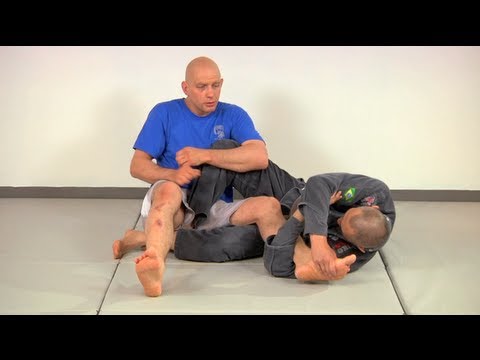
How to Defend and Escape the Kneebar
0
Kneebar Escape·Stephan Kesting
How to defend against the kneebar from the Submission Defense module in the Grapplearts BJJ Master App https://www.grapp…
Перевод: kneebar escape
The Kneebar Escape subfamily covers techniques for escaping the kneebar (hiza-juji-gatame), where the attacker hyperextends the knee joint by controlling the leg and applying hip pressure against the knee. [1] Kneebar escapes share mechanical principles with armbar escapes — the attacker uses the hips as a fulcrum against the joint — but are applied to the larger and more powerful leg, which provides more escape leverage. [1],[2] Escape strategies include bending the trapped knee to prevent hyperextension, rotating the hip to change the angle of attack, and pushing the attacker's hips away to create space. [2],[3]
Kneebar escapes developed as the kneebar became more widely used in submission grappling, particularly in no-gi competition where leg attacks gained prominence. [1] The kneebar's similarity to the armbar in terms of mechanics meant that many escape concepts transferred from upper-body to lower-body defence. [2],[3]
Kneebar escapes use hip positioning and leg straightening to relieve hyperextension pressure. [1]
Kneebar escapes are taught in BJJ and sambo defensive training. [1]
Kneebar defence is important in BJJ and MMA competition. [1]
Изображений для этой техники пока нет.
Войдите, чтобы предложить изображение.
How to defend against the kneebar from the Submission Defense module in the Grapplearts BJJ Master App https://www.grapp…
Учебных курсов по этой технике пока нет.
Войдите, чтобы предложить курс.
Риск травмы для человека, к которому применяется техника
Submission escapes carry risk of injury if executed too late; timing-critical
Уровень мастерства, необходимый для надёжного выполнения техники
Разрешена ли техника по основным соревновательным правилам
Jiu-Jitsu University (Saulo Ribeiro, 2008)
Alias sources — [1] Leg Locks: Enter the System (John Danaher, 2017) [2] Kodokan Judo (Jigoro Kano, 1986) [3] Jiu-Jitsu University (Saulo Ribeiro, 2008)
Effectiveness sources — [1] Jiu-Jitsu University (Ribeiro, 2008)
Mixed Japanese-Western terminology — combines traditional Japanese terms with katakana loanwords
Alias sources — [1] Leg Locks: Enter the System (John Danaher, 2017) [2] Kodokan Judo (Jigoro Kano, 1986) [3] Jiu-Jitsu University (Saulo Ribeiro, 2008)
Effectiveness sources — [1] Jiu-Jitsu University (Ribeiro, 2008)
hip mobility, explosive bridge/shrimp power, timing
flexible hips and strong glutes for escape movements
glutes, hip flexors, core, triceps (framing)
Каждое движение в любом боевом искусстве обладает рядом универсальных свойств. Комбинируйте параметры ниже, чтобы найти нужный инструмент или сравнить аналоги из разных стилей.
Triangle your legs to buy time and protect yourself—this is a critical component of any escape. According to Stephan Kesting, becoming conversant in triangling your legs correctly is essential, as triangling the wrong leg leaves you completely unprotected and your opponent can simply strip it and finish the tap.
You lose all protection and your opponent can easily strip your legs off and submit you. Stephan Kesting emphasizes this is a common panic mistake—people freak out in the moment and secure the triangle on the wrong leg, which defeats the entire defense.
Yes. Stephan Kesting advises that if you realize you've triangled incorrectly, you can switch and don't be afraid to cross your ankles at the ankle, reach up, and snug it into the correct position to properly defend.
The Kneebar Escape subfamily covers techniques for escaping the kneebar (hiza-juji-gatame), where the attacker hyperextends the knee joint by controlling the leg and applying hip pressure against the knee. Kneebar escapes share mechanical principles with armbar escapes — the attacker uses the hips as a fulcrum against the joint — but are applied to the larger and more powerful leg, which provides more escape leverage.
Kneebar escapes developed as the kneebar became more widely used in submission grappling, particularly in no-gi competition where leg attacks gained prominence. The kneebar's similarity to the armbar in terms of mechanics meant that many escape concepts transferred from upper-body to lower-body defence.
Unified MMA: разрешён — Legal defensive/transitional technique; IBJJF: разрешён — Legal; IJF: разрешён — Legal; ADCC: разрешён — Legal; UWW: разрешён — Legal, escape scores 1 point (freestyle), reversal scores 1 point; FIAS Sport Sambo: разрешён — Legal; NCAA Folkstyle: разрешён — Legal, escape scores 1 point, reversal scores 2 points
Оценка опасности 4/10. Moderate — submission escapes carry risk of injury if executed too late; timing-critical
Стандартная цепочка подготовки: Create Space → Disrupt Control → Execute Escape → Recover Position.
Стандартные контрприёмы: Maintain Pressure — keep consistent weight distribution to limit escape space / Anticipate Direction — read escape attempt direction and block early / Transition — flow to a new position when the current one is threatened.
Распространённые варианты: Standard escape (primary escape mechanic using frames, bridges, or hip mov…); Combination escape (chaining two escape directions or methods); Counter escape (using the opponent's attack attempt to create the escape …); Competition variation (modified for rule-set optimisation).
Kneebar defence is important in BJJ and MMA competition.
Основные ошибки, на которые стоит обратить внимание: Keeping the leg bent in the kneebar position — straighten or curl to remove the extension angle / Pulling the leg straight back — this fights against the opponent's hips, which are stronger; rotate instead / Not addressing the opponent's hip position — the hips are the fulcrum; push them away / Turning away from the opponent — turn toward them to collapse the angle.
Kneebar Escape также известен как Nībā Nige, Kneebar Defense, Hiza Juji Gatame Escape, Knee Lock Escape.