Trap & Roll Mount Escape
0
Standard Roll Escape·Trillo Jiujitsu Academy·Added by Admin
There are several ways you can escape from underneath the Mount Position. In this video I am going over several ways you…
Перевод: standard roll escape
The Standard Roll Escape executes a forward roll over the attacker's body, using the rotational momentum to pull the trapped arm through the armbar position and free it. [1] The defender drives forward into the attacker while initiating a roll, using the body's mass and momentum to overcome the grip. [1],[2] The roll is executed toward the trapped arm side, and as the defender comes over the top, the arm slides free from the hip clamp. [2],[3]
The standard roll escape is the baseline rolling armbar escape. [1]
A fundamental BJJ armbar escape. [1]
Used in BJJ competition. [1]
Изображений для этой техники пока нет.
Войдите, чтобы предложить изображение.
There are several ways you can escape from underneath the Mount Position. In this video I am going over several ways you…
http://www.infighting.ca/index.php Vancouver BJJ instructor shows how to escape bottom mount by seizing the arm and exec…
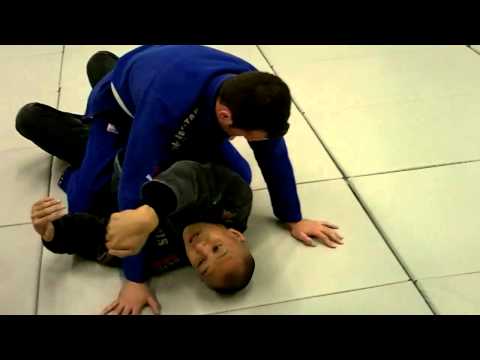
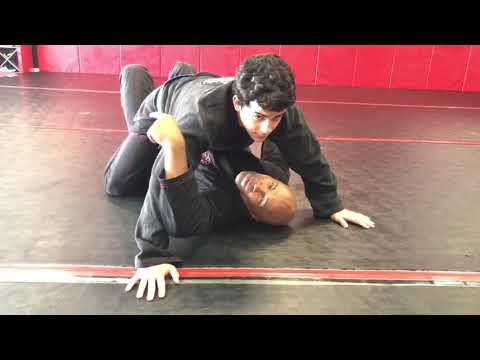
The standard roll escape from mount position, also called the trap and roll, involves isolating and controlling the top player's arm or hand before executing a hip bridge to reverse position. Ritchie Yip emphasizes timing and hand placement, teaching that the bottom player should clasp hands together to control the opponent's hand as it moves during the bridge, rather than relying on grip strength alone. He stresses bridging upward in rhythm—up, down, up—while simultaneously grabbing the opponent's hand on the descent, maintaining pressure through chest control. Critically, Yip notes that head positioning determines leverage: the bottom player's chin must align directly underneath the opponent's chin to generate sufficient bridge force, otherwise the weight distribution prevents the sweep regardless of strength. Trillo Jiujitsu Academy provides broader technical variations, teaching arm isolation above the elbow (not below) combined with simultaneous leg placement in the middle of the body near the hips. Trillo emphasizes that the three actions—trapping the hand/arm, trapping the leg, and bridging—occur simultaneously rather than sequentially. Both instructors agree on fundamental mechanics: isolate one limb, use the bridge to create rotational force, and manage upper body positioning. Trillo additionally covers defensive adjustments when the top player bases out or repositions, offering alternative angles of attack and directional shifts to complete the sweep.
Сформировано на основе 2 инструкторов
Учебных курсов по этой технике пока нет.
Войдите, чтобы предложить курс.
Риск травмы для человека, к которому применяется техника
Submission escapes carry risk of injury if executed too late; timing-critical
Уровень мастерства, необходимый для надёжного выполнения техники
Разрешена ли техника по основным соревновательным правилам
Jiu-Jitsu University (Saulo Ribeiro, 2008)
Alias sources — [1] Jiu-Jitsu University (Saulo Ribeiro, 2008) [2] Kodokan Judo (Jigoro Kano, 1986)
Effectiveness sources — [1] Jiu-Jitsu University (Ribeiro, 2008)
Mixed Japanese-Western terminology — combines traditional Japanese terms with katakana loanwords
Alias sources — [1] Jiu-Jitsu University (Saulo Ribeiro, 2008) [2] Kodokan Judo (Jigoro Kano, 1986)
Effectiveness sources — [1] Jiu-Jitsu University (Ribeiro, 2008)
hip escape (shrimping) speed, framing strength, timing
flexible hips and quick lateral movement
hip flexors, obliques, triceps (framing), core
Your second leg must be placed in the middle, close to your butt—not extended out to the side. This proper leg placement allows your hips to come off the ground effectively when you bridge and turn your opponent over.
Keep your arm really trapped inside tight. According to Trillo Jiujitsu Academy, trapping their hand firmly prevents them from using it to post and stop your roll.
Ritchie Yip recommends clasping your hands together and pulling their hand into your chest to control it through grip rather than relying on hand or arm strength alone. This method works better against stronger opponents than trying to grab their biceps or forearm.
According to Ritchie Yip, bridge your hips up first to grab your opponent's hand, then pull down on the descent of your hips—not before. The timing coordinates your hip movement with your hand control for maximum effectiveness.
Ritchie Yip explains that moving your head allows you to bridge your opponent directly above you over your shoulder rather than to the side, and looking into the mat enables you to fold through and complete the sweep. Additionally, positioning your chin directly underneath your opponent's chin maintains the leverage needed for the escape.
The Standard Roll Escape executes a forward roll over the attacker's body, using the rotational momentum to pull the trapped arm through the armbar position and free it. The defender drives forward into the attacker while initiating a roll, using the body's mass and momentum to overcome the grip.
The standard roll escape is one of the oldest armbar defences, derived from judo's ground escape methodology. It remains a commonly taught armbar escape in both gi and no-gi grappling.
Unified MMA: разрешён — Legal defensive/transitional technique; IBJJF: разрешён — Legal; IJF: разрешён — Legal; ADCC: разрешён — Legal; UWW: разрешён — Legal; FIAS Sport Sambo: разрешён — Legal
Оценка опасности 4/10. Moderate — submission escapes carry risk of injury if executed too late; timing-critical
Стандартная цепочка подготовки: Create Space → Disrupt Control → Execute Escape → Recover Position.
Стандартные контрприёмы: Maintain Pressure — keep consistent weight distribution to limit escape space / Anticipate Direction — read escape attempt direction and block early / Transition — flow to a new position when the current one is threatened.
Распространённые варианты: Shrimp to guard (framing and hip-escaping to recover full guard or half guard); Underhook escape (winning the underhook and coming to knees or reversing); Bridge to knees (bridging into the opponent and transitioning to turtle or…); Ghost escape (inverting under the opponent to re-guard from the opposit…).
Used in BJJ competition.
Основные ошибки, на которые стоит обратить внимание: Rolling backward instead of forward — forward rolls clear the armbar; backward rolls don't / Not using the opponent's extension force — time the roll to their extension attempt / Rolling without tucking the chin — neck injury risk during the somersault / Landing in a bad position — control the landing to end facing the opponent.
Standard Roll Escape также известен как Sutandādo Rōringu Nige, Basic Roll Armbar Escape, Standard Juji Roll Escape.