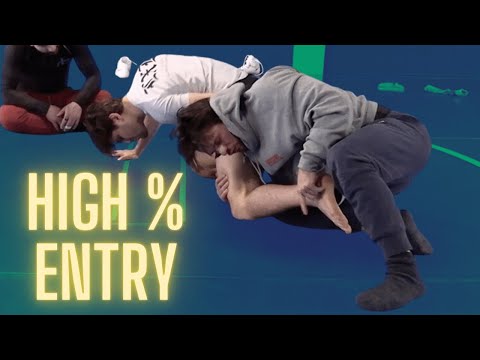
Half Guard Wrestle Up: The Easiest Way A Jiu Jitsu Athlete Can Develop Single Leg Offense
0
Standard Single Leg Wrestle-Up·Placido Santos ·Added by Admin
5 Stones Jiu Jitsu Class Excerpt
Перевод: standard single leg wrestle-up
The Standard Single Leg Wrestle-Up attacks one of the opponent's legs from the bottom — typically from half guard or seated guard — by securing the leg with both arms, then driving upward to standing while maintaining control of the leg. [1] The defender establishes the single-leg grip from the ground position, then uses a combination of leg drive and upper body pull to stand while keeping the opponent's leg trapped. [1],[2] Once standing with the single-leg control, the defender can complete the takedown, release and disengage, or transition to another attack. [2],[3]
The single leg wrestle-up is a highly effective technique for returning to standing from a seated guard position, combining a guard retention failure recovery with an offensive takedown attempt. [1] It is particularly effective in MMA and no-gi grappling where the guard player cannot rely on gi grips to maintain guard control. [1],[2]
A standard wrestling-based standup technique. [1]
Used in MMA competition. [1]
Изображений для этой техники пока нет.
Войдите, чтобы предложить изображение.
5 Stones Jiu Jitsu Class Excerpt
Учебных курсов по этой технике пока нет.
Войдите, чтобы предложить курс.
Риск травмы для человека, к которому применяется техника
Standing escapes from clinch/holds; involves explosive disengagement
Уровень мастерства, необходимый для надёжного выполнения техники
Разрешена ли техника по основным соревновательным правилам
Jiu-Jitsu University (Saulo Ribeiro, 2008)
Alias sources — [1] Wrestling Physical Conditioning Encyclopedia (John Jesse, 1974) [2] Mastering Jujitsu (Renzo Gracie & John Danaher, 2003)
Effectiveness sources — [1] Wrestling for Fighting (Randy Couture, 2007) [2] Mastering Jujitsu (Renzo Gracie & John Danaher, 2003)
Standard katakana transliteration of Western martial arts terminology (外来語) — used in Japanese MMA, boxing, and BJJ communities
Alias sources — [1] Wrestling Physical Conditioning Encyclopedia (John Jesse, 1974) [2] Mastering Jujitsu (Renzo Gracie & John Danaher, 2003)
Effectiveness sources — [1] Wrestling for Fighting (Randy Couture, 2007) [2] Mastering Jujitsu (Renzo Gracie & John Danaher, 2003)
hip mobility, explosive bridge/shrimp power, timing
flexible hips and strong glutes for escape movements
glutes, hip flexors, core, triceps (framing)
Grip at the hamstring level rather than at the waist or glutes. Placido Santos emphasizes that this positioning gives you better control for building into the single leg.
Extending your knee first gives your opponent time to drop their shoulder and defend. Instead, place your own hand on your own knee to maintain control and prevent this escape.
Keep your elbow in an inside position rather than flaring it outward, as Placido Santos explains—using an outside elbow position lets your opponent use their strength against you effectively.
Place your forehead on the mat and build your weight through your forehead and knees first. Placido Santos stresses not to try building with your forehead off the mat, as you'll lack the necessary base to generate height.
The Standard Single Leg Wrestle-Up attacks one of the opponent's legs from the bottom — typically from half guard or seated guard — by securing the leg with both arms, then driving upward to standing while maintaining control of the leg. The defender establishes the single-leg grip from the ground position, then uses a combination of leg drive and upper body pull to stand while keeping the opponent's leg trapped.
The standard single leg wrestle-up became one of the most important techniques at the intersection of wrestling and BJJ, providing a reliable method of escaping bottom position with offensive intent. It is now a fundamental technique in both sports.
Unified MMA: разрешён — Legal defensive/transitional technique; IBJJF: разрешён — Legal; IJF: разрешён — Legal; ADCC: разрешён — Legal; UWW: разрешён — Legal, escape scores 1 point (freestyle), reversal scores 1 point; FIAS Sport Sambo: разрешён — Legal; NCAA Folkstyle: разрешён — Legal, escape scores 1 point, reversal scores 2 points
Оценка опасности 3/10. Moderate — standing escapes from clinch/holds; involves explosive disengagement
Стандартная цепочка подготовки: Create Space → Disrupt Control → Execute Escape → Recover Position.
Стандартные контрприёмы: Maintain Pressure — keep consistent weight distribution to limit escape space / Anticipate Direction — read escape attempt direction and block early / Transition — flow to a new position when the current one is threatened.
Распространённые варианты: Standard escape (primary escape mechanic using frames, bridges, or hip mov…); Combination escape (chaining two escape directions or methods); Counter escape (using the opponent's attack attempt to create the escape …); Competition variation (modified for rule-set optimisation).
Used in MMA competition.
Основные ошибки, на которые стоит обратить внимание: Not completing the arm drag — a partial drag leaves the opponent's arm in position to frame and stop you / Rising with the head on the outside — outside head position exposes you to front headlock and guillotine / Not driving through with the legs — the legs provide the force for both the rise and the takedown / Releasing the single leg grip to readjust — maintain the grip through the entire finish.
Standard Single Leg Wrestle-Up также известен как Sutandādo Shinguru Reggu Resuru Appu, Basic Single Leg Wrestle-Up, Standard Single From Bottom.