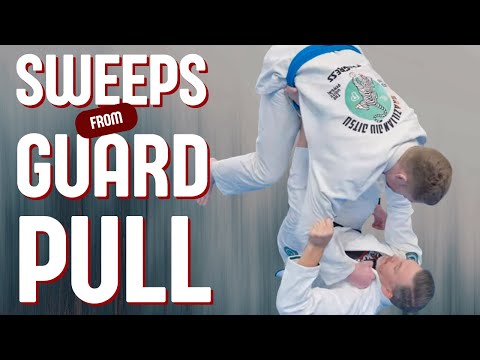
SWEEPS From GUARD PULL
0
Standard Guard Pull·The Grapple Lab
Sweeps from Guard Pull .. In this video we look at 4 sweep options you can hit straight from your guard pull. If you are…
Перевод: standard guard pull
The Standard Guard Pull subfamily covers the traditional guard pull where the practitioner jumps to closed guard by gripping the opponent's gi or body, pulling themselves up onto the opponent's hips, and closing the legs around the waist. [1] The standard guard pull aims to establish closed guard directly from standing, bypassing the standing phase entirely. [1],[2] The technique requires timing and grip strength — the puller must maintain strong grips while jumping and wrapping the legs before the opponent can prevent the guard closure. [2],[3]
The standard guard pull is the baseline guard pull technique. [1]
A fundamental BJJ competition technique. [1]
Commonly used in IBJJF competition. [1]
Изображений для этой техники пока нет.
Войдите, чтобы предложить изображение.
Sweeps from Guard Pull .. In this video we look at 4 sweep options you can hit straight from your guard pull. If you are…
Учебных курсов по этой технике пока нет.
Войдите, чтобы предложить курс.
Риск травмы для человека, к которому применяется техника
Standing escapes from clinch/holds; involves explosive disengagement
Уровень мастерства, необходимый для надёжного выполнения техники
Разрешена ли техника по основным соревновательным правилам
The Guard (Joe Moreira & Ed Beneville, 2008)
Alias sources — [1] Jiu-Jitsu University (Saulo Ribeiro, 2008) [2] Brazilian Jiu-Jitsu: Theory and Technique (Renzo Gracie & Royler Gracie, 2001)
Effectiveness sources — [1] Mastering Jujitsu (Gracie & Danaher, 2003)
Standard katakana transliteration of Western martial arts terminology (外来語) — used in Japanese MMA, boxing, and BJJ communities
Alias sources — [1] Jiu-Jitsu University (Saulo Ribeiro, 2008) [2] Brazilian Jiu-Jitsu: Theory and Technique (Renzo Gracie & Royler Gracie, 2001)
Effectiveness sources — [1] Mastering Jujitsu (Gracie & Danaher, 2003)
hip mobility, explosive bridge/shrimp power, timing
flexible hips and strong glutes for escape movements
glutes, hip flexors, core, triceps (framing)
Каждое движение в любом боевом искусстве обладает рядом универсальных свойств. Комбинируйте параметры ниже, чтобы найти нужный инструмент или сравнить аналоги из разных стилей.
The Grapple Lab emphasizes that you don't want to kick and pull your partner down while ending with your leg on the outside, as this often results in a 50-50 position, your back being taken, or your opponent coming up to strike. Instead, take your foot off the hip and drop it to the inside to maintain control.
The Grapple Lab explains that you want your opponent's posture broken with their hips slightly above their head; pull on the collar and sleeve while driving your hips underneath to create weightlessness, which sets up the sweep.
According to The Grapple Lab, if you want to consolidate points, take the foot to the inside to get mount position, scoring for both the sweep and the mount; if playing sub-only or as a submission-focused fighter, you can throw the arm across to start attacking the armbar instead.
The Grapple Lab stresses that you must stay in control and keep your opponent close after the sweep rather than launching them; once underneath, straighten your legs, use a steering wheel action by pulling the elbow in and driving up, and roll over the top of a shoulder to reach the top position.
The Standard Guard Pull subfamily covers the traditional guard pull where the practitioner jumps to closed guard by gripping the opponent's gi or body, pulling themselves up onto the opponent's hips, and closing the legs around the waist. The standard guard pull aims to establish closed guard directly from standing, bypassing the standing phase entirely.
The standard guard pull has been used in BJJ competition since the sport's early days, with many competitors preferring to fight from their guard rather than engage in the standing takedown exchange. The technique remains a fundamental competitive strategy in sport BJJ.
Unified MMA: разрешён — Legal defensive technique; IBJJF: разрешён — Legal — escapes and sweeps are fundamental to BJJ, sweep from bottom scores 2…; IJF: разрешён — Legal; ADCC: разрешён — Legal, sweep scores 2 points (4 from mount/back); FIAS Sport Sambo: разрешён — Legal; FIAS Combat Sambo: разрешён — Legal
Оценка опасности 3/10. Moderate — standing escapes from clinch/holds; involves explosive disengagement
Стандартная цепочка подготовки: Create Space → Disrupt Control → Execute Escape → Recover Position.
Стандартные контрприёмы: Maintain Pressure — keep consistent weight distribution to limit escape space / Anticipate Direction — read escape attempt direction and block early / Transition — flow to a new position when the current one is threatened.
Распространённые варианты: Standard escape (primary escape mechanic using frames, bridges, or hip mov…); Combination escape (chaining two escape directions or methods); Counter escape (using the opponent's attack attempt to create the escape …); Competition variation (modified for rule-set optimisation).
Commonly used in IBJJF competition.
Основные ошибки, на которые стоит обратить внимание: Pulling without establishing proper grips — the grips control the entire sequence / Not stepping on the hip — the foot on the hip controls distance and prevents the opponent from passing during the pull / Falling backward instead of sitting — the sit-and-pull is controlled; falling exposes your back / Releasing grips after pulling guard — the grips transition directly to offensive guard tools.
Standard Guard Pull также известен как Sutandādo Gādo Puru, Classic Guard Pull, Jump To Guard.