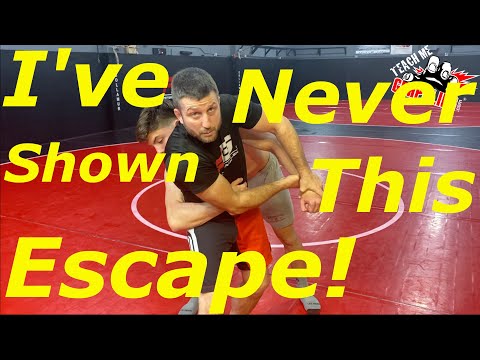
ESCAPE and Reverse with this 2 on 1 TRICK!
0
Standard Inversion Escape·TeachMeGrappling Coach Brian·Added by Admin
This video I breakdown an escape/reversal you can use in the standing position when you gain control of a 2on1 when your…
Перевод: standard inversion escape
The Standard Inversion Escape from north-south bridges the hips upward, rolls onto the upper back, and swings the legs over the body to hook around the opponent, recovering guard through the inversion. [1] The defender times the inversion with a frame push that creates momentary space, then rolls the hips over the shoulders and brings the legs around to catch the opponent. [1],[2] The escape requires flexibility and timing, as the inversion must be performed quickly before the opponent can follow and re-establish control. [2],[3]
The standard inversion escape is the baseline inverting north-south escape. [1]
A modern BJJ escape technique. [1]
Used in BJJ competition. [1]
Изображений для этой техники пока нет.
Войдите, чтобы предложить изображение.
This video I breakdown an escape/reversal you can use in the standing position when you gain control of a 2on1 when your…
Учебных курсов по этой технике пока нет.
Войдите, чтобы предложить курс.
Риск травмы для человека, к которому применяется техника
Bottom escapes from mount/side control; bridge and hip escape mechanics (Ribeiro 2008)
Уровень мастерства, необходимый для надёжного выполнения техники
Разрешена ли техника по основным соревновательным правилам
Jiu-Jitsu University (Saulo Ribeiro, 2008)
Alias sources — [1] Jiu-Jitsu University (Saulo Ribeiro, 2008) [2] Advanced Brazilian Jiu-Jitsu Techniques (Marcelo Garcia, 2007)
Effectiveness sources — [1] Jiu-Jitsu University (Ribeiro, 2008)
Mixed Japanese-Western terminology — combines traditional Japanese terms with katakana loanwords
Alias sources — [1] Jiu-Jitsu University (Saulo Ribeiro, 2008) [2] Advanced Brazilian Jiu-Jitsu Techniques (Marcelo Garcia, 2007)
Effectiveness sources — [1] Jiu-Jitsu University (Ribeiro, 2008)
grip fighting ability, hip mobility for sliding to the mat, chin defence
strong hands for grip fighting, flexible hips
forearms (grip fighting), core, hip flexors, neck
According to Coach Brian at TeachMeGrappling, use a two-on-one grip by placing your thumb inside their wrist and using the heel of your palm to break their fingers off. Step forward, sink your weight, and scrape their fingers as you fight their hands until the grip breaks.
Coach Brian emphasizes that instead of rushing to cut and turn for a one-point escape, you should take your time, regrip strongly on the wrist, and raise your opponent's arm at a bad angle while stepping forward. This patient approach can result in a reversal—putting you behind them—rather than just neutral positioning.
Coach Brian recommends keeping the hand on the same side as your opponent's arm you're controlling on the wrist, as it keeps better control. He notes that using the opposite hand can cause you to lose the wrist grab and end up in an awkward scramble.
While this two-on-one reversal technique is primarily taught in wrestling, Coach Brian notes it can also apply to MMA and self-defense situations where you want to control your opponent's arm and reverse them in the standing position.
The Standard Inversion Escape from north-south bridges the hips upward, rolls onto the upper back, and swings the legs over the body to hook around the opponent, recovering guard through the inversion. The defender times the inversion with a frame push that creates momentary space, then rolls the hips over the shoulders and brings the legs around to catch the opponent.
The standard inversion escape is an advanced BJJ technique from the modern guard retention school, providing a dynamic escape from the traditionally difficult north-south position. It is most commonly used by flexible, athletic grapplers.
Unified MMA: разрешён — Legal defensive/transitional technique; IBJJF: разрешён — Legal; IJF: разрешён — Legal; ADCC: разрешён — Legal; UWW: разрешён — Legal; FIAS Sport Sambo: разрешён — Legal
Оценка опасности 3/10. Moderate — bottom escapes from mount/side control; bridge and hip escape mechanics (Ribeiro 2008)
Стандартная цепочка подготовки: Create Space → Disrupt Control → Execute Escape → Recover Position.
Стандартные контрприёмы: Heavy Hips — maintain low hip pressure and wide base to absorb the bridge / Grapevine — hook legs inside opponent's thighs to neutralize hip movement / Post Hand — post arm on the mat in the direction of the bridge to maintain balance.
Распространённые варианты: Slide to side (choking-arm side) (fighting hands and sliding hips to the mat on the choking…); Peel-and-turn (stripping the seatbelt grip and turning into the opponent); Trap-arm escape (trapping one arm and rolling to pin the opponent's back); Body triangle escape (addressing the body triangle lock before escaping the hooks).
Used in BJJ competition.
Основные ошибки, на которые стоит обратить внимание: Rolling without framing first — the frame creates the space needed to initiate the roll / Rolling too slowly — the inversion must be fast; a slow roll is easily stopped / Not tucking the chin — the chin must be tucked to protect the neck and facilitate the roll / Inverting in the wrong direction — roll toward the space, not into the opponent's body.
Standard Inversion Escape также известен как Sutandādo Inbājon Nige, Basic Inversion Escape, Roll Over Guard Recovery.