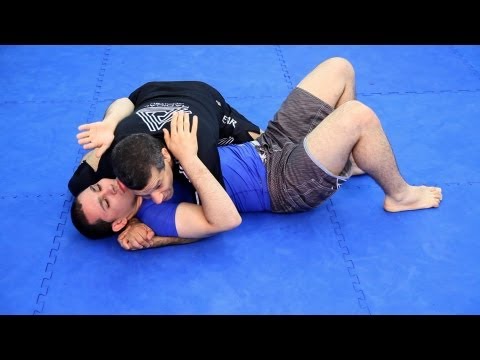
Side Control to Mount & Mount to Back | MMA Fighting
0
Standard Scoot And Turn·Howcast
Full Playlist: https://www.youtube.com/playlist?list=PL14CA107F0D3B6732 - - Like these MMA lessons !!! Check out the off…
Перевод: standard scoot and turn
The Standard Scoot And Turn slides the hips downward along the attacker's body while simultaneously turning toward the bottom hook side, working to slip below the attacker's control and turn to face them. [1] The defender uses the hands to defend the choke while the hips scoot down and to one side, eventually sliding low enough to turn and face the attacker, recovering half guard or full guard. [1],[2] The scooting motion must be persistent — small incremental slides rather than one big movement — to avoid giving the attacker space to readjust their control. [2],[3]
The standard scoot and turn is the baseline version of this back escape. [1]
A fundamental BJJ back escape. [1]
Used in BJJ competition. [1]
Изображений для этой техники пока нет.
Войдите, чтобы предложить изображение.
Full Playlist: https://www.youtube.com/playlist?list=PL14CA107F0D3B6732 - - Like these MMA lessons !!! Check out the off…
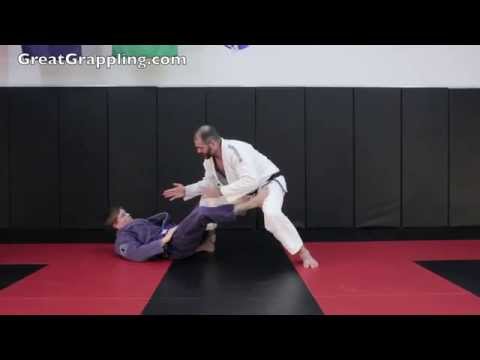
Another move shown to me by one of my Professors in Brazil, the Rommel pass is a great way to deal with a strong DLR gam…
The Standard Scoot and Turn escape represents a fundamental positional transition within rear-mount escape sequences, though the provided instructional videos address different technical contexts that do not directly align with this specific escape technique. Howcast's content emphasizes the hierarchical progression of dominant positions in Brazilian Jiu-Jitsu—from side control to mount to back mount—establishing conceptual frameworks about positional priority and control philosophy, but does not detail the scoot-and-turn escape mechanics from rear mount. Great Grappling's transcript focuses on the Rommel Pass (Hummel Pass) for addressing De La Riva guard, discussing guard passing mechanics, base management through proper squatting posture, and lapel control strategies during positional transitions. While neither video directly instructs the Standard Scoot and Turn escape specifically, both instructors emphasize common principles applicable to escaping compromised positions: maintaining solid base through proper leg positioning (Howcast's positional hierarchy; Great Grappling's emphasis on squatting versus waist bending), establishing control through strategic gripping (lapel control in Great Grappling), and understanding positional sequencing. Both videos reinforce that Brazilian Jiu-Jitsu prioritizes position over submissions and that controlled transitional mechanics are essential for effective escapes and dominant positioning.
Сформировано на основе 2 инструкторов
Учебных курсов по этой технике пока нет.
Войдите, чтобы предложить курс.
Риск травмы для человека, к которому применяется техника
Back escapes must address choke threat while escaping; urgency increases injury risk
Уровень мастерства, необходимый для надёжного выполнения техники
Разрешена ли техника по основным соревновательным правилам
Jiu-Jitsu University (Saulo Ribeiro, 2008)
Alias sources — [1] Jiu-Jitsu University (Saulo Ribeiro, 2008) [2] Brazilian Jiu-Jitsu: Theory and Technique (Renzo Gracie & Royler Gracie, 2001)
Effectiveness sources — [1] Jiu-Jitsu University (Ribeiro, 2008)
Standard katakana transliteration of Western martial arts terminology (外来語) — used in Japanese MMA, boxing, and BJJ communities
Alias sources — [1] Jiu-Jitsu University (Saulo Ribeiro, 2008) [2] Brazilian Jiu-Jitsu: Theory and Technique (Renzo Gracie & Royler Gracie, 2001)
Effectiveness sources — [1] Jiu-Jitsu University (Ribeiro, 2008)
explosive hip bridge power, shrimping ability, timing
strong glutes and hip extensors for powerful bridges
glutes, hip extensors, core, quadriceps
People often bend at the waist instead of getting a proper squat with their legs, and they over-commit by reaching without maintaining connection between the knee and elbow, which leaves them vulnerable to triangles and armbars.
Grab and hold the lapel—it's an excellent control point that allows you to lift his shoulders off the floor, crunch him slightly, and use your knee to drive his back toward the floor while powering up your crossface.
Keep your knee and elbow connected as you reach with your free hand; this connection is critical to prevent your opponent from escaping into submissions like triangles or armbars.
The Standard Scoot And Turn slides the hips downward along the attacker's body while simultaneously turning toward the bottom hook side, working to slip below the attacker's control and turn to face them. The defender uses the hands to defend the choke while the hips scoot down and to one side, eventually sliding low enough to turn and face the attacker, recovering half guard or full guard.
The standard scoot and turn has been a foundational back escape technique in BJJ, taught as one of the first back escape methods to beginners and refined through competitive experience. Its reliability has made it a universal back escape across all grappling disciplines.
Unified MMA: разрешён — Legal defensive/transitional technique; IBJJF: разрешён — Legal; IJF: разрешён — Legal; ADCC: разрешён — Legal; UWW: разрешён — Legal; FIAS Sport Sambo: разрешён — Legal
Оценка опасности 4/10. Moderate — back escapes must address choke threat while escaping; urgency increases injury risk
Стандартная цепочка подготовки: Create Space → Disrupt Control → Execute Escape → Recover Position.
Стандартные контрприёмы: Maintain Pressure — keep consistent weight distribution to limit escape space / Anticipate Direction — read escape attempt direction and block early / Transition — flow to a new position when the current one is threatened.
Распространённые варианты: Bridge and roll (upa) (explosive bridge trapping arm and leg to reverse position); Elbow-knee escape (framing and shrimping to recover guard); Foot drag escape (dragging the opponent's foot with the heel to create spac…); Combination escape (bridging to force a reaction, then shrimping when the opp…).
Used in BJJ competition.
Основные ошибки, на которые стоит обратить внимание: Scooting without maintaining hand defence — the opponent will choke you during the scoot if the neck is unprotected / Performing the scoots too far apart — each scoot should flow into the next with minimal pause / Turning before the bottom hook is fully cleared — premature turning gets you caught halfway / Not using the shrimping hip motion — flat scooting without hip angles doesn't create progress.
Standard Scoot And Turn также известен как Sutandādo Sukūto Ando Tān, Basic Scoot Escape, Slide And Face.