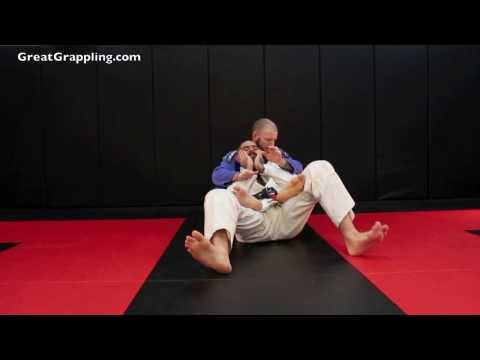
Back Control Escape The Double Scoot
0
Scoot And Turn Escape·Great Grappling
In this video I show a way to escape the back position by keeping both arms tight and scooting away (or a version of a r…
Перевод: scoot and turn escape
The Scoot And Turn Escape subfamily covers back escape techniques where the defender slides the hips downward and sideways while turning to face the attacker, using the scooting motion to create the space needed to extract from back control. [1] The scoot creates space between the defender's back and the attacker's chest, while the turn converts that space into a facing position where the defender can establish guard. [1],[2] The scoot and turn is one of the most commonly taught back escapes because it works against both hooks and body triangle. [2],[3]
The scoot and turn escape uses hip scooting to slide down while turning to face the opponent, escaping to guard. [1]
Developed in BJJ as a systematic back escape. [1]
Commonly used in BJJ competition. [1]
Изображений для этой техники пока нет.
Войдите, чтобы предложить изображение.
In this video I show a way to escape the back position by keeping both arms tight and scooting away (or a version of a r…
Учебных курсов по этой технике пока нет.
Войдите, чтобы предложить курс.
Риск травмы для человека, к которому применяется техника
Back escapes must address choke threat while escaping; urgency increases injury risk
Уровень мастерства, необходимый для надёжного выполнения техники
Разрешена ли техника по основным соревновательным правилам
Jiu-Jitsu University (Saulo Ribeiro, 2008)
Alias sources — [1] Jiu-Jitsu University (Saulo Ribeiro, 2008) [2] Mastering Jujitsu (Renzo Gracie & John Danaher, 2003) [3] Brazilian Jiu-Jitsu: Theory and Technique (Renzo Gracie & Royler Gracie, 2001)
Effectiveness sources — [1] Jiu-Jitsu University (Ribeiro, 2008)
Standard katakana transliteration of Western martial arts terminology (外来語) — used in Japanese MMA, boxing, and BJJ communities
Alias sources — [1] Jiu-Jitsu University (Saulo Ribeiro, 2008) [2] Mastering Jujitsu (Renzo Gracie & John Danaher, 2003) [3] Brazilian Jiu-Jitsu: Theory and Technique (Renzo Gracie & Royler Gracie, 2001)
Effectiveness sources — [1] Jiu-Jitsu University (Ribeiro, 2008)
explosive hip bridge power, shrimping ability, timing
strong glutes and hip extensors for powerful bridges
glutes, hip extensors, core, quadriceps
Каждое движение в любом боевом искусстве обладает рядом универсальных свойств. Комбинируйте параметры ниже, чтобы найти нужный инструмент или сравнить аналоги из разных стилей.
Keeping your arms in and protecting the space underneath your arms is critical, according to Great Grappling. This prevents your opponent from getting a seat belt grip or other controlling positions.
Dig your heels hard into the floor and scoot your bottom away from your opponent, even as they're squeezing hard to maintain control, says Great Grappling.
Bring your legs together to trap the hook, then open the door by laying over and belly flopping onto that leg while keeping your hips down—this allows you to drive the arm out safely between your legs without exposing yourself to an armbar, according to Great Grappling.
Don't pull your arm away directly; you risk getting arm barred badly when your opponent rips that arm off, explains Great Grappling. Instead, use the belly flop technique to safely extract the arm.
The Scoot And Turn Escape subfamily covers back escape techniques where the defender slides the hips downward and sideways while turning to face the attacker, using the scooting motion to create the space needed to extract from back control. The scoot creates space between the defender's back and the attacker's chest, while the turn converts that space into a facing position where the defender can establish guard.
The scoot and turn is a fundamental BJJ back escape that has been taught since the art's early development, valued for its reliability and applicability against various forms of back control. It remains one of the primary back escape methods taught at all levels.
Unified MMA: разрешён — Legal defensive/transitional technique; IBJJF: разрешён — Legal; IJF: разрешён — Legal; ADCC: разрешён — Legal; UWW: разрешён — Legal; FIAS Sport Sambo: разрешён — Legal
Оценка опасности 4/10. Moderate — back escapes must address choke threat while escaping; urgency increases injury risk
Стандартная цепочка подготовки: Create Space → Disrupt Control → Execute Escape → Recover Position.
Стандартные контрприёмы: Maintain Pressure — keep consistent weight distribution to limit escape space / Anticipate Direction — read escape attempt direction and block early / Transition — flow to a new position when the current one is threatened.
Распространённые варианты: Bridge and roll (upa) (explosive bridge trapping arm and leg to reverse position); Elbow-knee escape (framing and shrimping to recover guard); Foot drag escape (dragging the opponent's foot with the heel to create spac…); Combination escape (bridging to force a reaction, then shrimping when the opp…).
Commonly used in BJJ competition.
Основные ошибки, на которые стоит обратить внимание: Scooting upward instead of downward — the scoot direction is toward the opponent's feet, sliding below the hooks / Scooting too fast and losing defensive posture — each scoot should be controlled; maintain hand position on the neck / Not turning quickly enough after the bottom hook clears — the turn must be immediate; hesitation allows re-hooking / Scooting without shrimping — the hip angle change is what makes the scoot effective; flat scooting doesn't work.
Scoot And Turn Escape также известен как Sukūto Ando Tān Esukēpu, Slide And Turn, Hip Slide Escape, Scoot Down Escape.