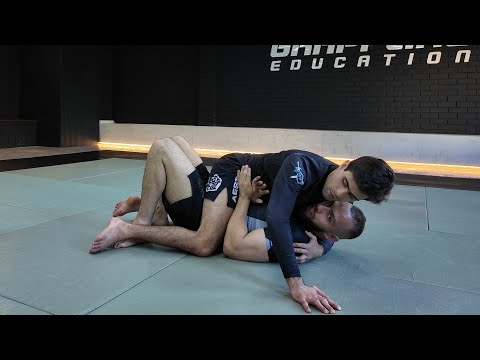
How I Escape EVERYONES Mount
0
Mount Escape·Ebsayz
Join Ebsayz Jiu Jitsu for 1 on 1 coaching to accelerate your progress and guaranteed results! https://www.skool.com/ebsa…
Перевод: Mount escape
The Mount Escape family within the Back Escape group covers techniques for escaping when the opponent achieves mount from a back-control transition — addressing the specific challenge of an opponent who has moved from behind you to a mounted position. [1] When an opponent transitions from back control to mount, the escape dynamics differ from a standard mount escape because the opponent's grips, hooks, and body positioning carry over from back control, and the bottom player may already be flattened and fatigued from defending back attacks. [1],[2] These escapes must account for the residual seatbelt grip, the transition momentum, and the opponent's established weight distribution that comes from having already controlled the back. [2],[3] The fundamental escapes (trap and roll, elbow-knee) apply but often require modification to address the specific control remnants of the back-to-mount transition. [3]
Mount escapes from back control transitions developed as back-taking became a more sophisticated skill in BJJ and MMA. [1] As back attack systems (rear naked choke, bow and arrow) became more dangerous, opponents began transitioning to mount when the choke was defended, requiring specific escape knowledge for this transition. [1],[2]
Back-to-mount transitions are common at the highest levels of BJJ and MMA competition; the ability to escape this specific scenario is essential for competitive survival. [1]
Изображений для этой техники пока нет.
Войдите, чтобы предложить изображение.
Join Ebsayz Jiu Jitsu for 1 on 1 coaching to accelerate your progress and guaranteed results! https://www.skool.com/ebsa…
Учебных курсов по этой технике пока нет.
Войдите, чтобы предложить курс.
Риск травмы для человека, к которому применяется техника
Being mounted after back control means the bottom player is likely already fatigued and potentially flattened; the opponent has established control and momentum; in MMA, ground-and-pound from this position is extremely dangerous
Уровень мастерства, необходимый для надёжного выполнения техники
Разрешена ли техника по основным соревновательным правилам
Jiu-Jitsu University (Saulo Ribeiro, 2008)
Description sources — [1] Jiu-Jitsu University (Ribeiro, 2008) on escape hierarchy [2] Competition analysis of back-to-mount transitions [3] MMA ground-fighting evolution
Description sources — [1] Jiu-Jitsu University (Ribeiro, 2008) on escape hierarchy [2] Competition analysis of back-to-mount transitions [3] MMA ground-fighting evolution
bridging power (escaping from a fatigued state), grip-stripping ability, hip mobility
cardio endurance (may be exhausted from defending back control), explosive hips, strong frames
glutes (bridging), core (turning from flat), forearms (grip stripping), hip flexors (shrimping)
Каждое движение в любом боевом искусстве обладает рядом универсальных свойств. Комбинируйте параметры ниже, чтобы найти нужный инструмент или сравнить аналоги из разных стилей.
The two fundamental mount escapes — elbow-knee escape (shrimping) and bridge-and-roll (upa) — are the first escapes taught in every BJJ school. Saulo Ribeiro considers the elbow-knee escape the single most important technique in jiu-jitsu. (Ribeiro, Jiu-Jitsu University)
According to Ebsayz, the order is critical because people get it wrong and give up prematurely. The sequence is: secure inside position, displace the opponent's base, then execute the escape.
Ebsayz emphasizes you must get inside position at: the hips (elbow inside), the forehead, the elbows, and the feet or knees. Getting all four of these inside positions is step one before attempting any escape.
Ebsayz explains that a strong mount forms a trapezoid shape where the opponent's hips are parallel to the mat with equal angles. Displacing this base geometry is essential to break their stability before escaping.
Ebsayz discourages relying on kipping alone, calling it a 'party trick' that doesn't work in serious competition. Focus instead on controlling inside positions and displacing your opponent's base.
The Mount Escape family within the Back Escape group covers techniques for escaping when the opponent achieves mount from a back-control transition — addressing the specific challenge of an opponent who has moved from behind you to a mounted position. When an opponent transitions from back control to mount, the escape dynamics differ from a standard mount escape because the opponent's grips, hooks, and body positioning carry over from back control, and the bottom player may already be flattened and fatigued from defending back attacks.
Mount escapes from back control transitions developed as back-taking became a more sophisticated skill in BJJ and MMA. As back attack systems (rear naked choke, bow and arrow) became more dangerous, opponents began transitioning to mount when the choke was defended, requiring specific escape knowledge for this transition.
Unified MMA: разрешён — Legal defensive/transitional technique; IBJJF: разрешён — Legal; IJF: разрешён — Legal; ADCC: разрешён — Legal; UWW: разрешён — Legal, escape scores 1 point (freestyle), reversal scores 1 point; FIAS Sport Sambo: разрешён — Legal; NCAA Folkstyle: разрешён — Legal, escape scores 1 point, reversal scores 2 points
Оценка опасности 7/10. High — being mounted after back control means the bottom player is likely already fatigued and potentially flattened; the opponent has established control and momentum; in MMA, ground-and-pound from this position is extremely dangerous
Стандартная цепочка подготовки: Recognise Transition → Fight During Transition → Strip Grips → Establish Frames → Execute Escape → Recover Position.
Стандартные контрприёмы: When mounted after back transition: immediately consolidate mount by settling weight and establishing grapevines / Use the transition momentum to advance directly to high mount / Maintain any residual grips from back control to limit the bottom player's escape options.
Распространённые варианты: Trap and roll from back-mount transition (trapping the arm and foot during the transition moment an…); Elbow-knee escape with grip strip (first stripping the residual seatbelt or collar grip from…); Frame and turn (creating frames against the chest and turning from the fl…); Heel drag escape (hooking the opponent's foot with your heel during the tra…).
Back-to-mount transitions are common at the highest levels of BJJ and MMA competition; the ability to escape this specific scenario is essential for competitive survival.
Основные ошибки, на которые стоит обратить внимание: Accepting the transition passively — the back-to-mount transition is a critical moment; fighting during the transitio… / Not stripping residual grips — attempting to bridge with the opponent still holding a seatbelt grip reduces escape ef… / Turning the wrong direction — turning toward the opponent's established grip side often results in being re-taken to … / Bridging straight up — bridges must be directional (at an angle) to create usable space.
Mount Escape также известен как Maunto Esukēpu, Mount Escape From Back, Rear Mount Escape.