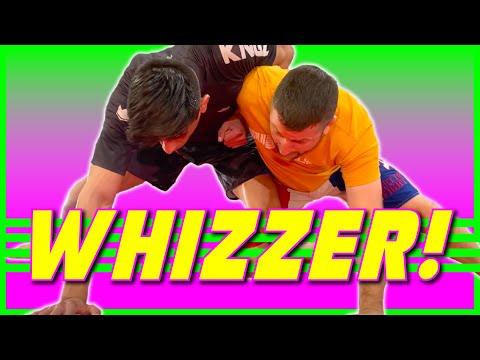
Whizzer BASICS for EVERYONE!
0
Standard Whizzer Kimura·TeachMeGrappling Coach Brian·Added by Admin
This video I breakdown the basics of the whizzer and uchi mata from the dogfight position. Check out the details and yo…
Перевод: standard whizzer kimura
The Standard Whizzer Kimura transitions from the overhook position by reaching the free hand across to grab the opponent's wrist on the overhook side, then locking the figure-four grip by connecting the overhook hand to the wrist-controlling hand. [1] Once the kimura grip is secured, the defender can apply the submission by rotating the opponent's arm behind their back, using the figure-four leverage to attack the shoulder joint. [1],[2] The transition must be quick to prevent the opponent from sensing the grip change and pulling the arm free. [2],[3]
The whizzer-to-kimura transition is effective because it converts a defensive overhook position into an offensive submission threat, surprising opponents who expect only a defensive application of the whizzer. [1] The figure-four kimura grip is mechanically strong and can be applied quickly from the overhook position. [2]
The whizzer-to-kimura transition represents the intersection of wrestling and BJJ technique, combining the wrestling overhook with the judo/BJJ double wristlock (ude-garami). [1] The kimura (ude-garami) itself is named after Masahiko Kimura, who used the technique to defeat Helio Gracie in 1951. [2]
The whizzer to kimura is used in MMA competition. [1]
Изображений для этой техники пока нет.
Войдите, чтобы предложить изображение.
This video I breakdown the basics of the whizzer and uchi mata from the dogfight position. Check out the details and yo…
Учебных курсов по этой технике пока нет.
Войдите, чтобы предложить курс.
Риск травмы для человека, к которому применяется техника
Sprawls and stuffs involve sudden body weight displacement; knee/hip strain risk
Уровень мастерства, необходимый для надёжного выполнения техники
Разрешена ли техника по основным соревновательным правилам
Kodokan Judo (Jigoro Kano, 1986)
Alias sources — [1] Jiu-Jitsu University (Ribeiro, 2008) [2] Fundamentals of Brazilian Jiu-Jitsu (Danaher, 2012) [3] Wrestling Coaching Manual (USA Wrestling, 2015)
Effectiveness sources — [1] Jiu-Jitsu University (Ribeiro, 2008) [2] Fundamentals of Brazilian Jiu-Jitsu (Danaher, 2012)
Mixed Japanese-Western terminology — combines traditional Japanese terms with katakana loanwords
Alias sources — [1] Jiu-Jitsu University (Ribeiro, 2008) [2] Fundamentals of Brazilian Jiu-Jitsu (Danaher, 2012) [3] Wrestling Coaching Manual (USA Wrestling, 2015)
Effectiveness sources — [1] Jiu-Jitsu University (Ribeiro, 2008) [2] Fundamentals of Brazilian Jiu-Jitsu (Danaher, 2012)
grip fighting technique, forearm endurance, timing
strong hands and forearms, quick stripping motions
forearm flexors/extensors, wrist rotators, biceps
According to Coach Brian at TeachMeGrappling, the whizzer is an overhook applied with pressure around an opponent's wrestling seatbelt or underhook at the waist. You get a tight whizzer by wrapping over, pulling up, and applying pressure downward by turning your hips.
Coach Brian recommends dropping your head and staying tight. If your opponent pushes, take your other hand out and use a shrug and duck motion to escape, which may even create an armbar opportunity if they leave their arm extended.
If your opponent maintains the whizzer, Coach Brian suggests you can circle up and step over their head, which converts their whizzer into an armbar position.
Coach Brian emphasizes that you must rotate your hips first before attempting any takedown or sweep with the whizzer, as proper hip rotation is necessary to get the correct angle and pressure.
The Standard Whizzer Kimura transitions from the overhook position by reaching the free hand across to grab the opponent's wrist on the overhook side, then locking the figure-four grip by connecting the overhook hand to the wrist-controlling hand. Once the kimura grip is secured, the defender can apply the submission by rotating the opponent's arm behind their back, using the figure-four leverage to attack the shoulder joint.
The standard whizzer-to-kimura transition became a common technique in MMA and BJJ, demonstrated by numerous fighters who used the defensive clinch position as a launching point for the kimura submission. It is now taught as a standard offensive option from the whizzer position.
Unified MMA: разрешён — Legal defensive technique; IBJJF: разрешён — Legal — defensive techniques are fundamental to grappling; IJF: разрешён — Legal defensive action; ADCC: разрешён — Legal; UWW: разрешён — Legal defensive technique; FIAS Sport Sambo: разрешён — Legal
Оценка опасности 3/10. Moderate — sprawls and stuffs involve sudden body weight displacement; knee/hip strain risk
Стандартная цепочка подготовки: Anticipate the Attack → Execute Defence → Recover Stance → Counter or Disengage.
Стандартные контрприёмы: Timing — attack when the defence is recovering or between movements / Feint — use deception to create openings in the defensive structure / Angle Change — attack from an unexpected angle that the defence does not cover.
Распространённые варианты: Standard defence (primary defensive technique from the most common position); Reactive defence (triggered by the opponent's attack, minimal movement for …); Proactive defence (anticipating the attack and positioning to neutralise it …); Counter defence (using the defensive movement to create an immediate count…).
The whizzer to kimura is used in MMA competition.
Основные ошибки, на которые стоит обратить внимание: Releasing the whizzer before securing the wrist — the transition must be smooth; don't lose control during the switch / Clasping hands in an S-grip instead of the figure-four — the figure-four provides much more rotational force for the … / Trying to finish standing without taking the fight down — the standing kimura is unreliable; transition to the ground / Not keeping hips close during the grip change — hip distance allows the opponent to pull the arm free.
Standard Whizzer Kimura также известен как Sutandādo Wizā Kimura, Basic Whizzer Kimura, Standard Overhook Kimura, Whizzer Double Wristlock.