How to learn 5 Basic karate Blocks?
0
Standard Low Base·Fitness Karate Academy
Learn 5 basic karate blocks at home step by step with Sensei James golestani. you will learn in this lesson, 5 basic kar…
Перевод: standard low base
The Standard Low Base positions the fighter in a wide, low athletic stance with the feet wider than shoulder width, knees bent, hips back, and weight distributed evenly between both legs. [1] The spine is kept relatively straight while the hips sink low, creating a dense, heavy base that is difficult to move or elevate. [1],[2] The standard low base allows the fighter to react quickly in any direction while maintaining the gravitational advantage of a low centre of mass. [2],[3]
A low base stance makes takedowns significantly more difficult because the defender's centre of gravity is closer to the ground, requiring the attacker to generate more force to lift or off-balance them. [1] The low base is particularly effective against double-leg and body-lock takedowns that rely on lifting. [2]
Low base defence is a fundamental wrestling concept taught from the earliest levels, as maintaining a low centre of gravity is one of the first principles of takedown defence. [1]
Low base is a standard takedown defence. [1]
Изображений для этой техники пока нет.
Войдите, чтобы предложить изображение.
Learn 5 basic karate blocks at home step by step with Sensei James golestani. you will learn in this lesson, 5 basic kar…
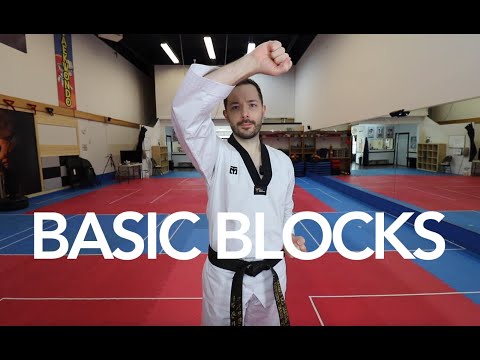
Day one on the Taekwondo mats... Here are the three blocks you would learn! High block, Middle block, and Down/Low block…
A Rogue Saber Academy Form 1 lesson featuring Lightsaber Training on how to fight, spar, duel, and train with real LED s…
The transcripts provided do not contain cohesive instruction on a 'Standard Low Base' technique as a unified defensive stance. Rogue Saber Academy's Lesson 14 focuses on the 'Smuggler' offensive saber technique—a leg-striking maneuver executed while moving laterally past an opponent—rather than a defensive base position. TaekwondoShawn and Fitness Karate Academy both cover fundamental blocking techniques (high block, middle block, down block) in Taekwondo and Karate respectively, emphasizing proper arm positioning, wrist alignment, elbow placement, and hip-driven power generation. While these blocking videos address defensive postures and protective positioning, they do not specifically address or define a 'Standard Low Base' as a distinct, named defensive stance. The blocking instruction emphasizes maintaining proper body alignment, keeping elbows close to the body line, and generating power through hip rotation and twisting motions, but this appears distinct from the technique topic requested.
Сформировано на основе 3 инструкторов
Учебных курсов по этой технике пока нет.
Войдите, чтобы предложить курс.
Риск травмы для человека, к которому применяется техника
Sprawls and stuffs involve sudden body weight displacement; knee/hip strain risk
Уровень мастерства, необходимый для надёжного выполнения техники
Разрешена ли техника по основным соревновательным правилам
Karate-Do Kyohan: The Master Text (Gichin Funakoshi, 1935)
Alias sources — [1] Wrestling Coaching Manual (USA Wrestling, 2015) [2] MMA Instruction Manual (Ryan & Snowden, 2010) [3] MMA Instruction Manual (Ryan & Snowden, 2010)
Effectiveness sources — [1] Wrestling Coaching Manual (USA Wrestling, 2015) [2] MMA Instruction Manual (Ryan & Snowden, 2010)
Standard katakana transliteration of Western martial arts terminology (外来語) — used in Japanese MMA, boxing, and BJJ communities
Alias sources — [1] Wrestling Coaching Manual (USA Wrestling, 2015) [2] MMA Instruction Manual (Ryan & Snowden, 2010) [3] MMA Instruction Manual (Ryan & Snowden, 2010)
Effectiveness sources — [1] Wrestling Coaching Manual (USA Wrestling, 2015) [2] MMA Instruction Manual (Ryan & Snowden, 2010)
reaction speed, structural body mechanics, defensive awareness
quick reflexes and conditioned defensive surfaces
varies — forearms (blocking), legs (movement), core (stability)
Your fist should be one fist length away from your forehead, with your wrist higher than your elbow and kept straight as if punching. Your arm should be above your head covering everything, like holding an umbrella over your body to protect against punches to the face and attacks from above.
Your elbow should stay the same distance from your body the whole time as it circles around from the front and the side. Keeping your elbow close to your body maintains power; if it wanders away, you lose effectiveness.
You want to make sure your back stays straight and strong because if you reach too low, your opponent can attack your head instead of defending against lower body attacks. You must also keep the block close to your body line—if it wanders away, you lose your power.
A common bad habit is bending your wrist during blocks, particularly in the middle block. You want to make sure your wrist stays straight and points at your belly button when executing the block.
The Standard Low Base positions the fighter in a wide, low athletic stance with the feet wider than shoulder width, knees bent, hips back, and weight distributed evenly between both legs. The spine is kept relatively straight while the hips sink low, creating a dense, heavy base that is difficult to move or elevate.
The standard low base is the foundational wrestling defensive stance, taught as the first principle of defensive wrestling posture in training programmes worldwide. Every wrestling programme emphasises the importance of keeping the hips low and the base wide.
Unified MMA: разрешён — Legal defensive technique; IBJJF: разрешён — Legal — defensive techniques are fundamental to grappling; IJF: разрешён — Legal defensive action; ADCC: разрешён — Legal; UWW: разрешён — Legal defensive technique; FIAS Sport Sambo: разрешён — Legal
Оценка опасности 3/10. Moderate — sprawls and stuffs involve sudden body weight displacement; knee/hip strain risk
Стандартная цепочка подготовки: Anticipate the Attack → Execute Defence → Recover Stance → Counter or Disengage.
Стандартные контрприёмы: Timing — attack when the defence is recovering or between movements / Feint — use deception to create openings in the defensive structure / Angle Change — attack from an unexpected angle that the defence does not cover.
Распространённые варианты: Standard defence (primary defensive technique from the most common position); Reactive defence (triggered by the opponent's attack, minimal movement for …); Proactive defence (anticipating the attack and positioning to neutralise it …); Counter defence (using the defensive movement to create an immediate count…).
Low base is a standard takedown defence.
Основные ошибки, на которые стоит обратить внимание: Knees caving inward in the low base — keep the knees tracking over the toes for structural integrity / Looking down at the ground — eyes up, watching the opponent's level and hand movement / Putting the weight on the heels in the low position — heels down = slow sprawl; stay on the balls of the feet / Holding the breath in the low position — breathe normally; breath-holding causes rapid fatigue.
Standard Low Base также известен как Sutandādo Rō Bēsu, Basic Low Base, Standard Wide Base, Squat Base.