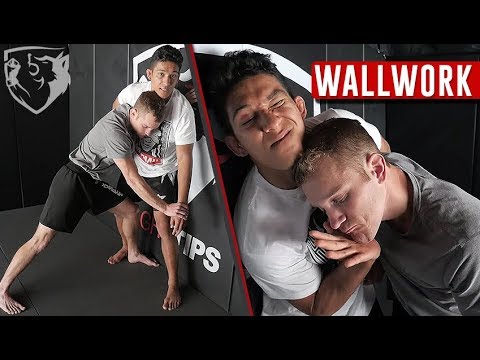
Wallwork: Fighting Off of the Cage & MMA Clinch
0
Standard Cage Brace·fightTIPS·Added by Admin
Fighting off the wall or cage is an art in itself, with very specific techniques that utilize leverage and control. 'The…
Перевод: standard cage brace
The Standard Cage Brace presses the back or hips against the cage fence while establishing underhooks or wrist control against the opponent, using the fence as a third point of support that prevents being driven backward. [1] The defender keeps the hips low and heavy, posts the feet wide for base, and uses the fence friction to maintain standing position while working to pummel for underhooks or create space for separation. [1],[2] The standard cage brace transforms a defensive cage position into a neutral one from which the defender can work to re-establish offence. [2],[3]
The cage brace is an MMA-specific defensive technique that uses the cage wall as a structural support to resist takedowns, effectively giving the defender a 'third leg' to base against. [1] Fighters who master the cage brace can defend against high-level wrestlers by distributing their weight between their legs and the cage wall. [2]
The cage brace is a standard MMA defence. [1]
Изображений для этой техники пока нет.
Войдите, чтобы предложить изображение.
Fighting off the wall or cage is an art in itself, with very specific techniques that utilize leverage and control. 'The…
Учебных курсов по этой технике пока нет.
Войдите, чтобы предложить курс.
Риск травмы для человека, к которому применяется техника
Sprawls and stuffs involve sudden body weight displacement; knee/hip strain risk
Уровень мастерства, необходимый для надёжного выполнения техники
Разрешена ли техника по основным соревновательным правилам
Freestyle Wrestling: A Complete Guide for Coaches and Wrestlers (Petrov, 1977)
Alias sources — [1] MMA Instruction Manual (Ryan & Snowden, 2010) [2] MMA Instruction Manual (Ryan & Snowden, 2010) [3] MMA Instruction Manual (Ryan & Snowden, 2010)
Effectiveness sources — [1] MMA Instruction Manual (Ryan & Snowden, 2010) [2] MMA Instruction Manual (Ryan & Snowden, 2010)
Standard katakana transliteration of Western martial arts terminology (外来語) — used in Japanese MMA, boxing, and BJJ communities
Alias sources — [1] MMA Instruction Manual (Ryan & Snowden, 2010) [2] MMA Instruction Manual (Ryan & Snowden, 2010) [3] MMA Instruction Manual (Ryan & Snowden, 2010)
Effectiveness sources — [1] MMA Instruction Manual (Ryan & Snowden, 2010) [2] MMA Instruction Manual (Ryan & Snowden, 2010)
reaction speed, structural body mechanics, defensive awareness
quick reflexes and conditioned defensive surfaces
varies — forearms (blocking), legs (movement), core (stability)
According to fightTIPS, the key defensive priorities are controlling your opponent's head, hands, and hips while changing levels. Making sure your own head doesn't get controlled is critical—if you can safely get your head in and establish control, you can start to move off the wall.
fightTIPS recommends keeping your hips centered underneath you, then lifting your knee up to break the grip. Once the grip is broken, you can swim an underhook or clear enough space to work off the cage immediately.
Spreading your legs wide and keeping your hips low is a key defensive principle—it creates a stable base to prevent being controlled and allows you to scoop your hips out or create space to escape, as fightTIPS explains.
Yes, according to fightTIPS, getting your head in and controlling your opponent's chin allows you to pressure them away and move around, even if they have double underhooks or their arms are in.
The Standard Cage Brace presses the back or hips against the cage fence while establishing underhooks or wrist control against the opponent, using the fence as a third point of support that prevents being driven backward. The defender keeps the hips low and heavy, posts the feet wide for base, and uses the fence friction to maintain standing position while working to pummel for underhooks or create space for separation.
The standard cage brace became a fundamental MMA defensive technique as cage wrestling evolved into a systematic discipline. Fighters who excelled at cage defence, like Georges St-Pierre and Fabricio Werdum, demonstrated how effective cage bracing could neutralise even elite wrestlers.
Unified MMA: разрешён — Legal defensive technique; IBJJF: разрешён — Legal; IJF: разрешён — Legal defensive action; WBC/Boxing: разрешён — Legal; WKF: разрешён — Legal; WT: разрешён — Legal
Оценка опасности 3/10. Moderate — sprawls and stuffs involve sudden body weight displacement; knee/hip strain risk
Стандартная цепочка подготовки: Anticipate the Attack → Execute Defence → Recover Stance → Counter or Disengage.
Стандартные контрприёмы: Timing — attack when the defence is recovering or between movements / Feint — use deception to create openings in the defensive structure / Angle Change — attack from an unexpected angle that the defence does not cover.
Распространённые варианты: Standard defence (primary defensive technique from the most common position); Reactive defence (triggered by the opponent's attack, minimal movement for …); Proactive defence (anticipating the attack and positioning to neutralise it …); Counter defence (using the defensive movement to create an immediate count…).
The cage brace is a standard MMA defence.
Основные ошибки, на которые стоит обратить внимание: Bracing without pressing the hips forward — hips back against the cage means the opponent controls you / Placing only one foot on the cage — both feet provide maximum stability / Framing with the hands instead of the forearms — forearms provide a stronger, more stable frame / Staying in the brace position longer than necessary — the brace is a platform for transition, not a resting place.
Standard Cage Brace также известен как Sutandādo Kēji Burēsu, Basic Cage Brace, Standard Wall Post, Fence Hand Post.