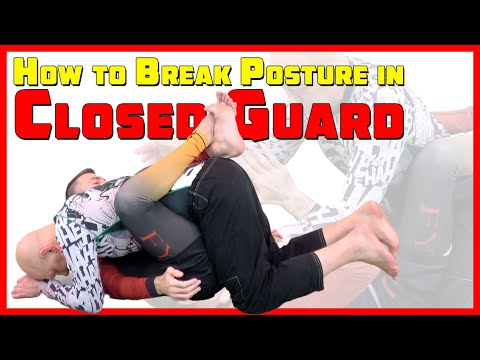
How to Break Posture in Closed Guard
0
Posture Break·Stephan Kesting
To attack from the closed guard with sweeps and submissions you need to first need to off-balance your opponent with Kuz…
Перевод: posture break
The Posture Break subfamily covers grip breaking techniques that deny or break the opponent's grips by using postural changes — standing up, posturing the spine upright, or changing the angle of the body — to make the grip mechanically unsustainable. [1] Posture-based grip breaking uses the strength of the legs and core to overpower the opponent's grip strength, as the large muscles of the lower body can generate far more force than the opponent's hands and forearms. [1],[2] This approach is particularly effective against collar grips and sleeve grips in the gi, where posturing away from the opponent strips the grip through distance. [2],[3]
Posture breaking pulls the opponent's posture down, disrupting their balance and creating offensive opportunities. [1]
Posture breaking is fundamental in guard play in BJJ. [1]
Used in BJJ competition. [1]
Изображений для этой техники пока нет.
Войдите, чтобы предложить изображение.
To attack from the closed guard with sweeps and submissions you need to first need to off-balance your opponent with Kuz…
Учебных курсов по этой технике пока нет.
Войдите, чтобы предложить курс.
Риск травмы для человека, к которому применяется техника
Submission defence involves resisting joint locks/chokes; risk of injury if defence fails or is delayed
Уровень мастерства, необходимый для надёжного выполнения техники
Разрешена ли техника по основным соревновательным правилам
Boxing (Edwin Haislet, 1940)
Alias sources — [1] Jiu-Jitsu University (Ribeiro, 2008) [2] Fundamentals of Brazilian Jiu-Jitsu (Danaher, 2012) [3] Kodokan Judo (Kano, 1986)
Effectiveness sources — [1] Jiu-Jitsu University (Ribeiro, 2008)
Standard katakana transliteration of Western martial arts terminology (外来語) — used in Japanese MMA, boxing, and BJJ communities
Alias sources — [1] Jiu-Jitsu University (Ribeiro, 2008) [2] Fundamentals of Brazilian Jiu-Jitsu (Danaher, 2012) [3] Kodokan Judo (Kano, 1986)
Effectiveness sources — [1] Jiu-Jitsu University (Ribeiro, 2008)
grip fighting technique, forearm endurance, timing
strong hands and forearms, quick stripping motions
forearm flexors/extensors, wrist rotators, biceps
Каждое движение в любом боевом искусстве обладает рядом универсальных свойств. Комбинируйте параметры ниже, чтобы найти нужный инструмент или сравнить аналоги из разных стилей.
According to Stephan Kesting, you should set your knees high and clamp them to your opponent's torso just under your armpit, creating a lever out of their spine rather than placing them lower on the body.
No—Stephan Kesting emphasizes that you should pull them slightly past you rather than directly forward, which improves safety for your face and gives you a dominant angle for subsequent attacks.
Stephan Kesting recommends resting your butt on your opponent's thigh close to their hips while climbing with your knees high, and using heel pressure against their lower back combined with hand grip fighting to control the pull.
The Posture Break subfamily covers grip breaking techniques that deny or break the opponent's grips by using postural changes — standing up, posturing the spine upright, or changing the angle of the body — to make the grip mechanically unsustainable. Posture-based grip breaking uses the strength of the legs and core to overpower the opponent's grip strength, as the large muscles of the lower body can generate far more force than the opponent's hands and forearms.
Posture-based grip breaking has been a fundamental technique in judo and BJJ, where using body position to overcome grip strength is a core tactical principle. It is taught as the primary grip breaking method for beginners due to its reliability and simplicity.
Unified MMA: разрешён — Legal defensive technique; IBJJF: разрешён — Legal — defensive techniques are fundamental to grappling; IJF: разрешён — Legal defensive action; ADCC: разрешён — Legal; UWW: разрешён — Legal defensive technique; FIAS Sport Sambo: разрешён — Legal
Оценка опасности 3/10. Moderate — submission defence involves resisting joint locks/chokes; risk of injury if defence fails or is delayed
Стандартная цепочка подготовки: Anticipate the Attack → Execute Defence → Recover Stance → Counter or Disengage.
Стандартные контрприёмы: Timing — attack when the defence is recovering or between movements / Feint — use deception to create openings in the defensive structure / Angle Change — attack from an unexpected angle that the defence does not cover.
Распространённые варианты: Standard defence (primary defensive technique from the most common position); Reactive defence (triggered by the opponent's attack, minimal movement for …); Proactive defence (anticipating the attack and positioning to neutralise it …); Counter defence (using the defensive movement to create an immediate count…).
Used in BJJ competition.
Основные ошибки, на которые стоит обратить внимание: Posturing up with a rounded back — the spine must be straight for effective posture / Leaning back to create distance instead of driving forward and up — leaning back compromises your base / Not using the hands on the hips as a structural support — hands on hips are the foundation of the posture position / Abandoning posture recovery after one failed attempt — the opponent will break posture repeatedly; keep recovering.
Posture Break также известен как Posuchā Bureiku, Posture Control Break, Kuzushi Break, Posture Disruption.