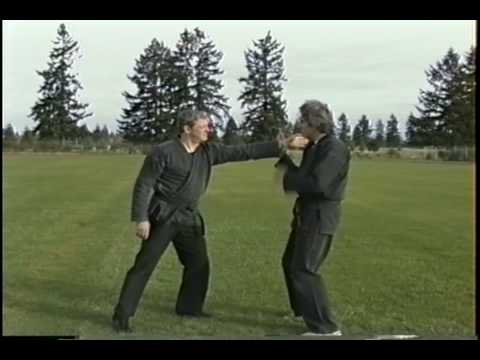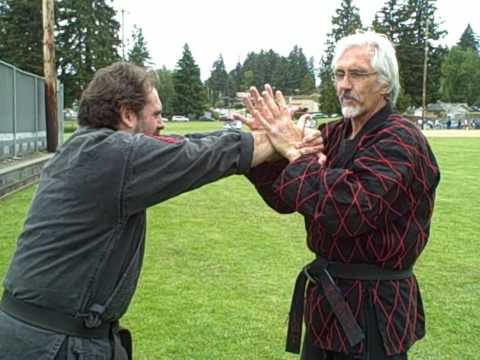
MCC - 083 Defending Front Grab to Both Arms
0
Arm Compression Defence·Spreadswings
Defending frontal grab to both arms. DISCLAIMER: These clips are for entertainment and general informational purposes o…
Перевод: arm compression defence
The Arm Compression Defence subfamily covers defences against bicep slicers and arm crushes, where the opponent places their shin, forearm, or wrist across the defender's bicep and folds the arm to compress the muscle between the bone surfaces. [1] The primary defence is preventing the arm from being folded past the point where compression becomes dangerous, either by straightening the arm or by positioning the elbow to avoid the fulcrum. [1],[2] If caught, the defender must relieve pressure by extending the arm or repositioning the fulcrum before the compression causes pain compliance or injury. [2],[3]
Arm compression defence prevents bicep slicers. [1]
Developed in BJJ. [1]
Used in BJJ competition. [1]
Изображений для этой техники пока нет.
Войдите, чтобы предложить изображение.
Defending frontal grab to both arms. DISCLAIMER: These clips are for entertainment and general informational purposes o…
Striking releases to wrist grabs. How to escape from a wrist grab, using striking counters. DISCLAIMER: These clips are…
Учебных курсов по этой технике пока нет.
Войдите, чтобы предложить курс.
Риск травмы для человека, к которому применяется техника
Submission defence involves resisting joint locks/chokes; risk of injury if defence fails or is delayed
Уровень мастерства, необходимый для надёжного выполнения техники
Разрешена ли техника по основным соревновательным правилам
Boxing (Edwin Haislet, 1940)
Alias sources — [1] Jiu-Jitsu University (Ribeiro, 2008) [2] Fundamentals of Brazilian Jiu-Jitsu (Danaher, 2012) [3] Brazilian Jiu-Jitsu: Theory and Technique (Gracie, 2001)
Effectiveness sources — [1] Jiu-Jitsu University (Ribeiro, 2008)
Mixed Japanese-Western terminology — combines traditional Japanese terms with katakana loanwords
Alias sources — [1] Jiu-Jitsu University (Ribeiro, 2008) [2] Fundamentals of Brazilian Jiu-Jitsu (Danaher, 2012) [3] Brazilian Jiu-Jitsu: Theory and Technique (Gracie, 2001)
Effectiveness sources — [1] Jiu-Jitsu University (Ribeiro, 2008)
reaction speed, structural body mechanics, defensive awareness
quick reflexes and conditioned defensive surfaces
varies — forearms (blocking), legs (movement), core (stability)
Каждое движение в любом боевом искусстве обладает рядом универсальных свойств. Комбинируйте параметры ниже, чтобы найти нужный инструмент или сравнить аналоги из разных стилей.
You can move sideways to reduce their power, or go underneath their grip to expose target areas for your counter. Going underneath is often preferable because it disrupts their power circle and creates an opening.
In the crane technique, when your opponent grabs you, you move your arms in a specific way while they're still holding on, using controlled arm movement rather than brute force to create the escape.
Yes—you can clap your hands together into a prayer hand position from a front grab to both arms, which allows you to open up your opponent and generate responses from that position.
The Arm Compression Defence subfamily covers defences against bicep slicers and arm crushes, where the opponent places their shin, forearm, or wrist across the defender's bicep and folds the arm to compress the muscle between the bone surfaces. The primary defence is preventing the arm from being folded past the point where compression becomes dangerous, either by straightening the arm or by positioning the elbow to avoid the fulcrum.
Arm compression defences developed alongside the increasing use of bicep slicers in submission grappling competition. The techniques became more systematically taught as compression locks gained recognition as legitimate and effective submissions in modern grappling.
Unified MMA: разрешён — Legal defensive technique; IBJJF: разрешён — Legal — defensive techniques are fundamental to grappling; IJF: разрешён — Legal defensive action; ADCC: разрешён — Legal; UWW: разрешён — Legal defensive technique; FIAS Sport Sambo: разрешён — Legal
Оценка опасности 3/10. Moderate — submission defence involves resisting joint locks/chokes; risk of injury if defence fails or is delayed
Стандартная цепочка подготовки: Anticipate the Attack → Execute Defence → Recover Stance → Counter or Disengage.
Стандартные контрприёмы: Timing — attack when the defence is recovering or between movements / Feint — use deception to create openings in the defensive structure / Angle Change — attack from an unexpected angle that the defence does not cover.
Распространённые варианты: Standard defence (primary defensive technique from the most common position); Reactive defence (triggered by the opponent's attack, minimal movement for …); Proactive defence (anticipating the attack and positioning to neutralise it …); Counter defence (using the defensive movement to create an immediate count…).
Used in BJJ competition.
Основные ошибки, на которые стоит обратить внимание: Bending the arm further to 'protect' the elbow — this is a natural instinct but it worsens the compression / Not controlling the opponent's lever (the forearm or shin behind your arm) — the lever creates the compression / Focusing on the pain rather than the escape mechanics — stay calm and address the lever arm and angle / Not recognizing the transition from armbar to bicep slicer — this common chain catches many grapplers off guard.
Arm Compression Defence также известен как Ude Appaku Difensu, Bicep Slicer Defence, Arm Crush Defence, Bicep Compression Defence.