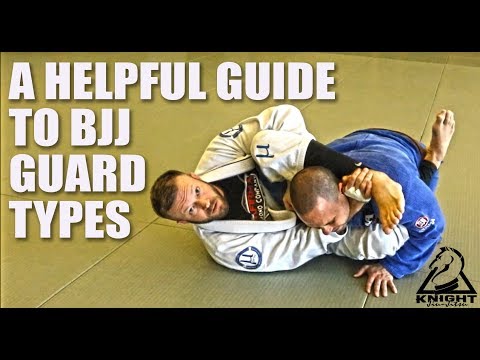
Helpful Guide to Common BJJ Guard Types
0
Long Guard·Knight Jiu-Jitsu
Here is a way I have found helpful in explaining and illustrating some basic guard types to students. There are so many …
Перевод: long guard
The Long Guard subfamily covers the defensive posture where one or both arms are extended forward, creating a barrier at maximum arm's length that disrupts the opponent's attacks before they develop full power. [1] The long guard uses the extended arm to obstruct the opponent's vision, block punches at their origin, and maintain distance through constant hand contact with the opponent's head or shoulders. [1],[2] The long guard is distinct from standard blocking because it is proactive — it disrupts attacks before they launch rather than intercepting them in flight. [2],[3]
The long guard extends the lead arm to create distance and obstruct the opponent's vision and attack line. [1]
The long guard is used in Muay Thai and MMA. [1]
The long guard is used in Muay Thai and MMA competition. [1]
Изображений для этой техники пока нет.
Войдите, чтобы предложить изображение.
Here is a way I have found helpful in explaining and illustrating some basic guard types to students. There are so many …
Учебных курсов по этой технике пока нет.
Войдите, чтобы предложить курс.
Риск травмы для человека, к которому применяется техника
Blocking and parrying absorb strike force; hand/forearm injury from repeated blocking
Уровень мастерства, необходимый для надёжного выполнения техники
Разрешена ли техника по основным соревновательным правилам
Karate-Do Kyohan: The Master Text (Gichin Funakoshi, 1935)
Alias sources — [1] Muay Thai: The Most Distinguished Art of Fighting (Kraitus, 1988) [2] MMA Instruction Manual (Ryan & Snowden, 2010) [3] MMA Instruction Manual (Ryan & Snowden, 2010)
Effectiveness sources — [1] Muay Thai Unleashed (Delp, 2006)
Standard katakana transliteration of Western martial arts terminology (外来語) — used in Japanese MMA, boxing, and BJJ communities
Alias sources — [1] Muay Thai: The Most Distinguished Art of Fighting (Kraitus, 1988) [2] MMA Instruction Manual (Ryan & Snowden, 2010) [3] MMA Instruction Manual (Ryan & Snowden, 2010)
Effectiveness sources — [1] Muay Thai Unleashed (Delp, 2006)
forearm conditioning, reaction speed, structural stability
dense bone structure, strong forearms
forearm flexors/extensors, deltoids, biceps, core (absorbing impact)
Каждое движение в любом боевом искусстве обладает рядом универсальных свойств. Комбинируйте параметры ниже, чтобы найти нужный инструмент или сравнить аналоги из разных стилей.
According to Knight Jiu-Jitsu, you should hide your arm so your opponent cannot attack it or shut down your position. Keeping your arm protected allows you to set up sweeps and submissions more effectively.
Knight Jiu-Jitsu explains that your head should rest on your opponent's leg while you hold either their belt or leg with your hands. This positioning helps you maintain control and prevents them from posturing up effectively.
From long guard, you can set up sweeps by getting your leg inside to scoop and back, or execute modified chokes. Knight Jiu-Jitsu emphasizes that effective attacks require pushing and pulling in complementary opposite directions.
The Long Guard subfamily covers the defensive posture where one or both arms are extended forward, creating a barrier at maximum arm's length that disrupts the opponent's attacks before they develop full power. The long guard uses the extended arm to obstruct the opponent's vision, block punches at their origin, and maintain distance through constant hand contact with the opponent's head or shoulders.
The long guard has roots in traditional martial arts and was used in early bare-knuckle boxing. It was revived in modern MMA by fighters like Jon Jones and Anderson Silva, who used the extended arm to disrupt opponents' offence and maintain range control.
Unified MMA: разрешён — Legal defensive technique; IBJJF: разрешён — Legal; IJF: разрешён — Legal defensive action; WBC/Boxing: разрешён — Legal; WKF: разрешён — Legal; WT: разрешён — Legal
Оценка опасности 3/10. Moderate — blocking and parrying absorb strike force; hand/forearm injury from repeated blocking
Стандартная цепочка подготовки: Anticipate the Attack → Execute Defence → Recover Stance → Counter or Disengage.
Стандартные контрприёмы: Timing — attack when the defence is recovering or between movements / Feint — use deception to create openings in the defensive structure / Angle Change — attack from an unexpected angle that the defence does not cover.
Распространённые варианты: High block (forearm raised above the head to protect against overhead…); Low block (forearm driven downward to deflect kicks or body strikes); Cross block (forearm crosses the body to protect the opposite side); Double forearm block (both forearms together for maximum coverage).
The long guard is used in Muay Thai and MMA competition.
Основные ошибки, на которые стоит обратить внимание: Keeping the arm extended passively — the long guard must actively post, push, or measure; passive extension is useless / Leaving the chin exposed behind a single extended arm — the rear hand MUST guard the chin / Extending the arm with the elbow up — the elbow should point down for structural strength / Using the long guard from too far away — it's a mid-range to clinch-range tool.
Long Guard также известен как Rongu Gādo, Extended Guard, Long Arm Guard, Thai Long Guard.