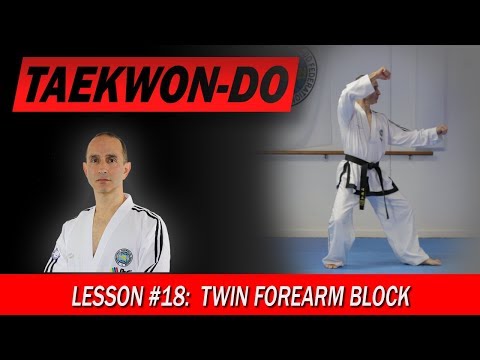
Twin Forearm Block - Taekwon-Do Lesson #18
0
Forearm Block·Donato Nardizzi·Added by Admin
This video shows you how to perform a Twin Forearm Block. Recommended for 8th kup grade studentsand above, the video exp…
Перевод: forearm block
The Forearm Block raises the forearm horizontally above the head to create a shield against high strikes, using the flat surface of the forearm to absorb and deflect incoming attacks. [1] Unlike the rising block (age uke) which sweeps the arm upward, the forearm block positions the arm in a fixed horizontal position overhead, creating a static barrier. [1],[2] The forearm block is commonly used in boxing and MMA as a protective ceiling against looping overhand punches and hammer fists in the ground-and-pound position. [2],[3]
The forearm block is one of the most practical defensive techniques across all striking arts, using the dense bone and muscle of the forearm to absorb or deflect incoming strikes. [1] In Muay Thai, the forearm block against body kicks is considered a staple defence because it protects the ribs while allowing the defender to remain balanced and ready to counter. [2]
Forearm blocks are standard defensive techniques in karate and other striking arts. [1]
Изображений для этой техники пока нет.
Войдите, чтобы предложить изображение.
This video shows you how to perform a Twin Forearm Block. Recommended for 8th kup grade studentsand above, the video exp…
Учебных курсов по этой технике пока нет.
Войдите, чтобы предложить курс.
Риск травмы для человека, к которому применяется техника
Blocking and parrying absorb strike force; hand/forearm injury from repeated blocking
Уровень мастерства, необходимый для надёжного выполнения техники
Разрешена ли техника по основным соревновательным правилам
Karate-Do Kyohan: The Master Text (Gichin Funakoshi, 1935)
Alias sources — [1] Championship Fighting (Dempsey, 1950) [2] Boxing Mastery (Hatmaker, 2004) [3] Fighter's Fact Book (Christensen, 2000)
Effectiveness sources — [1] Dynamic Karate (Nakayama, 1966) [2] Muay Thai: The Most Distinguished Art of Fighting (Kraitus, 1988)
Official karate technique names (和語/漢語)
Established Japanese martial arts naming convention — native Japanese term (和語/漢語)
Alias sources — [1] Championship Fighting (Dempsey, 1950) [2] Boxing Mastery (Hatmaker, 2004) [3] Fighter's Fact Book (Christensen, 2000)
Effectiveness sources — [1] Dynamic Karate (Nakayama, 1966) [2] Muay Thai: The Most Distinguished Art of Fighting (Kraitus, 1988)
forearm conditioning, reaction speed, structural stability
dense bone structure, strong forearms
forearm flexors/extensors, deltoids, biceps, core (absorbing impact)
According to Donato Nardizzi, you must twist both forearms at the same time, and they cannot both be in the same position—one arm should be on the inside slightly on top for the side block while the other is positioned differently for the rising block. Make sure the outer forearm of the side block is in line with the center of your shoulder, with the fist at shoulder level and elbow bent 45 degrees.
When you finish the block, your body should be half facing, and you should drop 70% of your weight onto the rear leg in L stance. The block should finish as you step down into L stance while breathing out at the same time.
Donato Nardizzi recommends jerking your abdomen at the end of the block to get more weight behind the side block, which increases power and effectiveness.
When performing the rising block as a primary block, your inner forearm should be 7 centimeters from your forehead and in line with your forehead, with your elbow bent at 45 degrees.
The Forearm Block raises the forearm horizontally above the head to create a shield against high strikes, using the flat surface of the forearm to absorb and deflect incoming attacks. Unlike the rising block (age uke) which sweeps the arm upward, the forearm block positions the arm in a fixed horizontal position overhead, creating a static barrier.
The forearm block is a practical defensive technique used across martial arts styles, with its simplest form being one of the most instinctive defensive reactions to overhead attacks. In MMA ground fighting, the forearm block became a critical defence against ground-and-pound strikes.
Unified MMA: разрешён — Legal defensive technique; WBC/Boxing: разрешён — Legal — blocking and evasion are core boxing skills; WKF: разрешён — Legal — blocking is a fundamental karate skill; Kyokushin: разрешён — Legal; WT: разрешён — Legal; WAKO: разрешён — Legal; K: разрешён — 1/GLORY — Legal; IFMA: разрешён — Legal
Оценка опасности 3/10. Moderate — blocking and parrying absorb strike force; hand/forearm injury from repeated blocking
Стандартная цепочка подготовки: Read the Attack → Position the Guard → Absorb Impact → Counter or Reset.
Стандартные контрприёмы: Feint — fake an attack to draw out the block then strike the opening / Level Change — switch attack levels to go around the blocking defence / Combination — throw multiple strikes to overwhelm the single defensive response.
Распространённые варианты: High block (forearm raised above the head to protect against overhead…); Low block (forearm driven downward to deflect kicks or body strikes); Cross block (forearm crosses the body to protect the opposite side); Double forearm block (both forearms together for maximum coverage).
Forearm blocks are standard defensive techniques in karate and other striking arts.
Основные ошибки, на которые стоит обратить внимание: Blocking with the inside of the forearm (soft side) — use the outside (ulna bone) for a harder surface / Extending the forearm away from the body — the block is strongest close to the body / Blocking with a single forearm for every strike — use both forearms and adjust the angle to match the incoming strike / Tensing the entire arm and shoulder — tense only at the moment of impact, then relax.
Forearm Block также известен как Zenwan Uke, Forearm Shield, Arm Block, Hard Forearm Cover.