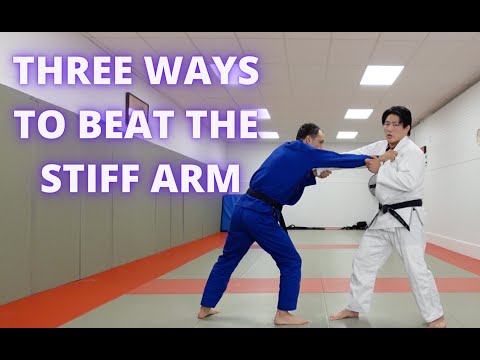
3 ways to beat the stiff arm
0
Standard Stiff Arm·Shintaro Higashi·Added by Admin
3 ways to beat the stiff arm https://www.youtube.com/channel/UCHDPspEXGaVTwxHL11Tsygw https://judofanatics.com/collect…
Перевод: standard stiff arm
The Standard Stiff Arm extends the arm fully against the opponent's collar bone, bicep, or shoulder, locking the elbow and using skeletal alignment to maintain distance without relying on muscular effort. [1] The placement of the stiff arm is critical — targeting bony structures like the collar bone or shoulder provides a stable pushing surface, while targeting soft tissue like the chest allows the opponent to walk through the frame. [1],[2] The standard stiff arm is combined with hip movement to create space for reguarding or standing up. [2],[3]
The stiff arm frame is a fundamental defensive technique. [1]
Used in BJJ competition. [1]
Изображений для этой техники пока нет.
Войдите, чтобы предложить изображение.
3 ways to beat the stiff arm https://www.youtube.com/channel/UCHDPspEXGaVTwxHL11Tsygw https://judofanatics.com/collect…
This video is directed toward one of my newer adaptive self defense clients, Nathan. I am demonstrating here some of the…
Bob Rea teaches a judo clinic at Windsong dojo. This lesson series focuses on fixing bad habits in experienced judo stud…
The standard stiff arm is a defensive framing technique in which a standing grappler extends one arm rigidly to maintain distance and prevent an opponent from closing in or establishing grips. Shintaro Higashi emphasizes that the stiff arm leverages postural strength—particularly the extended elbow position—making it extremely difficult to break through with conventional two-handed grip attacks. Higashi teaches multiple counters: applying counter-pressure to extend the opponent further, then releasing and moving away to collapse their structure; rolling the shoulder downward to compromise the arm angle and reduce pushing power; and attacking the elbow joint with a punching motion to destabilize the frame before closing distance. He notes that breaking the stiff arm requires chaining multiple techniques together rather than relying on a single solution, and emphasizes that timing attacks with balance disruption (kazushi) creates openings to peel off the hand. Kaze Uta Budo Kai's Bob Rea approaches the problem from a different angle, focusing on continuous offensive movement and positional recovery to mentally reset the opponent; he suggests that rather than directly fighting the strength, practitioners should move circularly and avoid direct arm-to-arm contests, instead working around the extended arms through footwork and sequential attacking entries that force defensive reactions. Both instructors agree that direct strength-against-strength approaches fail, though they diverge on whether the solution emphasizes technical arm manipulation (Higashi) or positional flow and evasion (Rea). JingShenKuoshu's content on rolling elbows addresses related defensive principles but focuses on close-range elbow strikes rather than grip-fighting mechanics, and thus provides limited direct application to standard stiff-arm defense.
Сформировано на основе 3 инструкторов
Учебных курсов по этой технике пока нет.
Войдите, чтобы предложить курс.
Риск травмы для человека, к которому применяется техника
Guard retention uses frames and hip movement; minimal direct injury risk
Уровень мастерства, необходимый для надёжного выполнения техники
Разрешена ли техника по основным соревновательным правилам
Jiu-Jitsu University (Saulo Ribeiro, 2008)
Alias sources — [1] Jiu-Jitsu University (Ribeiro, 2008) [2] Fundamentals of Brazilian Jiu-Jitsu (Danaher, 2012) [3] Brazilian Jiu-Jitsu: Theory and Technique (Gracie, 2001)
Effectiveness sources — [1] Jiu-Jitsu University (Ribeiro, 2008) [2] Fundamentals of Brazilian Jiu-Jitsu (Danaher, 2012)
Standard katakana transliteration of Western martial arts terminology (外来語) — used in Japanese MMA, boxing, and BJJ communities
Alias sources — [1] Jiu-Jitsu University (Ribeiro, 2008) [2] Fundamentals of Brazilian Jiu-Jitsu (Danaher, 2012) [3] Brazilian Jiu-Jitsu: Theory and Technique (Gracie, 2001)
Effectiveness sources — [1] Jiu-Jitsu University (Ribeiro, 2008) [2] Fundamentals of Brazilian Jiu-Jitsu (Danaher, 2012)
structural arm strength, forearm density, timing
strong arms and elbows for load-bearing frames
triceps, deltoids, forearms, core
According to Shintaro Higashi, when an opponent has their hand posting in a stiff arm position, they are insanely strong in that extended arm posture. This makes it very difficult to simply break the grip, especially if you attempt a two-handed grip break, because the opponent can maintain control with both hands while you're committed to just one.
Shintaro Higashi recommends pushing into the stiff arm to create counter force, then releasing and moving your body backward to fully extend their arm. Once their arm is completely extended, you can take their hand off more easily. You can also roll your shoulder to bring their hand down and compromise the angle of their arm, making it less powerful.
When facing a strong stiff arm with double collar control, Shintaro Higashi advises attacking the bend of the elbow joint rather than trying to fuss with the sleeve. Push into them, feel the pressure, then punch the elbow and bring your elbow to the inside—this removes the pushing power from their arm and opens up your opportunity for throws.
The Standard Stiff Arm extends the arm fully against the opponent's collar bone, bicep, or shoulder, locking the elbow and using skeletal alignment to maintain distance without relying on muscular effort. The placement of the stiff arm is critical — targeting bony structures like the collar bone or shoulder provides a stable pushing surface, while targeting soft tissue like the chest allows the opponent to walk through the frame.
The standard stiff arm frame is a fundamental defensive technique across all grappling arts, from wrestling to BJJ to MMA ground defence. It is one of the first defensive tools taught to beginners for managing pressure from top position.
Unified MMA: разрешён — Legal defensive technique; IBJJF: разрешён — Legal — defensive techniques are fundamental to grappling; IJF: разрешён — Legal defensive action; ADCC: разрешён — Legal; UWW: разрешён — Legal defensive technique; FIAS Sport Sambo: разрешён — Legal
Оценка опасности 2/10. Low — guard retention uses frames and hip movement; minimal direct injury risk
Стандартная цепочка подготовки: Anticipate the Attack → Execute Defence → Recover Stance → Counter or Disengage.
Стандартные контрприёмы: Timing — attack when the defence is recovering or between movements / Feint — use deception to create openings in the defensive structure / Angle Change — attack from an unexpected angle that the defence does not cover.
Распространённые варианты: Standard defence (primary defensive technique from the most common position); Reactive defence (triggered by the opponent's attack, minimal movement for …); Proactive defence (anticipating the attack and positioning to neutralise it …); Counter defence (using the defensive movement to create an immediate count…).
Used in BJJ competition.
Основные ошибки, на которые стоит обратить внимание: Locking the elbow fully straight — this invites arm bar attacks; keep a micro-bend / Pushing on the face in training — frame on the shoulder or chest / Holding the stiff arm without hip movement — the arm creates space; the hips must use it / Leaving the arm extended for too long — retract within 1-2 seconds to avoid arm attacks.
Standard Stiff Arm также известен как Sutandādo Sutifu Āmu, Basic Stiff Arm, Straight Arm Post, Locked Arm Frame.