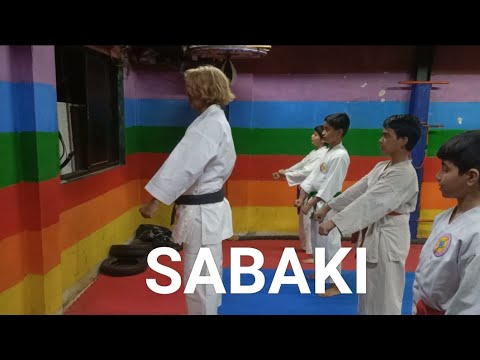
SABAKI - TYPES OF DEFENCE MOVEMENT
0
Sabaki Evasive Movement·KARATE ORGANIZATION INDIA
Перевод: Handling / management / smooth dispatch
Sabaki is a family of evasive footwork patterns from Japanese martial arts (especially Aikido, Kyokushin karate, and the Ashihara/Enshin lineage) that move the defender off the opponent's attack line and into an angle that simultaneously disrupts the attacker's balance and sets up a counter. [1],[2] Rather than blocking force with force, sabaki teaches the practitioner to redirect the engagement: pivoting, side-stepping, or circling such that the attacker's incoming energy passes harmlessly while the defender ends up in a flanking or rear-quarter position from which a counterattack is naturally available. [1],[3] The four canonical sabaki directions (forward / backward / left-flank / right-flank) form the basic four-corner movement framework; advanced sabaki adds rotational components and tempo manipulation. [2]
Sabaki as a defensive principle has roots in classical Japanese martial arts under the broader term 'tai sabaki' (body handling), present in Daito-ryu aiki-jujutsu, classical jujutsu, and karate kata. [1],[2] It was codified into a structured four-direction framework by Hideyuki Ashihara when he founded Ashihara Karate (split from Kyokushin in 1980), and further evolved by Joko Ninomiya who founded Enshin Karate in 1988. [1],[3] Modern sabaki-based competition formats (Sabaki Challenge tournaments) test the principle directly. [3]
Sabaki is a core defensive principle in modern Kyokushin-derived karate styles and remains foundational in Aikido and traditional jujutsu. [1],[2] Its effectiveness in full-contact striking has been demonstrated in the annual Sabaki Challenge tournament (Enshin Karate's flagship event, held since 1989) where the principle is the explicit competitive premise — fighters who excel at off-line angle-change consistently outperform purely linear strikers. [3] Beyond its source styles, sabaki has been increasingly visible in MMA, where lateral footwork and 45-degree off-line steps against linear strikers map directly onto sabaki principles. [4] Notable MMA practitioners cited as showing sabaki-influenced footwork include Lyoto Machida (whose father is a Shotokan karate practitioner) and Stephen 'Wonderboy' Thompson (point-karate background). [4] In self-defense contexts, sabaki principles inform the Krav Maga 'angle-of-defense' framework and several reality-based self-defense systems.
Classical Japanese tai sabaki (Daito-ryu aiki-jujutsu, classical jujutsu) → Mas Oyama's Kyokushin Karate (1953) → Hideyuki Ashihara's split from Kyokushin and founding of Ashihara Karate (1980) → Joko Ninomiya (formerly Ashihara) founded Enshin Karate (1988) and codified the Sabaki Method into a structured four-direction system. [1],[3] Independent parallel development in Aikido under Morihei Ueshiba via tai sabaki (1920s onward). [2] Modern MMA influence visible in Lyoto Machida (Shotokan-influenced sabaki) and Stephen Thompson (point-karate angle attacks). [4]
Sabaki Challenge (Enshin Karate's annual flagship tournament since 1989, hosted in Denver) tests the principle directly under full-contact bare-knuckle rules. [3] In 2024, the Sabaki World Championship draws competitors from 30+ countries. Notable Sabaki Challenge champions: Joko Ninomiya himself in early editions; modern champions include various Enshin instructors. Beyond its native tournament, sabaki principles have appeared in Kyokushin-rules competitions (KWU, IKO Worlds), and as crossover technique in MMA (Lyoto Machida UFC reign 2008-2011, Stephen Thompson UFC welterweight title contention 2016-2018). [4]
Изображений для этой техники пока нет.
Войдите, чтобы предложить изображение.
Учебных курсов по этой технике пока нет.
Войдите, чтобы предложить курс.
Риск травмы для человека, к которому применяется техника
Defensive footwork — no inherent danger to either practitioner
Уровень мастерства, необходимый для надёжного выполнения техники
Разрешена ли техника по основным соревновательным правилам
Ashihara — Fighting Karate (1985) and Ninomiya — Sabaki Method: Karate in the Inner Circles (1991)
Description sources — [1] Ashihara Karate Sabaki Method documentation; [2] traditional tai sabaki in jujutsu / aikido; [3] Enshin Karate Sabaki Challenge competition format
Official karate technique names (和語/漢語)
Established Japanese martial arts naming convention — native Japanese term (和語/漢語)
Description sources — [1] Ashihara Karate Sabaki Method documentation (Hideyuki Ashihara's books); [2] traditional tai sabaki in jujutsu / aikido (Ueshiba Budo, classical Daito-ryu sources); [3] Enshin Karate Sabaki Challenge competition format and tournament archive; [4] modern MMA crossover analysis (Joe Rogan / Bas Rutten commentary on Machida and Wonderboy footwork)
Aikido technique naming conventions
Description sources — [1] Ashihara Karate Sabaki Method documentation (Hideyuki Ashihara's books); [2] traditional tai sabaki in jujutsu / aikido (Ueshiba Budo, classical Daito-ryu sources); [3] Enshin Karate Sabaki Challenge competition format and tournament archive; [4] modern MMA crossover analysis (Joe Rogan / Bas Rutten commentary on Machida and Wonderboy footwork)
timing and reaction speed, hip mobility, foot agility, spatial awareness
hip rotators (gluteus medius, piriformis), calves (push-off), tibialis anterior (stopping the step cleanly)
Sabaki is most associated today with Ashihara Karate (founded 1980 by Hideyuki Ashihara, who split from Kyokushin) and Enshin Karate (founded 1988 by Joko Ninomiya, formerly Ashihara), where it's been codified as a four-direction framework with explicit defensive-into-counter pairings. The Sabaki Challenge tournament (held annually since 1989) is the flagship competition format showcasing it. Aikido and classical jujutsu use the broader 'tai sabaki' (体捌き, 'body handling') under the same root concept.
Sabaki is a family of evasive footwork patterns from Japanese martial arts (especially Aikido, Kyokushin karate, and the Ashihara/Enshin lineage) that move the defender off the opponent's attack line and into an angle that simultaneously disrupts the attacker's balance and sets up a counter. Rather than blocking force with force, sabaki teaches the practitioner to redirect the engagement: pivoting, side-stepping, or circling such that the attacker's incoming energy passes harmlessly while the defender ends up in a flanking or rear-quarter position from which a counterattack is naturally available.
Sabaki as a defensive principle has roots in classical Japanese martial arts under the broader term 'tai sabaki' (body handling), present in Daito-ryu aiki-jujutsu, classical jujutsu, and karate kata. It was codified into a structured four-direction framework by Hideyuki Ashihara when he founded Ashihara Karate (split from Kyokushin in 1980), and further evolved by Joko Ninomiya who founded Enshin Karate in 1988.
All competition rule sets: разрешён — footwork patterns are not regulated; sabaki principles inform legal evasive m…
Оценка опасности 1/10. Defensive footwork — no inherent danger to either practitioner
Стандартная цепочка подготовки: Establish Defensive Posture → Read Incoming Attack Type and Line → Initiate Lateral or Rotational Step → Land in Angled Position → Counterattack from the Flank.
Стандартные контрприёмы: Tracking footwork — attacker mirrors the angle change to maintain alignment / Initiating combinations rather than single committed strikes — sabaki is harder against multi-attack pressure / Closing pressure that doesn't commit a single line — limits the off-line opportunity.
Распространённые варианты: Tai Sabaki (Aikido / classical) (full-body angle change, often combined with a wrist or el…); Ashihara Sabaki (Hideyuki Ashihara's codification into a four-zone (forwar…); Enshin Sabaki (Joko Ninomiya's evolution emphasising 90° flanking entrie…); Pivot-Step Sabaki (single-foot pivot variant for tight close-range exchanges); Step-Through Sabaki (full directional step for longer-range engagements).
Sabaki Challenge (Enshin Karate's annual flagship tournament since 1989, hosted in Denver) tests the principle directly under full-contact bare-knuckle rules. In 2024, the Sabaki World Championship draws competitors from 30+ countries.
Основные ошибки, на которые стоит обратить внимание: Stepping straight back instead of off-line — keeps the defender on the attacker's line and just creates distance for … / Stepping too far away — loses counter-attack range; the goal is angle, not retreat / Squaring the hips during the step — defeats the side-on body protection sabaki provides / Telegraphed movement — sabaki only works if it's reactive and unannounced.
Sabaki Evasive Movement также известен как Sabaki, Sabaki-Method, Tai Sabaki, Body Management, Off-Line Movement.