If You're Smaller, Footwork is Everything in Self Defense
0
Footwork Defence·Kevin Goat Self Defense
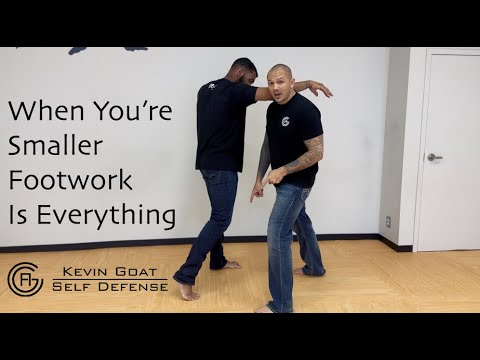
Against a larger attacker it's unlikely you'll be able to use muscle to protect yourself, knowing how to move can be the…
Перевод: Footwork defence
Footwork Defence covers all defensive techniques that use movement, angles, and distance management to avoid or mitigate attacks — the most sophisticated form of defence, relying on not being where the attack lands rather than blocking or absorbing it. [1] Footwork-based defence includes lateral movement, pivots, retreating steps, angle changes, and the subtle weight shifts that keep a fighter just outside the opponent's effective range while remaining in range to counter-attack. [1],[2] Masters of footwork defence — Willie Pep, Pernell Whitaker, Vasyl Lomachenko, and Muhammad Ali — are regarded as the greatest defensive fighters in combat sports history because they could make opponents miss repeatedly without using their hands, demoralising attackers while conserving energy. [2],[3] In fencing, footwork (la marche, la retraite, the fleche) is considered the foundation upon which all offensive and defensive actions are built. [3]
Defensive footwork has been central to combat arts since the earliest formalised systems — fencing developed the most codified footwork system (French school, 17th–18th centuries), while boxing refined footwork for hand-combat range. [1] In boxing, defensive footwork was revolutionised by fighters like Jack Johnson (early 1900s), who used movement to frustrate aggressive opponents. [1],[2] Muhammad Ali (1960s–70s) transformed boxing footwork with his 'float like a butterfly' movement style, and Pernell Whitaker (1980s–90s) and Vasyl Lomachenko (2010s–present) further advanced the art. [2],[3] In MMA, footwork defence gained importance as the sport matured beyond the 'stand and trade' era into more technically sophisticated striking exchanges. [3]
Footwork defence is the most energy-efficient form of defence — it avoids damage entirely rather than absorbing it, preserving both health and energy over long fights and careers. [1] Pernell Whitaker's defensive footwork was so effective that he is considered pound-for-pound the greatest defensive fighter in boxing history, losing only 4 fights in a 46-fight career. [2] In MMA, fighters with superior footwork (Israel Adesanya, Max Holloway, Valentina Shevchenko) consistently outperform opponents in lengthy title reigns. [3]
Изображений для этой техники пока нет.
Войдите, чтобы предложить изображение.
Against a larger attacker it's unlikely you'll be able to use muscle to protect yourself, knowing how to move can be the…
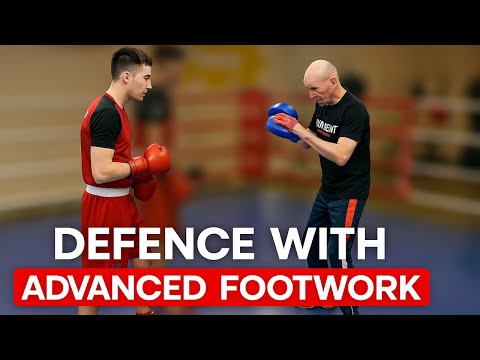
Bending back and slip, make angle and attack.
Учебных курсов по этой технике пока нет.
Войдите, чтобы предложить курс.
Риск травмы для человека, к которому применяется техника
Very low — footwork defence is the safest defensive technique because it avoids contact entirely; the primary risk is misjudging distance (stepping too far back and being out of counter range, or not moving enough and getting clipped)
Уровень мастерства, необходимый для надёжного выполнения техники
Разрешена ли техника по основным соревновательным правилам
Not yet documented
Not yet documented
Tao of Jeet Kune Do (Bruce Lee, 1975)
Description sources — [1] Tao of Jeet Kune Do (Lee, 1975) on footwork as foundation [2] Championship Fighting (Dempsey, 1950) [3] The Art and Science of Fencing (Gaugler, 2004)
History sources — [1] French fencing school traditions [2] Jack Johnson, Muhammad Ali boxing records [3] Modern MMA evolution
Description sources — [1] Tao of Jeet Kune Do (Lee, 1975) on footwork as foundation [2] Championship Fighting (Dempsey, 1950) [3] The Art and Science of Fencing (Gaugler, 2004)
History sources — [1] French fencing school traditions [2] Jack Johnson, Muhammad Ali boxing records [3] Modern MMA evolution
quick feet, balance, spatial awareness, cardio endurance (constant movement is demanding)
long legs (covering more distance per step), light build (easier to move quickly), good proprioception
calves (push-off for lateral movement), quadriceps (supporting bent-knee stance), hip flexors (quick directional changes), ankles (pivoting)
Каждое движение в любом боевом искусстве обладает рядом универсальных свойств. Комбинируйте параметры ниже, чтобы найти нужный инструмент или сравнить аналоги из разных стилей.
The Movement Defence family covers body movement techniques that avoid strikes through head movement, torso displacement, and body angles rather than blocking — the most sophisticated and energy-efficient form of defence in striking arts. [1] Movement defence includes slipping (moving the head laterally off the punch line), bobbing and weaving (dipping under hooks and rising on the other side), pulling (leaning back to make strikes fall short), ducking (dropping the level under high attacks), and the lean-back (shifting weight to the rear foot). [1,2] These techniques are considered superior to blocking because they avoid damage entirely (rather than absorbing reduced impact through a block), leave both hands free for immediate counter-attacks, and conserve energy compared to absorbing strikes. [2,3] Masters of movement defence — Muhammad Ali's head movement, Pernell Whitaker's body evasion, and Anderson Silva's Matrix-like leaning — represent the highest level of striking defence achievable. [3]
Sabaki is a family of evasive footwork patterns from Japanese martial arts (especially Aikido, Kyokushin karate, and the Ashihara/Enshin lineage) that move the defender off the opponent's attack line and into an angle that simultaneously disrupts the attacker's balance and sets up a counter. [1,2] Rather than blocking force with force, sabaki teaches the practitioner to redirect the engagement: pivoting, side-stepping, or circling such that the attacker's incoming energy passes harmlessly while the defender ends up in a flanking or rear-quarter position from which a counterattack is naturally available. [1,3] The four canonical sabaki directions (forward / backward / left-flank / right-flank) form the basic four-corner movement framework; advanced sabaki adds rotational components and tempo manipulation. [2]
Defensive footwork — lateral movement, pivots, and angles — determines whether a fighter gets hit. In boxing, the pivot is the most important single defensive movement. In MMA, the 45-degree angle step is the primary evasive footwork. (Dempsey, Championship Fighting; MMA training manuals)
You should bend back diagonally rather than twist your body to the side, as twisting causes you to lose balance and stay in place. The Russian School of Boxing emphasizes that bending forward and diagonally while stepping keeps you balanced and mobile.
The Russian School of Boxing stresses that once you've made the effort to improve your position through footwork defence, returning to the line of fire wastes that effort and puts you back in danger. Instead, use your new angle to counter-punch or land strikes from the side.
Kevin Goat Self Defense explains that by stepping through your opponent's feet and cutting the angle properly, you can position yourself at 90 degrees to their stance with minimal effort, which destabilizes their balance and gives you control.
The Russian School of Boxing teaches that you must combine footwork with body movement—bend back first, then step, then accelerate—rather than making a standalone step, otherwise your body will fall behind and you'll remain in place.
Footwork Defence covers all defensive techniques that use movement, angles, and distance management to avoid or mitigate attacks — the most sophisticated form of defence, relying on not being where the attack lands rather than blocking or absorbing it. Footwork-based defence includes lateral movement, pivots, retreating steps, angle changes, and the subtle weight shifts that keep a fighter just outside the opponent's effective range while remaining in range to counter-attack.
Defensive footwork has been central to combat arts since the earliest formalised systems — fencing developed the most codified footwork system (French school, 17th–18th centuries), while boxing refined footwork for hand-combat range. In boxing, defensive footwork was revolutionised by fighters like Jack Johnson (early 1900s), who used movement to frustrate aggressive opponents.
Unified MMA: разрешён — Legal defensive technique; WBC/Boxing: разрешён — Legal — blocking and evasion are core boxing skills; WKF: разрешён — Legal — blocking is a fundamental karate skill; Kyokushin: разрешён — Legal; WT: разрешён — Legal; WAKO: разрешён — Legal; K: разрешён — 1/GLORY — Legal; IFMA: разрешён — Legal
Оценка опасности 1/10. Very low — footwork defence is the safest defensive technique because it avoids contact entirely; the primary risk is misjudging distance (stepping too far back and being out of counter range, or not moving enough and getting clipped)
Распространённые варианты: Lateral movement (stepping sideways to take the head off the centre line; t…); Pivot (planting one foot and rotating around it to change facing…); Pull-back (shifting weight backward to make punches fall short witho…); Backstep (stepping backward to create distance; simple but effectiv…); Circling (continuous movement around the opponent, preventing them …); V-step (stepping diagonally forward at an angle, simultaneously e…); Fencing footwork (advance (la marche), retreat (la retraite), balestra (jum…).
Footwork-dominant fighters consistently achieve the longest championship reigns — Muhammad Ali, Floyd Mayweather, Pernell Whitaker, and Vasyl Lomachenko in boxing; Israel Adesanya and Valentina Shevchenko in MMA.
Основные ошибки, на которые стоит обратить внимание: Running instead of fighting — excessive movement that avoids engagement entirely is penalised in many rulesets and pr… / Crossing the feet — bringing the feet together or crossing them during movement destroys balance and creates vulnerab… / Moving straight backward only — backing up in a straight line allows the opponent to chase in a straight line; angle … / Flat-footed movement — heavy, flat-footed steps are slow; stay on the balls of the feet for quick, responsive movement.
Footwork Defence также известен как Futtowāku Difensu, Footwork Defence, Evasive Footwork, Defensive Movement.