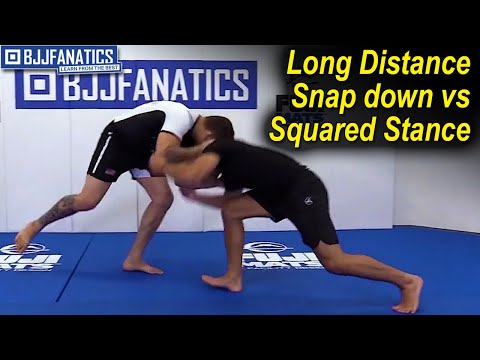
Long Distance Snap down vs Squared Stance by Nick Rodriguez
0
Stance-Distance Control·BJJ Fanatics
LONG DISTANCE SNAP DOWN VS SQUARED STANCE https://bjjfanatics.com In this Jiu Jitsu training video, Nicky Rodgriguez te…
Перевод: distance control
The Stance-Distance Control family covers defensive techniques that manage the spatial relationship between fighters through stance selection, positional awareness, and range management. [1] Distance control is the most fundamental defensive concept in fighting — if the opponent cannot reach the defender, no attack can land. [1],[2] This family includes out-fighting range control (maintaining long range), cage/ring awareness (using the fighting space intelligently), and stance adjustments that optimise defensive positioning. [2],[3]
Distance control has been the foundation of fencing theory for centuries, with the concept of 'measure' (the distance between fighters) being one of the oldest tactical principles in combat. [1] Boxing adopted distance management as a core defensive principle, and MMA expanded it to include cage positioning and octagon control. [2],[3]
Distance control theory is central to boxing, fencing, and all striking arts. [1]
Distance control is a key performance indicator in MMA analytics. [1]
Изображений для этой техники пока нет.
Войдите, чтобы предложить изображение.
LONG DISTANCE SNAP DOWN VS SQUARED STANCE https://bjjfanatics.com In this Jiu Jitsu training video, Nicky Rodgriguez te…
Учебных курсов по этой технике пока нет.
Войдите, чтобы предложить курс.
Риск травмы для человека, к которому применяется техника
Evasion techniques avoid contact entirely; lowest injury risk of all techniques
Уровень мастерства, необходимый для надёжного выполнения техники
Разрешена ли техника по основным соревновательным правилам
Boxing (Edwin Haislet, 1940)
Alias sources — [1] Championship Fighting (Dempsey, 1950) [2] Championship Fighting (Dempsey, 1950) [3] Championship Fighting (Dempsey, 1950) [4] Boxing Mastery (Hatmaker, 2004)
Effectiveness sources — [1] Boxing: The Complete Guide to Training and Fitness (Hatmaker, 2004) [2] Mastering Jujitsu (Gracie & Danaher, 2003)
Official karate technique names (和語/漢語)
Established Japanese martial arts naming convention — native Japanese term (和語/漢語)
Alias sources — [1] Championship Fighting (Dempsey, 1950) [2] Championship Fighting (Dempsey, 1950) [3] Championship Fighting (Dempsey, 1950) [4] Boxing Mastery (Hatmaker, 2004)
Effectiveness sources — [1] Boxing: The Complete Guide to Training and Fitness (Hatmaker, 2004) [2] Mastering Jujitsu (Gracie & Danaher, 2003)
agility, quick directional changes, balance in motion
light feet, strong calves and ankles
calves, tibialis anterior, quadriceps, hip stabilisers
Каждое движение в любом боевом искусстве обладает рядом универсальных свойств. Комбинируйте параметры ниже, чтобы найти нужный инструмент или сравнить аналоги из разных стилей.
The Cage-Ring Awareness subfamily covers defensive techniques related to spatial awareness within the fighting area — understanding and controlling one's position relative to the cage walls, ropes, corners, and centre of the fighting surface. [1] Ring and cage awareness is a critical defensive skill because being trapped against the cage or in a corner severely limits defensive movement options and exposes the fighter to sustained offence. [1,2] Defensive cage awareness includes recognising when the cage is approaching, initiating lateral movement or pivots before being pinned, and using the cage strategically for stand-ups and escapes when pressed against it. [2,3]
The Out-Fighting Range Control subfamily covers defensive techniques for maintaining long fighting range, keeping the opponent at the maximum effective distance where the defender's longest weapons can reach but the opponent's shorter weapons cannot. [1] Out-fighting is a range-based defensive strategy where the fighter uses jabs, teeps (push kicks), and footwork to maintain distance and prevent the opponent from closing to their preferred range. [1,2] This defensive approach is particularly effective for taller fighters with longer reach who want to fight at their range advantage. [2,3]
Stance and distance control — maintaining the optimal range for your techniques while denying the opponent theirs — is the fundamental strategic concept in all striking arts. In boxing, 'fighting at your range' determines who wins the exchange. (Dempsey, Championship Fighting; boxing and MMA manuals)
Nick Rodriguez emphasizes staying on the outside and working from a distance to avoid the danger zone, since a heavier opponent makes it much harder to escape from bad positions. Work control sequences like collar tie and armpit grips from the far distance rather than closing the gap prematurely.
Nick Rodriguez demonstrates a push-pull pattern: grab your opponent's collar tie with your lead hand and control the armpit with your other arm, then execute a push-pull motion to snap them from distance. Repeat this sequence 2-3 times on both sides (left and right lead) to set up your takedown.
The Stance-Distance Control family covers defensive techniques that manage the spatial relationship between fighters through stance selection, positional awareness, and range management. Distance control is the most fundamental defensive concept in fighting — if the opponent cannot reach the defender, no attack can land.
Distance control has been the foundation of fencing theory for centuries, with the concept of 'measure' (the distance between fighters) being one of the oldest tactical principles in combat. Boxing adopted distance management as a core defensive principle, and MMA expanded it to include cage positioning and octagon control.
Unified MMA: разрешён — Legal defensive technique; WBC/Boxing: разрешён — Legal — blocking and evasion are core boxing skills; WKF: разрешён — Legal — blocking is a fundamental karate skill; Kyokushin: разрешён — Legal; WT: разрешён — Legal; WAKO: разрешён — Legal; K: разрешён — 1/GLORY — Legal; IFMA: разрешён — Legal
Оценка опасности 1/10. Low — evasion techniques avoid contact entirely; lowest injury risk of all techniques
Стандартная цепочка подготовки: Anticipate the Attack → Execute Defence → Recover Stance → Counter or Disengage.
Стандартные контрприёмы: Timing — attack when the defence is recovering or between movements / Feint — use deception to create openings in the defensive structure / Angle Change — attack from an unexpected angle that the defence does not cover.
Распространённые варианты: Standard defence (primary defensive technique from the most common position); Reactive defence (triggered by the opponent's attack, minimal movement for …); Proactive defence (anticipating the attack and positioning to neutralise it …); Counter defence (using the defensive movement to create an immediate count…).
Distance control is a key performance indicator in MMA analytics.
Основные ошибки, на которые стоит обратить внимание: Standing square (feet side by side) — maintain a staggered stance for balance, mobility, and smaller target profile / Standing flat-footed — stay on the balls of the feet for quick movement in any direction / Fighting at the opponent's preferred distance — impose your own range preference through footwork and jabs / Ignoring cage/ring position — backing into the ropes or cage eliminates your retreat option.
Stance-Distance Control также известен как Ma-ai Kanri, Range Management, Spacing, Distance Fighting, Zoning.