JKD: Free Video Lesson #6...Kicks You MUST Know!
0
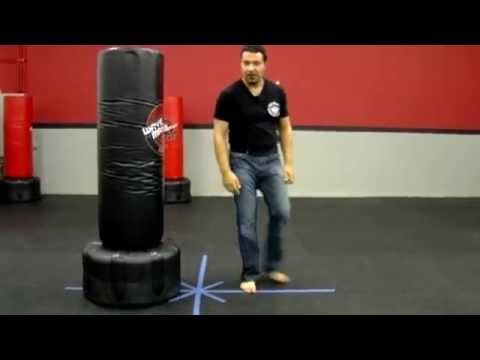
Standard Retreating Step·Xtreme Training Academy
Subscribe To Our Page! Follow Us On Facebook: Xtreme Training Academy Go to http://www.XtremeTrainingAcademy.com and …
Перевод: standard retreating step
The Standard Retreating Step moves the rear foot backward first, followed by the lead foot, maintaining the fighter's stance width and balance throughout the backward movement. [1] The step must be long enough to exit the opponent's range but controlled enough to maintain balance for an immediate counter-attack or defensive adjustment. [1],[2] The standard retreating step keeps the fighter's guard up and shoulders squared, ready to block or counter as they move backward. [2],[3]
The standard retreating step is the baseline backward defensive movement. [1]
A fundamental striking defence. [1]
Used in all combat sports. [1]
Изображений для этой техники пока нет.
Войдите, чтобы предложить изображение.
Subscribe To Our Page! Follow Us On Facebook: Xtreme Training Academy Go to http://www.XtremeTrainingAcademy.com and …
Watch Jeet Kune Do, Wing Chun and other martial arts tutorials by Ninja Nate. Subscribe and turn on notification to be n…
The standard retreating step is a foundational footwork element used to create and maintain distance during defense. Xtreme Training Academy emphasizes the retreating step as part of a structured progression beginning with proper base and stance, progressing through fundamental movements like the step-slide and push-shuffle before introducing kicks. The step occurs when weight transfers to the front leg during techniques like the oblique kick or push kick, with the rear leg raising to deliver force while the body leans back—this backward lean is critical for both power generation and distance management. Sifu Nate's instruction on jab-cross defense adds depth to the footwork component, demonstrating how the retreating step integrates with head movement and weight distribution. He describes shifting weight forward-and-back and left-and-right between feet while slipping strikes, keeping movements small and controlled to maintain balance. Both instructors agree that the retreating step prevents overcommitment and allows the defender to stay within their own balance while evading incoming attacks. Xtreme Training Academy illustrates the technique's practical application in stopping an opponent's forward progress during kicks, while Sifu Nate shows how the footwork supports simultaneous hand defenses and enables countering opportunities.
Сформировано на основе 2 инструкторов
Учебных курсов по этой технике пока нет.
Войдите, чтобы предложить курс.
Риск травмы для человека, к которому применяется техника
Evasion techniques avoid contact entirely; lowest injury risk of all techniques
Уровень мастерства, необходимый для надёжного выполнения техники
Разрешена ли техника по основным соревновательным правилам
Karate-Do Kyohan: The Master Text (Gichin Funakoshi, 1935)
Alias sources — [1] Championship Fighting (Dempsey, 1950) [2] Boxing Mastery (Hatmaker, 2004) [3] Fighter's Fact Book (Christensen, 2000)
Effectiveness sources — [1] Boxing: The Complete Guide to Training and Fitness (Hatmaker, 2004)
Standard katakana transliteration of Western martial arts terminology (外来語) — used in Japanese MMA, boxing, and BJJ communities
Alias sources — [1] Championship Fighting (Dempsey, 1950) [2] Boxing Mastery (Hatmaker, 2004) [3] Fighter's Fact Book (Christensen, 2000)
Effectiveness sources — [1] Boxing: The Complete Guide to Training and Fitness (Hatmaker, 2004)
forearm conditioning, reaction speed, structural stability
dense bone structure, strong forearms
forearm flexors/extensors, deltoids, biceps, core (absorbing impact)
According to Xtreme Training Academy, avoid pivoting on the ball of your front foot as this creates poor balance and power. Instead, preload by turning your front foot 90 degrees and creating tension between your heel to your knee to your hip.
Xtreme Training Academy emphasizes leaning your torso back as you push, rather than just pushing forward. This allows you to target multiple areas including the front quad, hip, or solar plexus while maintaining defensive position.
The Standard Retreating Step moves the rear foot backward first, followed by the lead foot, maintaining the fighter's stance width and balance throughout the backward movement. The step must be long enough to exit the opponent's range but controlled enough to maintain balance for an immediate counter-attack or defensive adjustment.
The standard retreating step has been the basic backward defensive movement in boxing and kickboxing since these sports were formally taught. It is the first defensive footwork technique taught to beginners across all striking martial arts.
Unified MMA: разрешён — Legal defensive technique; WBC/Boxing: разрешён — Legal — blocking and evasion are core boxing skills; WKF: разрешён — Legal — blocking is a fundamental karate skill; Kyokushin: разрешён — Legal; WT: разрешён — Legal; WAKO: разрешён — Legal; K: разрешён — 1/GLORY — Legal; IFMA: разрешён — Legal
Оценка опасности 1/10. Low — evasion techniques avoid contact entirely; lowest injury risk of all techniques
Стандартная цепочка подготовки: Anticipate the Attack → Execute Defence → Recover Stance → Counter or Disengage.
Стандартные контрприёмы: Timing — attack when the defence is recovering or between movements / Feint — use deception to create openings in the defensive structure / Angle Change — attack from an unexpected angle that the defence does not cover.
Распространённые варианты: High block (forearm raised above the head to protect against overhead…); Low block (forearm driven downward to deflect kicks or body strikes); Cross block (forearm crosses the body to protect the opposite side); Double forearm block (both forearms together for maximum coverage).
Used in all combat sports.
Основные ошибки, на которые стоит обратить внимание: Moving the lead foot first (instead of rear foot first) — this narrows your stance dangerously / Taking too large a step — 6-12 inches is sufficient; larger steps break balance / Not sliding the lead foot to match — you end up in an overly wide or narrow stance / Flat-footed steps — push off the ball of the foot for quick, light movement.
Standard Retreating Step также известен как Sutandādo Bakku Suteppu, Step-Back Retreat, Backward Step, Fading Step.