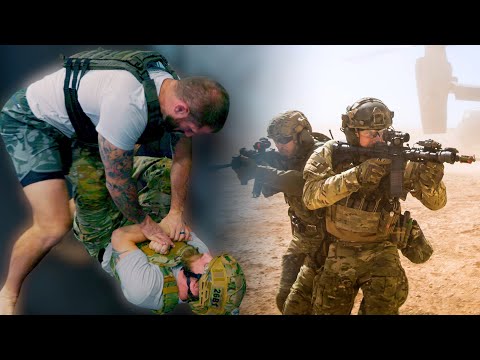
MMA Training with Special Forces | Wall Fighting System
0
Standard Wall Walk·FNG ACADEMY
Check us out for vetted selection gear and swag today! https://thefngacademy.com/FNGACADEMY Grab your ticket to the …
Перевод: standard wall walk
The Standard Wall Walk subfamily describes the fundamental wall walking technique where the attacker uses alternating underhook pummel, hip positioning, and cage pressure to climb from a lower or neutral cage clinch position to a dominant one. [1] The walk involves small, incremental positional improvements — securing one underhook, then pummelling for the second, then transitioning to a body lock — all while maintaining cage pin pressure. [1],[2] The standard wall walk is taught as a systematic process rather than a single technique, emphasising patience and positional discipline in cage clinch advancement. [2],[3]
Standard wall walk technique uses the cage surface to stand up from bottom position while managing the clinch. [1]
Developed in MMA as a cage-specific skill. [1]
The standard wall walk is a fundamental cage-fighting technique used at every level of MMA competition to escape inferior positions against the fence. [1]
Изображений для этой техники пока нет.
Войдите, чтобы предложить изображение.
Check us out for vetted selection gear and swag today! https://thefngacademy.com/FNGACADEMY Grab your ticket to the …
Учебных курсов по этой технике пока нет.
Войдите, чтобы предложить курс.
Риск травмы для человека, к которому применяется техника
Cage clinch work involves grinding pressure; rib/facial abrasion risk
Уровень мастерства, необходимый для надёжного выполнения техники
Разрешена ли техника по основным соревновательным правилам
Mastering Jujitsu (Renzo Gracie & John Danaher, 2003)
Alias sources — [1] Clinch Fighting for MMA (Couture, 2011) [2] MMA Instruction Manual (UFC, 2008) [3] Wrestling for Fighting (Velasquez, 2012)
Effectiveness sources — [1] Wrestling for Fighting (Couture, 2007)
Standard katakana transliteration of Western martial arts terminology (外来語) — used in Japanese MMA, boxing, and BJJ communities
Alias sources — [1] Clinch Fighting for MMA (Couture, 2011) [2] MMA Instruction Manual (UFC, 2008) [3] Wrestling for Fighting (Velasquez, 2012)
Effectiveness sources — [1] Wrestling for Fighting (Couture, 2007)
swimming speed for inside position, shoulder drive, hip pressure
strong shoulders and low centre of gravity
deltoids, pectorals, core, quadriceps
Каждое движение в любом боевом искусстве обладает рядом универсальных свойств. Комбинируйте параметры ниже, чтобы найти нужный инструмент или сравнить аналоги из разных стилей.
Your outside leg is the primary driver in the wall walk. FNG Academy emphasizes that your outside leg does the work while your hands can transition to grappling or controlling your opponent's position if needed.
Once your hands engage with grappling or securing your opponent, your leg action becomes the primary control mechanism to maintain positioning and keep your opponent at distance, according to FNG Academy's wall fighting system.
The Standard Wall Walk subfamily describes the fundamental wall walking technique where the attacker uses alternating underhook pummel, hip positioning, and cage pressure to climb from a lower or neutral cage clinch position to a dominant one. The walk involves small, incremental positional improvements — securing one underhook, then pummelling for the second, then transitioning to a body lock — all while maintaining cage pin pressure.
The standard wall walk was developed and systematised by MMA coaches as cage wrestling evolved into a distinct tactical discipline within the sport. The technique reflects the unique positional challenges created by the cage environment that do not exist in open-mat wrestling.
Unified MMA: разрешён — Legal — clinching is integral to MMA; IJF: разрешён — Legal — kumi-kata (grip fighting) is fundamental to judo; IBJJF: разрешён — Legal — standing grip fighting and clinch work permitted; IFMA: разрешён — Legal — the clinch is a core element of Muay Thai, clinch dominance is highly…; WBC/Boxing: ограничен — Holding is technically a foul — referee breaks clinch, excessive holding resu…; K: ограничен — 1/GLORY — One attack from clinch allowed, then referee breaks; WAKO: ограничен — Clinch generally broken by referee — limited or no clinch fighting in most fo…; UWW: разрешён — Legal — clinch is fundamental to wrestling, the primary position in Greco-Roman
Оценка опасности 4/10. Moderate — cage clinch work involves grinding pressure; rib/facial abrasion risk
Стандартная цепочка подготовки: Close Distance → Establish Primary Grip → Position the Hips → Apply Pressure.
Стандартные контрприёмы: Pummeling — fight for inside position by swimming arms under opponent's grips / Frame and Push — create distance using forearm frames against the chest or neck / Grip Break — systematically strip the opponent's controlling grips / Posture Up — straighten the spine and drive the hips forward to break clinch control.
Распространённые варианты: Single underhook (one arm inside for angle and control); Double underhooks (both arms inside for maximum inside position); Underhook with collar tie (combining the underhook with head control).
The standard wall walk is a fundamental cage-fighting technique used at every level of MMA competition to escape inferior positions against the fence.
Основные ошибки, на которые стоит обратить внимание: Trying to stand up all at once — the wall walk is progressive; rise incrementally while maintaining control / Not using the cage as leverage — press your back into it; the cage is your structural support / Failing to hand-fight during the ascent — the opponent will re-pin you if you don't fight their grips / Walking up with your hips away from the cage — keep your lower back in contact with the cage wall.
Standard Wall Walk также известен как Sutandādo Wōru Wōku, Standard Cage Walk, Basic Wall Walk-Up, Fence Walk Clinch.