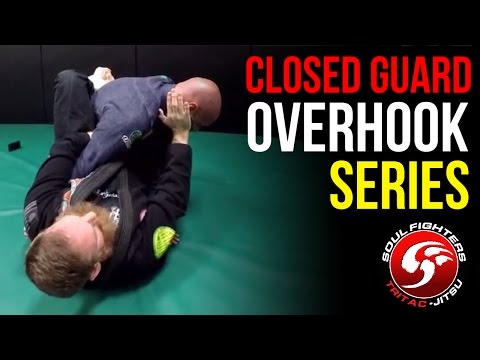
Closed Guard - Overhook Series: TRITAC-Jitsu Lesson
0
Standard Overhook Position·TRITAC Martial Arts·Added by Admin
What's your strongest Jiu-Jitsu weapon? Find out & sharpen it with a FREE custom 14-day training plan – take the survey:…
Перевод: standard overhook position
The Standard Overhook Position wraps the arm over the opponent's bicep and shoulder, hooking deep so the hand can grip the opponent's far shoulder or lat, pulling the overhook arm tight against the attacker's body. [1] The grip secures the opponent's arm in place, preventing them from swimming through to an underhook or using the trapped arm for offence. [1],[2] From the standard overhook position, the attacker can execute arm drags, transition to head control, or use the overhook as a platform for hip throws like harai-goshi. [2],[3]
The standard overhook position has been a core element of clinch fighting across all wrestling styles, serving as both a defensive response to the opponent's underhook and an offensive control position in its own right. [1] It remains a universally taught clinch technique across combat sports. [2],[3]
The standard overhook position hooks over the opponent's arm from outside, providing leverage for throws and defensive control. [1]
Taught in wrestling and judo from beginner level. [1]
The standard overhook position is fundamental in freestyle and Greco-Roman wrestling competition, taught at introductory level and used through Olympic competition. [1]
Изображений для этой техники пока нет.
Войдите, чтобы предложить изображение.
What's your strongest Jiu-Jitsu weapon? Find out & sharpen it with a FREE custom 14-day training plan – take the survey:…
Учебных курсов по этой технике пока нет.
Войдите, чтобы предложить курс.
Риск травмы для человека, к которому применяется техника
Upper body clinch positions for control and transitions
Уровень мастерства, необходимый для надёжного выполнения техники
Разрешена ли техника по основным соревновательным правилам
Freestyle Wrestling: A Complete Guide for Coaches and Wrestlers (Petrov, 1977)
Alias sources — [1] Wrestling Physical Conditioning Encyclopedia (Welker, 2010) [2] NCAA Wrestling Rules and Interpretations (NCAA, 2020) [3] Clinch Fighting for MMA (Couture, 2011)
Effectiveness sources — [1] Wrestling Physical Conditioning Encyclopedia (Petrov, 1977)
Official Kodokan ground technique classification system
Standard katakana transliteration of Western martial arts terminology (外来語) — used in Japanese MMA, boxing, and BJJ communities
Alias sources — [1] Wrestling Physical Conditioning Encyclopedia (Welker, 2010) [2] NCAA Wrestling Rules and Interpretations (NCAA, 2020) [3] Clinch Fighting for MMA (Couture, 2011)
Effectiveness sources — [1] Wrestling Physical Conditioning Encyclopedia (Petrov, 1977)
swimming speed for inside position, shoulder drive, hip pressure
strong shoulders and low centre of gravity
deltoids, pectorals, core, quadriceps
Push your opponent's head away to create that initial space, which allows you to start setting up your attack. You can also push on their shoulder to create angles for getting your knee in position.
From the standard overhook position, you can attack submissions like arm locks, perform sweeps, and drive through using the overhook to control and manipulate your opponent's positioning.
The Standard Overhook Position wraps the arm over the opponent's bicep and shoulder, hooking deep so the hand can grip the opponent's far shoulder or lat, pulling the overhook arm tight against the attacker's body. The grip secures the opponent's arm in place, preventing them from swimming through to an underhook or using the trapped arm for offence.
The standard overhook position has been a core element of clinch fighting across all wrestling styles, serving as both a defensive response to the opponent's underhook and an offensive control position in its own right. It remains a universally taught clinch technique across combat sports.
Unified MMA: разрешён — Legal — clinching is integral to MMA; IJF: разрешён — Legal — kumi-kata (grip fighting) is fundamental to judo; IBJJF: разрешён — Legal — standing grip fighting and clinch work permitted; IFMA: разрешён — Legal — the clinch is a core element of Muay Thai, clinch dominance is highly…; WBC/Boxing: ограничен — Holding is technically a foul — referee breaks clinch, excessive holding resu…; K: ограничен — 1/GLORY — One attack from clinch allowed, then referee breaks; WAKO: ограничен — Clinch generally broken by referee — limited or no clinch fighting in most fo…; UWW: разрешён — Legal — clinch is fundamental to wrestling, the primary position in Greco-Roman
Оценка опасности 4/10. Moderate — upper body clinch positions for control and transitions
Стандартная цепочка подготовки: Close Distance → Establish Primary Grip → Position the Hips → Apply Pressure.
Стандартные контрприёмы: Pummeling — fight for inside position by swimming arms under opponent's grips / Frame and Push — create distance using forearm frames against the chest or neck / Grip Break — systematically strip the opponent's controlling grips / Posture Up — straighten the spine and drive the hips forward to break clinch control.
Распространённые варианты: Single underhook (one arm inside for angle and control); Double underhooks (both arms inside for maximum inside position); Underhook with collar tie (combining the underhook with head control).
The standard overhook position is fundamental in freestyle and Greco-Roman wrestling competition, taught at introductory level and used through Olympic competition.
Основные ошибки, на которые стоит обратить внимание: Accepting the overhook position passively — it's a defensive position; always work toward upgrading / Not maintaining hip pressure — without the hip, the opponent's underhook becomes dominant / Standing still in the overhook position — use footwork and grip changes to create opportunities / Keeping both arms on the same side — the other hand must control the opposite side of the opponent's body.
Standard Overhook Position также известен как Ōbāfukku Pojishon (Kihon-gata), Basic Overhook Position, Fundamental Overhook Tie, Standard Outside Tie Position.