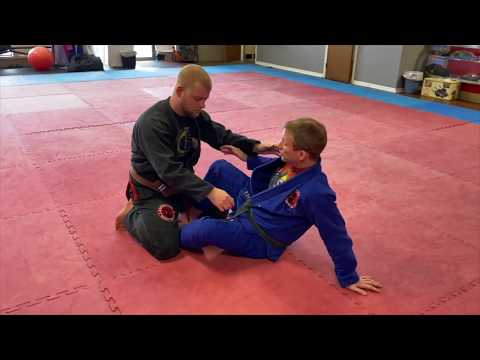
Butterfly Guard - Obtaining the Belt Grip
0
Standard Front Belt Grip·Grove City Brazilian Jiu Jitsu Academy·Added by Admin
Butterfly guard theory and using the arm drag threat to get the underhook and the sweep
Перевод: standard front belt grip
The Standard Front Belt Grip secures the opponent's belt from the front, typically reaching over the opponent's arm or through the clinch to grab the belt at the side or front of the waist. [1] The grip is maintained with a firm overhand wrap around the belt material, pulling it tight to eliminate slack and create a direct connection to the opponent's hips. [1],[2] From the standard front belt grip, the attacker can initiate lifts by driving the hips under and pulling up on the belt, or execute throws by combining the belt pull with rotational body movement. [2],[3]
The standard front belt grip clasps the opponent's belt with one or both hands from the front, providing leverage for hip throws. [1]
A fundamental judo grip taught alongside collar and sleeve grips. [1]
The standard front belt grip is a common kumi-kata position in judo competition at all levels, from local tournaments to Olympic Games. [1]
Изображений для этой техники пока нет.
Войдите, чтобы предложить изображение.
Butterfly guard theory and using the arm drag threat to get the underhook and the sweep
Учебных курсов по этой технике пока нет.
Войдите, чтобы предложить курс.
Риск травмы для человека, к которому применяется техника
Grip fighting is primarily positional; finger/wrist strain risk
Уровень мастерства, необходимый для надёжного выполнения техники
Разрешена ли техника по основным соревновательным правилам
Kodokan Judo (Jigoro Kano, 1986)
Alias sources — [1] Kodokan Judo (Kano, 1986) [2] Kodokan New Japanese-English Dictionary of Judo (IJF, 2000) [3] UWW Technical Terminology (UWW, 2018)
Effectiveness sources — [1] Kodokan Judo (Kano, 1986)
Official Kodokan ground technique classification system
Mixed Japanese-Western terminology — combines traditional Japanese terms with katakana loanwords
Alias sources — [1] Kodokan Judo (Kano, 1986) [2] Kodokan New Japanese-English Dictionary of Judo (IJF, 2000) [3] UWW Technical Terminology (UWW, 2018)
Effectiveness sources — [1] Kodokan Judo (Kano, 1986)
grip strength, upper body endurance, balance under pressure
strong arms and shoulders, stable base
forearms, deltoids, core, hip muscles
According to Grove City Brazilian Jiu Jitsu Academy, opponents won't readily let you grab the belt, and fighting for underhooks while trying to set up the grip in butterfly guard creates difficulty.
Grove City Brazilian Jiu Jitsu Academy recommends using an arm drag approach—when you go to arm drag and your opponent resists, this creates an opportunity to secure the belt grip.
The Standard Front Belt Grip secures the opponent's belt from the front, typically reaching over the opponent's arm or through the clinch to grab the belt at the side or front of the waist. The grip is maintained with a firm overhand wrap around the belt material, pulling it tight to eliminate slack and create a direct connection to the opponent's hips.
The standard front belt grip is a fundamental technique in judo and sambo competition, where reaching for the belt is a common strategy for establishing a dominant clinch position. It is particularly emphasised in Georgian judo and wrestling traditions.
Unified MMA: разрешён — Legal — clinching is integral to MMA; IJF: разрешён — Legal — kumi-kata (grip fighting) is fundamental to judo; IBJJF: разрешён — Legal — standing grip fighting and clinch work permitted; IFMA: разрешён — Legal — the clinch is a core element of Muay Thai, clinch dominance is highly…; WBC/Boxing: ограничен — Holding is technically a foul — referee breaks clinch, excessive holding resu…; K: ограничен — 1/GLORY — One attack from clinch allowed, then referee breaks; WAKO: ограничен — Clinch generally broken by referee — limited or no clinch fighting in most fo…; UWW: разрешён — Legal — clinch is fundamental to wrestling, the primary position in Greco-Roman
Оценка опасности 2/10. Low — grip fighting is primarily positional; finger/wrist strain risk
Стандартная цепочка подготовки: Close Distance → Establish Primary Grip → Position the Hips → Apply Pressure.
Стандартные контрприёмы: Pummeling — fight for inside position by swimming arms under opponent's grips / Frame and Push — create distance using forearm frames against the chest or neck / Grip Break — systematically strip the opponent's controlling grips / Posture Up — straighten the spine and drive the hips forward to break clinch control.
Распространённые варианты: Standard variation (primary clinch configuration from the most common entry); Gi variation (adapted with collar and sleeve grips for gi-based grappling); No-gi / MMA variation (modified for no-gi or cage fighting conditions); Offensive variation (configured to set up strikes, takedowns, or submissions f…).
The standard front belt grip is a common kumi-kata position in judo competition at all levels, from local tournaments to Olympic Games.
Основные ошибки, на которые стоит обратить внимание: Gripping the belt from outside instead of hooking underneath — the underhand hook is mechanically superior / Releasing the sleeve grip to grab the belt with both hands — maintain two-point control (belt + sleeve) / Not pulling upward before throwing — the lifting action is the whole point of the belt grip / Reaching for the belt when the opponent is standing upright — the belt is easier to reach when they lean forward.
Standard Front Belt Grip также известен как Sutandādo Mae Obi-dori, Basic Front Belt Grab, Standard Obi-Tori, Front Belt Control.