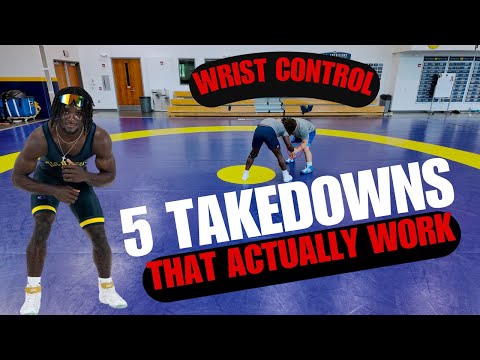
5 Wrist Control Takedowns Every Wrestler Should Know (D1 Breakdown)
0
Double Wrist Control·Christian Tanefeu
🔥 Master Wrist Control: 5 Takedowns Every Wrestler Needs In this video, I break down 5 takedowns you can hit from wrist…
Перевод: double wrist control
The Double Wrist Control subfamily covers positions where the attacker controls both of the opponent's wrists simultaneously, completely managing the opponent's hand placement and grip establishment. [1] Double wrist control is a highly dominant arm control position because it neutralises both of the opponent's arms, preventing strikes, frames, and grip fighting. [1],[2] From double wrist control, the attacker can release one grip to transition into deeper positions while maintaining control with the other hand, or use the position to set up push-pull off-balancing sequences. [2],[3]
Double wrist control has been used in martial arts for centuries, particularly in Japanese arts where controlling both hands (morote-dori) is a recognised attack scenario in aikido and jujutsu. [1] In modern grappling and MMA, double wrist control is taught as a clinch management tool for controlling distance and hand fighting. [2],[3]
Double wrist control immobilises both of the opponent's arms, preventing strikes, grips, and offensive actions while creating opportunities for knee strikes, trips, and guard passes. [1]
Double wrist control is used across multiple martial arts, from Muay Thai clinch fighting to BJJ guard retention. [1]
Double wrist control is a common control position in MMA, used to neutralise opponents on the ground. [1]
Изображений для этой техники пока нет.
Войдите, чтобы предложить изображение.
🔥 Master Wrist Control: 5 Takedowns Every Wrestler Needs In this video, I break down 5 takedowns you can hit from wrist…
Учебных курсов по этой технике пока нет.
Войдите, чтобы предложить курс.
Риск травмы для человека, к которому применяется техника
Arm control positions limit opponent's offense; low direct injury risk
Уровень мастерства, необходимый для надёжного выполнения техники
Разрешена ли техника по основным соревновательным правилам
Freestyle Wrestling: A Complete Guide for Coaches and Wrestlers (Petrov, 1977)
Alias sources — [1] Wrestling Physical Conditioning Encyclopedia (Welker, 2010) [2] Clinch Fighting for MMA (Couture, 2011) [3] No-Gi Grappling Fundamentals (Danaher, 2010)
Effectiveness sources — [1] Mastering Jujitsu (Gracie & Danaher, 2003)
Aikido technique naming conventions
Established Japanese martial arts naming convention — native Japanese term (和語/漢語)
Alias sources — [1] Wrestling Physical Conditioning Encyclopedia (Welker, 2010) [2] Clinch Fighting for MMA (Couture, 2011) [3] No-Gi Grappling Fundamentals (Danaher, 2010)
Effectiveness sources — [1] Mastering Jujitsu (Gracie & Danaher, 2003)
grip strength, upper body endurance, balance under pressure
strong arms and shoulders, stable base
forearms, deltoids, core, hip muscles
Каждое движение в любом боевом искусстве обладает рядом универсальных свойств. Комбинируйте параметры ниже, чтобы найти нужный инструмент или сравнить аналоги из разных стилей.
Double wrist control — gripping both of the opponent's wrists — is the most basic standing control in martial arts. Used in self-defense (controlling an attacker's hands), grappling (preventing grips and punches), and weapons defense (controlling the weapon hand). (Military combatives manuals; self-defense texts)
According to Christian Tanefeu, the biggest mistake is not committing fully to the takedown. Once you get the outside step, you need to release the arm and fully execute the double leg rather than hesitating—you really have to sell it and commit to the shot.
Christian Tanefeu teaches starting with opposite side collar pressure, hitting the wrist, then circling to create space. Once you secure the outside step, the key is to release the arm immediately and drive into the double leg takedown.
Christian Tanefeu emphasizes that the only way to learn wrist control takedowns is through daily repetition—you must practice this technique every single day to develop proficiency.
The Double Wrist Control subfamily covers positions where the attacker controls both of the opponent's wrists simultaneously, completely managing the opponent's hand placement and grip establishment. Double wrist control is a highly dominant arm control position because it neutralises both of the opponent's arms, preventing strikes, frames, and grip fighting.
Double wrist control has been used in martial arts for centuries, particularly in Japanese arts where controlling both hands (morote-dori) is a recognised attack scenario in aikido and jujutsu. In modern grappling and MMA, double wrist control is taught as a clinch management tool for controlling distance and hand fighting.
Unified MMA: разрешён — Legal — clinching is integral to MMA; IJF: разрешён — Legal — kumi-kata (grip fighting) is fundamental to judo; IBJJF: разрешён — Legal — standing grip fighting and clinch work permitted; IFMA: разрешён — Legal — the clinch is a core element of Muay Thai, clinch dominance is highly…; WBC/Boxing: ограничен — Holding is technically a foul — referee breaks clinch, excessive holding resu…; K: ограничен — 1/GLORY — One attack from clinch allowed, then referee breaks; WAKO: ограничен — Clinch generally broken by referee — limited or no clinch fighting in most fo…; UWW: разрешён — Legal — clinch is fundamental to wrestling, the primary position in Greco-Roman
Оценка опасности 3/10. Moderate — arm control positions limit opponent's offense; low direct injury risk
Стандартная цепочка подготовки: Close Distance → Establish Primary Grip → Position the Hips → Apply Pressure.
Стандартные контрприёмы: Pummeling — fight for inside position by swimming arms under opponent's grips / Frame and Push — create distance using forearm frames against the chest or neck / Grip Break — systematically strip the opponent's controlling grips / Posture Up — straighten the spine and drive the hips forward to break clinch control.
Распространённые варианты: Standard variation (primary clinch configuration from the most common entry); Gi variation (adapted with collar and sleeve grips for gi-based grappling); No-gi / MMA variation (modified for no-gi or cage fighting conditions); Offensive variation (configured to set up strikes, takedowns, or submissions f…).
Double wrist control is a common control position in MMA, used to neutralise opponents on the ground.
Основные ошибки, на которые стоит обратить внимание: Holding double wrist control as a permanent position — it stalls the fight and the referee may separate you / Trying to attack while holding both wrists — you have no free hands; you must release one to act / Keeping both arms straight — bent elbows give better structural control / Not immediately chaining to a transition — double wrist control has a 1-2 second shelf life.
Double Wrist Control также известен как Ryō-tekubi Seigyo, Double Wrist Tie, Two-Hand Wrist Control, Bilateral Wrist Grip.