Addressing Defensive Opponents
When facing defensive wrestlers who retreat and minimize scoring opportunities, practitioners must develop adaptable offensive strategies. Success against these opponents requires consistent practice of fundamental details, as habits developed in drilling translate directly to match performance without conscious thought.
Establishing the Tie
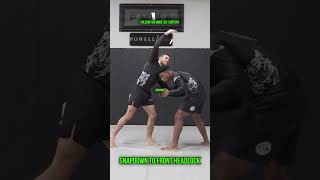
The foundation of the snap down begins with proper tie control: match the opponent's lead leg while posting with the opposite hand on the collar and wrist. This secure positioning prevents defensive counters and creates the leverage necessary for subsequent offensive techniques.
Pressure and Reaction Control
Applying pressure to the opponent forces a reactive push backward, which the attacker can exploit by using the opponent's momentum. This pressure fatigues the defender while making all subsequent offensive attacks exponentially more effective.
The Fake Setup
Execute the fake by moving the feet and head toward the opponent's knee rather than using only hand movement. Lowering the head near the knee creates genuine threat recognition in the opponent's mind, triggering defensive leg positioning and making the snap more effective.
The Snap Mechanics
The snap should be performed with a flicking motion similar to removing water from the hands, generating whip-like power rather than a tight squeeze. This snapping action drives the opponent's hands to the mat more effectively than a slow, forceful pull.
Transitioning to Front Headlock Position
After snapping the opponent down, immediately establish the front headlock with one hand on the neck and the other controlling the tricep. This position prevents the opponent from using arm movement to create distance or mobility.
Securing the Elbow Control
Push into the opponent and sense their counter-pressure, then spin to snap the elbow to the mat. Once the elbow is grounded, transition the grip to the armpit with the thumb inside to maximize weight distribution and control.
The Far Ankle Takedown
From the secured position, spin to capture the far ankle rather than the near ankle, as the near ankle finish leaves the opponent vulnerable to standing or scrambling. Capturing the far ankle with a dropped shoulder running toward the hip completes the takedown with maximum control.
Post-Takedown Positioning
After achieving the takedown, immediately drive the opponent's knee through to position them on their belly. This finishing detail makes escapes significantly more difficult and creates opportunities for pin advancement or positional transitions.
BO NICKAL TECHNIQUE: Snap Downs for Wrestling and BJJ! 🤼
Key Takeaways
- •Addressing Defensive Opponents
- •Establishing the Tie
- •Pressure and Reaction Control
- •The Fake Setup
Bo Nickal's wrestling technique is unreal! This video outlines how Nickal uses his snap down series to get takedowns against any opponent. Use this technique in wrestling or to develop safe takedowns for jiu jitsu! Learn directly and ask questions to 3x National Champion and MMA prodigy Bo Nickal! Don't forget to watch UFC 290 and see Bo Nickal vs Tresean Gore on July 8th! Click the link below for the full Instructional! 🔗 to Instructional: https://app.athletesocean.com/courses/easy-money-takedowns-by-bo-nickal/ 👤 Create your FREE PROFILE today 🙌 Engage directly with your FAVORITE ATHLETES 🥇 Learn from the GREATEST and COMPETE WITH CONFIDENCE SIGN UP HERE 👉 https://app.athletesocean.com/registration 🌊 EXPLORE NEW DEPTHS™ Social: IG: https://www.instagram.com/athletes.ocean/ Facebook: https://www.facebook.com/athletesoceanfb/
Frequently Asked Questions
What does this video teach about snap down to front headlock?
This video covers addressing defensive opponents, establishing the tie, pressure and reaction control. It provides detailed instruction from Athletes Ocean.
How long does it take to learn snap down to front headlock?
The basic mechanics can be understood in a single session, but developing reliable execution requires consistent drilling over weeks of practice. This 9-part breakdown helps structure your training by isolating each phase of the technique.
What are the key details for finishing snap down to front headlock?
From the secured position, spin to capture the far ankle rather than the near ankle, as the near ankle finish leaves the opponent vulnerable to standing or scrambling. Capturing the far ankle with a dropped shoulder running toward the hip completes the takedown with maximum control.
Related videos
Chain your snap down into an effective front headlock with this system! #bjj #grappling #jiujitsu
The Art of Fighting

Technique Snap Down From Front Head Lock
Superhero Jiu Jitsu Academy
Front Headlock Offense: Snap Down
Folkjitsu : Wrestling for Jiu-Jitsu
Snap down to front headlock
Takedown Nation
Snap Down | Wrestling Moves
Iron Faith Wrestling