Introduction to Foot Sweep Fundamentals
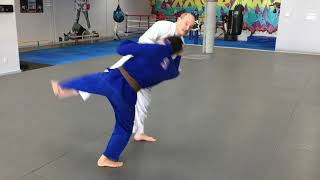
Mark Gilston and Sean Cooper introduce two closely related judo techniques: de ashi barai (advancing foot sweep) and harai tsuri komi ashi (sweeping lifting pull foot throw). The primary distinction between these techniques lies in the opponent's direction of movement—forward or backward. Both techniques are timing-based and require substantial practice to execute effectively in live training, though they remain highly applicable to both BJJ and judo.
Timing and Off-Balancing Principles
De ashi barai and harai tsuri komi ashi rely heavily on natural movement and timing rather than forced off-balancing (kuzushi). Practitioners execute these techniques most effectively when their opponent is already moving, creating opportunities to exploit momentum. The instructor demonstrates that when the opponent attempts to push backward, the defender steps to the side and catches the opponent's heel as their forward step continues.
Foot Mechanics and Positioning
Proper foot mechanics are critical for effective foot sweeps. The sweeping leg must remain straight with the toe pointed to maximize vertical power through the calf muscles, rather than keeping the foot flexed which strengthens lateral movement. The sweep itself must be executed with the sole of the foot to avoid injuring the sweeper's instep or the opponent's shin. Keeping the sweeping foot low to the ground increases leverage and extension, sometimes catching the opposite foot for equally effective results.
De Ashi Barai Application and Variations
De ashi barai can be executed regardless of whether the defender moves to the side or not, as long as the sweep contact is maintained. The box step—where the opponent steps back and turns to set up position—creates an ideal opportunity for this technique. The instructor demonstrates that this throw works with either partner as the aggressor, making it versatile for both offensive and defensive scenarios.
The Swallowtail Reversal Counter
The swallowtail reversal (subani gayesh) serves as a counter to de ashi barai, allowing the defender to escape and immediately sweep the attacking opponent. As the opponent commits to their sweep, the defender avoids contact and transitions into their own sweep, reversing the positions. This technique requires maintaining a straight leg position throughout both the escape and counter-sweep phases.
Harai Tsuri Komi Ashi Mechanics
Harai tsuri komi ashi differs from de ashi barai in that the opponent moves backward rather than forward. In this technique, the sweeper brings one foot into the opponent's other foot using a pumping motion and sole-of-foot contact. Simultaneously, the hands lift and pull the opponent forward onto their toes, combining the upward lift (tsuri komi) with the foot sweep (harai).
Setting Up Follow-Up Techniques
When an opponent becomes defensive about foot sweep attacks, they unconsciously create openings for higher-percentage techniques. The instructor demonstrates that leaning responses to de ashi barai attempts can be exploited with sacrifice throws, hip throws, or side separation techniques. The key principle is that foot sweeps must be genuine attacks to provoke authentic reactions; feinting without commitment yields no tactical advantage.
De Ashi Barai and Harai Tsuri Komi Ashi
Key Takeaways
- •Introduction to Foot Sweep Fundamentals
- •Timing and Off-Balancing Principles
- •Foot Mechanics and Positioning
- •De Ashi Barai Application and Variations
Mark Gilston, 4th degree judo black belt, discusses and demonstrates uses for two basic foot sweeps in judo and BJJ. http://www.coopermma.com/
Frequently Asked Questions
What does this video teach about standard sasae tsurikomi ashi?
This video covers introduction to foot sweep fundamentals, timing and off-balancing principles, foot mechanics and positioning. It provides detailed instruction from Seiryoku Zenyo.
How long does it take to learn standard sasae tsurikomi ashi?
The basic mechanics can be understood in a single session, but developing reliable execution requires consistent drilling over weeks of practice. This 7-part breakdown helps structure your training by isolating each phase of the technique.
What are the key details for finishing standard sasae tsurikomi ashi?
Harai tsuri komi ashi differs from de ashi barai in that the opponent moves backward rather than forward. In this technique, the sweeper brings one foot into the opponent's other foot using a pumping motion and sole-of-foot contact. Simultaneously, the hands lift and pull the opponent forward onto their toes, combining the upward lift (tsuri komi) with the foot sweep (harai).
Related videos

LEG LACING ASHI GARAMI FUNDAMENTALS
welcomematstevescott

Sasae Tsurikomi Course - Standard Fundamentals by Vladislav Koulikov
The Grapplers Guide by Jason Scully

Sasae tsurikomi ashi 1/2 | Online Judo Lesson You Can Do At Home Alone!
Shintaro Nakano
Integrated Attacks - Ko Soto Gari
Seiryoku Zenyo

WHY IT'S CALLED DE ASHI BARAI
welcomematstevescott