Understanding the Body Triangle
The body triangle is an effective control position because the attacker's shin creates a direct bar across the defender's hip line, immobilizing the hips and preventing movement. This locked position constrains both fighters to move as a single unit. Understanding this mechanical constraint is essential for developing an effective escape strategy.
The Core Escape Principle
The fundamental escape involves moving the hips past the attacker's heel. Once the hip position clears the heel, the angle of the shin changes relative to the defender's body, breaking the control mechanism. This single principle forms the basis of all body triangle escapes, regardless of the attacker's leg length or strength.
Basic Escape Execution
The defender initiates the escape by driving the top leg backward while simultaneously rotating the hips forward. This motion forces the hip past the attacker's heel, disrupting the triangle's mechanical advantage. Once the hips break free, the defender can transition to standard back control escape techniques.
Adapting to Long-Legged Opponents
Against opponents with longer legs, the standard backward kick may prove insufficient. In such cases, the defender lifts the leg slightly, allowing the knee to pass in front of the attacker's knee before moving underneath. This creates the necessary gap to advance the hip past the heel without sacrificing positional safety.
Floor-Side Body Triangle Escape
When the body triangle is established with the attacker's bottom leg on the mat, the same hip-past-heel principle applies. The ground anchors the attacker's foot, but the mechanical break remains identical. The defender drives the leg back and rotates to create space and initiate the transition away from back control.
Managing Neck Defense During Escape
Throughout the escape sequence, the defender must maintain active neck defense to prevent the attacker from transitioning to choke submissions. Escaping the body triangle does not guarantee complete safety; it only eliminates the immediate control problem. Continuous defensive awareness is required during and after the hip escape.
Post-Escape Positioning and Transitions
Once the hips clear the heel, the defender achieves a neutral position relative to the body triangle but remains in back control. From this point, standard escape progressions—such as controlling the attacker's ankle and working to establish mat contact—become the focus. The escaped position is a transitional state, not a completed escape from all danger.
Advanced Variations and Adaptability
Skilled defenders can employ creative variations, such as using one foot to remove the attacker's heel while simultaneously positioning the other foot for the escape. However, these techniques are refinements rather than necessities. The core principle of clearing the hip past the heel remains the most reliable and efficient approach across all defensive scenarios.
How to Escape the Body Triangle
Key Takeaways
- •Understanding the Body Triangle
- •The Core Escape Principle
- •Basic Escape Execution
- •Adapting to Long-Legged Opponents
How to escape the body triangle. This video demonstrates how to get out of the body triangle when your opponent has your back either in BJJ or MMA. Get more tips and techniques on www.jiujitsuedu.com Whether it's in MMA or BJJ, the figure 4 body triangle is an exceptional way to control an opponent from the back. Being stuck in this method of control is extremely grueling and taxing on one's energy reserve and can lend itself to be the beginning of the end if not escaped. It is a common misconception that the locked figure 4 body triangle is a virtually unescapable position, or that one must get the figure 4 on the ground to allow escape. This is indeed incorrect. Escaping the actual body triangle is relatively easy. Of course, the more efficient the attacker's back control and legwork methods are, one might find himself/herself in several other dangerous situations. However, with this simple counter of the triangle itself one will at least be on their way to a successful defensive campaign.
Related Techniques
Frequently Asked Questions
What does this video teach about standard body triangle escape?
This video covers understanding the body triangle, the core escape principle, basic escape execution. It provides detailed instruction from Shawn Williams BJJ.
How long does it take to learn standard body triangle escape?
The basic mechanics can be understood in a single session, but developing reliable execution requires consistent drilling over weeks of practice. This 8-part breakdown helps structure your training by isolating each phase of the technique.
What are the key details for finishing standard body triangle escape?
Once the hips clear the heel, the defender achieves a neutral position relative to the body triangle but remains in back control. From this point, standard escape progressions—such as controlling the attacker's ankle and working to establish mat contact—become the focus. The escaped position is a transitional state, not a completed escape from all danger.
Related videos

Escape the Body Triangle Every Time in Jiu Jitsu | Jiu Jitsu Tutorial | Matt Arroyo
Matt Arroyo Jiu Jitsu
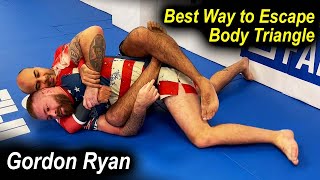
The Best Way To Escape From The Jiu Jitsu Body Triangle by Gordon Ryan
Bernardo Faria BJJ Fanatics
Butterfly To Stand Up Sweep!
The Grappling Academy
Escaping mount and using butterfly to sweep
Marcos Cerqueira Brazilian Jiu-Jitsu
12b Mount Escape, Push Leg & Trap Foot
Pathfinder Jiu-Jitsu Team