Wall Training Context
The instructor emphasizes the practical importance of learning to fight against walls, as real-world altercations typically occur in unmapped environments with obstacles rather than in controlled training spaces. Understanding how to escape wall pins is a foundational self-defense skill applicable to realistic street scenarios.
Basic Wall Pin Escape Setup
When an opponent applies pressure against a pinned defender's body into a wall, the defender cannot push backward (due to wall contact) and lacks sufficient leverage against the opponent's stable base. This leaves only lateral movement as a viable escape route.
Elbow Control and Lateral Step
The defender initiates escape by securing both of the opponent's elbows, then stepping laterally to create space. The key principle is moving one's own body rather than attempting to move the opponent, which requires less force and is mechanistically more efficient.
Backstep and Body Rotation
After stepping to the side, the defender executes a backstep while rotating the opponent's torso in the opposite direction of movement. This rotation disrupts the opponent's balance as their forward momentum carries them toward the wall, allowing the defender to create separation.
Directional Optimization via Foot Positioning
The instructor notes that analyzing the opponent's stance—specifically which foot is forward versus back—reveals their vulnerable side. Stepping toward the opponent's back foot maximizes the off-balancing effect of the escape.
Counterattack Following Escape
Once the defender achieves separation from the wall, they can immediately follow with strikes such as a knee to the solar plexus or transition into offensive techniques like takedowns.
Over-Under Clinch Application
When trapped in a wall pin from an over-under position, the defender applies the same rotational principle by raising the underhook arm while sliding laterally off the wall, achieving a dominant outside position.
Elbow Hook and Secondary Control
If the opponent adjusts and reapplies pressure during the escape, the defender can hook under the opponent's elbow (similar to a heel hook grip) and rotate in the opposite direction, driving the opponent's face into the wall and locking their shoulder and spine.
Pin and Finish Options
After forcing the opponent against the wall via elbow control, the defender pins the opponent's head and can follow with knee strikes, takedowns, or leg hook techniques to complete the sequence.
Fighting Off The Wall
Key Takeaways
- •Wall Training Context
- •Basic Wall Pin Escape Setup
- •Elbow Control and Lateral Step
- •Backstep and Body Rotation
Here are a few options to use to escape or fight off the wall or car if you get pinned.
Frequently Asked Questions
What does this video teach about standard wall pin?
This video covers wall training context, basic wall pin escape setup, elbow control and lateral step. It provides detailed instruction from Gracie Ohio Jiu-Jitsu Academy.
How long does it take to learn standard wall pin?
The basic mechanics can be understood in a single session, but developing reliable execution requires consistent drilling over weeks of practice. This 9-part breakdown helps structure your training by isolating each phase of the technique.
What are the key details for finishing standard wall pin?
If the opponent adjusts and reapplies pressure during the escape, the defender can hook under the opponent's elbow (similar to a heel hook grip) and rotate in the opposite direction, driving the opponent's face into the wall and locking their shoulder and spine.
Related videos
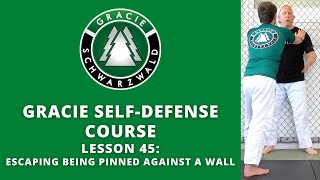
BJJ Self-Defense Course | Lesson 45: Wall Pin Defense
Gracie Schwarzwald Jiu-Jitsu

Technique Tuesday | How to Clinch WITHOUT Being Thrown
Bangtao Muay Thai & MMA

Wallwork: Fighting Off of the Cage & MMA Clinch
fightTIPS

9 Fundamentals of Clinch Fighting
Ramsey Dewey

MMA Using the Cage Wall Tutorial
Stuart Tomlinson