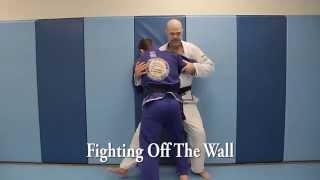
Wall Pin as Ground Position
The instructor frames wall pinning as analogous to ground grappling positions such as mount or side control. Rather than relying on strength to push the attacker away, the defender must change angles and body positioning to escape, similar to shrimp escapes performed on the mat.
Weight Commitment and Triceps Control
The defender establishes control by gripping behind the attacker's triceps and pulling inward to lock the attacker's weight onto their hands. The defender simultaneously rests their own weight against the wall, allowing the attacker to commit fully to the pin rather than maintain independent balance.
Shrimp Movement Mechanics
The escape employs a shrimp-like motion where one leg steps out to the side while hips and shoulders rotate simultaneously to change the angle. The instructor emphasizes that this is not a muscular movement to physically move the attacker, but rather a positional shift that causes the attacker to lose balance when their weight is committed forward.
Footwork and Hip Rotation
The defending leg steps slightly forward and outward to create space, while the back hip and shoulder pull away from the attacker. The back foot should move at least in line with the front foot or further back, with the pulling motion creating rotation rather than lateral displacement of the attacker.
Directional Stepping Outside Base
The defender steps outside the attacker's lead leg and pulls toward the attacker's front side, forcing the back leg to step forward to recover base. This directional choice is critical—stepping toward the attacker's trailing leg does not disrupt their balance as effectively.
Application to Underhook and Framing
The footwork pattern applies across various wall pinning scenarios including underhooks, biceps grips, and chest frames. The synchronized hip and shoulder movement remains consistent regardless of hand positioning, though the two-hand choke requires different technical treatment.
Synchronized Movement and Wall Utility
The defender must move hips and shoulders together rather than sequentially, allowing the wall or ground to assist the escape through body sliding rather than muscular effort. The defender maintains contact with the wall throughout, using it as a passive support surface that reduces the attacker's available response options.
BJJ Self-Defense Course | Lesson 45: Wall Pin Defense
Key Takeaways
- •Wall Pin as Ground Position
- •Weight Commitment and Triceps Control
- •Shrimp Movement Mechanics
- •Footwork and Hip Rotation
We hope everyone is enjoying our Gracie Jiu-Jitsu Self-Defense Course. We are offering these lessons for free, but If you are enjoying what we are doing and want to support us, you can make a donation to PayPal at [email protected]. Please click Like, Subscribe, and hit the notification bell for updates on this course. You can also Join my Patreon for more Content at: www.Patreon.com/RoyMarshJiuJitsu.com Or, check out my Video Instructionals at RoyMarsh.selz.com You can also read my Blog at: www.ConceptualJiuJitsu.Worpress.com My Websites: www.GracieSchwarzwald.com www.RoyMarshJiuJitsu.com www.Facebook.com/GracieSchwarzwald www.Instagram.com/GracieSchwarzwald
Frequently Asked Questions
What does this video teach about standard wall pin?
This video covers wall pin as ground position, weight commitment and triceps control, shrimp movement mechanics. It provides detailed instruction from Gracie Schwarzwald Jiu-Jitsu.
How long does it take to learn standard wall pin?
The basic mechanics can be understood in a single session, but developing reliable execution requires consistent drilling over weeks of practice. This 7-part breakdown helps structure your training by isolating each phase of the technique.
What are the key details for finishing standard wall pin?
The footwork pattern applies across various wall pinning scenarios including underhooks, biceps grips, and chest frames. The synchronized hip and shoulder movement remains consistent regardless of hand positioning, though the two-hand choke requires different technical treatment.