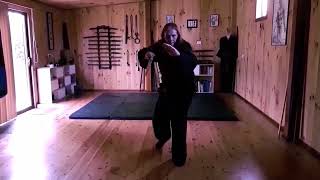
Introduction and Instructors
Jeremiah Bockhouse of the Wisconsin Historical Fencing Association and Eric White of the New Jersey Historical Fencing Association present foundational wrestling principles applicable to historical dagger combat.
Uneven Extension and Arm Distance
Rather than maintaining equal distance with both hands during engagement, practitioners should extend and retract unevenly. This creates a weak zone at distance and a strong control zone near the body, establishing the tactile foundation necessary for wrestling-based dagger work.
Extended Arm as Sensory Mechanism
The extended arm functions as a sensory apparatus, gathering information about the opponent's movement and direction. This tactile feedback enables practitioners to recognize openings and execute locks and throws with greater precision and timing.
Extended Guard in Rondell and Close Range
The extended arm principle applies equally in rondell dagger and close-quarter engagements, even when practitioners are not in optimal measure. This extended position allows rapid defensive responses and distance assessment with minimal hand travel, improving reaction efficiency.
Hand Orientation and Weapon Type
Hand orientation—palm in or palm out—should correspond to weapon function and protective priorities. Cutting weapons benefit from palm-in positioning to shield vulnerable hand anatomy, while thrusting daggers may employ inverted hand positions to facilitate stripping and disarming actions.
Wrestling as Primary Dagger Framework
Dagger technique is fundamentally an application of wrestling principles, not independent striking methodology. Hands remain extended to establish contact, allowing practitioners to feel and respond to opponent movements through direct sensory engagement rather than committed strikes.
Failure of Viper Strike Mentality
The common 'viper strike' approach—attempting rapid stabs without wrestling engagement—lacks historical textual support and creates strategic vulnerability. When an opponent transitions to wrestling-based dagger work, practitioners limited to striking mentality lose tactical options and controlling advantage.
A Fundamental to HEMA Wrestling and Dagger
Key Takeaways
- •Introduction and Instructors
- •Uneven Extension and Arm Distance
- •Extended Arm as Sensory Mechanism
- •Extended Guard in Rondell and Close Range
A demonstration of body positioning for HEMA wrestling and dagger (rondel) fighting. Intro music: The altered segment of “Master of the Feast” by Kevin MacLeod is licensed under a Attribution 3.0 International License. Kevin McLeod in no way endorses this video.
Frequently Asked Questions
What does this video teach about standard hema dagger?
This video covers introduction and instructors, uneven extension and arm distance, extended arm as sensory mechanism. It provides detailed instruction from New Jersey Historical Fencing Association.
How long does it take to learn standard hema dagger?
The basic mechanics can be understood in a single session, but developing reliable execution requires consistent drilling over weeks of practice. This 7-part breakdown helps structure your training by isolating each phase of the technique.
What are the key details for finishing standard hema dagger?
Dagger technique is fundamentally an application of wrestling principles, not independent striking methodology. Hands remain extended to establish contact, allowing practitioners to feel and respond to opponent movements through direct sensory engagement rather than committed strikes.