Historical Dagger Overview
The rondelle dagger, most frequently depicted in historical martial arts manuals, is characterized by its extended length, which reflects its primary design as a thrusting weapon rather than a cutting implement. This distinction in weapon design directly influenced the technical approaches documented across multiple centuries and cultures.
Why Thrusting Over Cutting
Historical combatants wore substantially thicker clothing than modern practitioners, rendering slashing attacks largely ineffective. The dagger functioned primarily as a close-quarters weapon for exploiting armor gaps and executing strikes during grappling exchanges or close-contact combat.
Grip and Attack Mechanics
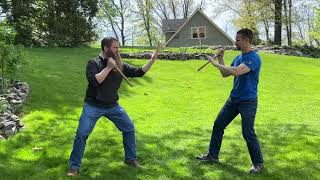
Dagger attacks typically employ an ice-pick style grip executed from a descending angle. This grip allows practitioners to generate downward penetrating force while maintaining control for follow-on grappling, throwing, or limb manipulation.
Inside Defense Against Descending Strikes
The primary defensive response to a descending dagger attack involves deflecting the strike on the inside using the off-hand while engaging the entire body. Correct execution of this deflection simultaneously breaks the attacker's structure to the outside, positioning the defender to transition into disarming techniques by securing the dagger against the elbow.
Outside Defense and Control
An alternative defensive approach utilizes outside position to hook and control the dagger hand. From this position, the defender can execute a downward wrench that establishes dominant control over the engagement.
Off-Hand Blade Contact Applications
Extended dagger length permits the off-hand to contact the blade itself, enabling reinforcement of guard positions and the development of specialized joint locks. This dual-hand control significantly enhances defensive capabilities and control options.
Historical Recurring Themes
Historical manuals demonstrate consistent technical principles across different sources, as practitioners using similar tools developed comparable solutions to common problems. However, individual variance and innovation remain documented throughout the historical record.
Dagger as Standard Equipment
Dagger carrying was ubiquitous in medieval Europe, making armed encounters the normative assumption in historical self-defense contexts. Historical combat sources emphasize either wrestling against armed opponents or dagger-versus-dagger engagements, reflecting the practical realities of the period.
Introduction to the Dagger - Showcasing HEMA
Key Takeaways
- •Historical Dagger Overview
- •Why Thrusting Over Cutting
- •Grip and Attack Mechanics
- •Inside Defense Against Descending Strikes
Knife goes in, guts come out. Knife goes in, guts come out. Check out our Patreon for extended and early content! - www.Patreon.com/BloodandironHEMA Weapons used in video: Daggers - Misc. custom ones, too hard to track down. Sorry :( Messer - Ensifer Messer. Village Consort Kevin MacLeod (incompetech.com) Licensed under Creative Commons: By Attribution 3.0 License http://creativecommons.org/licenses/by/3.0/
Frequently Asked Questions
What does this video teach about standard hema dagger technique?
This video covers historical dagger overview, why thrusting over cutting, grip and attack mechanics. It provides detailed instruction from Blood and Iron HEMA.
How long does it take to learn standard hema dagger technique?
The basic mechanics can be understood in a single session, but developing reliable execution requires consistent drilling over weeks of practice. This 8-part breakdown helps structure your training by isolating each phase of the technique.
What are the key details for finishing standard hema dagger technique?
Historical manuals demonstrate consistent technical principles across different sources, as practitioners using similar tools developed comparable solutions to common problems. However, individual variance and innovation remain documented throughout the historical record.