Pinning for Position and Submission
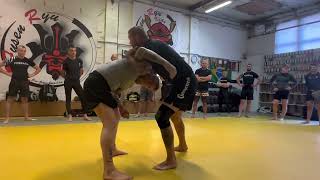
The instructor introduces the core principle of grappling transitions: holding an opponent for time to establish dominance, then transitioning into a submission technique. This strategic progression is essential across multiple grappling disciplines including Sambo, freestyle judo, and submission grappling competition.
Competition Context and Scoring
In freestyle judo and Sambo, competitors earn four points for a successful pin (at 22 seconds), after which referees permit submission attempts. In submission grappling tournaments, pins cannot win the match—only a tap-out submission can secure victory, making efficient position-to-submission transitions critical.
North-South Kami Shiho Gatami Setup
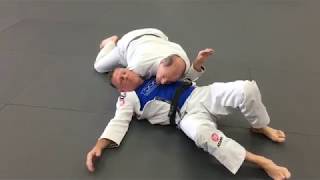
From the north-south position, the instructor demonstrates the upper four-corner control (kami shiho gatami). Both hands grip beneath the opponent's shoulders and secure the belt, while the knees pinch the head tightly to prevent escape and bridging.
Transitioning to the Arm Lock Submission
The instructor shifts both arms to pin the opponent's arm between his forearm and shoulder, applying pressure with the shoulder. After securing control, he grips the opponent's wrist, captures his own wrist, and forces the opponent's knuckles across the mat to complete the submission.
Kata Gatame Head and Arm Control
The kata gatame (head and arm choke) requires pinning the opponent's arm in front of the body to prevent bridging and rolling. The grip must trap rather than wrap around the arm, maintaining superior control and preventing the opponent from reaching backward.
Isolating the Wrist and Applying Pressure
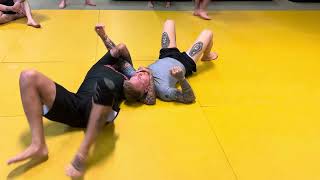
From the kata gatame position, the practitioner isolates the opponent's wrist and forces it downward toward the leg. When the wrist approaches the leg, the upper leg traps it, creating a devastating armlock or choke depending on positioning.
Maintaining Base Position During Submission
A critical error is surrendering base position while attempting a submission, as this allows the opponent to escape or roll free. The instructor emphasizes keeping hips properly aligned and maintaining contact with the mat to maximize pressure and control.
Progressive Arm Lock Variations
The instructor demonstrates two pathways: initially applying pressure to a bent arm, which often causes the opponent to straighten it defensively. Once the arm is extended, the practitioner can transition to either a shin lock or a knee squeeze technique depending on opponent size and flexibility.
Shin Lock vs. Knee Squeeze Mechanics
Larger opponents benefit from shin lock techniques for simplicity, while smaller or more flexible opponents require the knee squeeze method, which provides greater pressure. Proper wrist trapping ensures the opponent cannot escape by rotating the arm, making hip alignment and knee closure essential.
Complete Position-to-Submission Integration
The instructor concludes by emphasizing that transitioning from a dominant pin to a submission finish is a specialized art requiring deliberate practice. Competitors should develop proficiency in multiple submission pathways—chokes, armlocks, and leg locks—seamlessly connected to their pinning positions.
PIN FOR TIME AND APPLY THE SUBMISSION TECHNIQUE 2 Pins and 3 Armlocks
Key Takeaways
- •Pinning for Position and Submission
- •Competition Context and Scoring
- •North-South Kami Shiho Gatami Setup
- •Transitioning to the Arm Lock Submission
This video shows how to control an opponent with Osaekomi Waza (Pinning Techniques) and apply different submission techniques. Go to www.amazon.com or www.ymaa.com to get Steve Scott's books THE JUDO ADVANTAGE, SAMBO ENCYCLOPEDIA and JUJI GATAME ENCYCLOPEDIA. Our channel was started in 2010 as an extension of our program at Welcome Mat. Welcome Mat was founded in 1969 by Steve Scott in Kansas City, Missouri, USA and has produced thousands of successful students, athletes and coaches in a variety of grappling sports. View over a thousand videos on the subjects of judo, freestyle judo, Shingitai Jujitsu, sambo, submission grappling and sport jujitsu are on our Youtube channel. Browse through our playlists to see what we have on our channel. If a video is listed as "private" is it because that video is still in development or scheduled for later viewing. You can subscribe for free to our channel at http://youtube.com/user/welcomematstevescott. We strive to provide fundamentally sound and technically innovative skills and information on a variety of grappling sports. We appreciate your support! Please tell others about our channel. You can help support our channel by going to our online store and purchasing items. Go to http://www.WelcomeMatStore.com. We have a variety of books, shirts and other items for sale. Music for the Freestyle Judo show provided by YouTube Copyright Free Audio featuring "Fiend" by Sting and performed by the Jingle Punks and "All This Down Time" by Sting and performed by the Jingle Punks. Visit our club web site at http://www.WelcomeMatJudoClub. For information on the Judo Black Belt Association, go to http://www.judoblackbelt.com. Thank you for watching our video. Please tell others about our channel. Our videos are all original material and are copyrighted. Reproduction or showing these videos without the specific permission of Steve Scott is prohibited. #osaekomi #osaekomiwaza #shimewaza
Related Techniques
Frequently Asked Questions
What does this video teach about cattle choke from standing headlock?
This video covers pinning for position and submission, competition context and scoring, north-south kami shiho gatami setup. It provides detailed instruction from welcomematstevescott.
How long does it take to learn cattle choke from standing headlock?
The basic mechanics can be understood in a single session, but developing reliable execution requires consistent drilling over weeks of practice. This 10-part breakdown helps structure your training by isolating each phase of the technique.
What are the key details for finishing cattle choke from standing headlock?
Larger opponents benefit from shin lock techniques for simplicity, while smaller or more flexible opponents require the knee squeeze method, which provides greater pressure. Proper wrist trapping ensures the opponent cannot escape by rotating the arm, making hip alignment and knee closure essential.