Initial Position and Posture
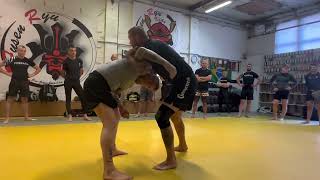
The practitioner establishes a bent-over posture with an underhook, keeping the opponent's leg positioned to prevent them from escaping. Proper posture is essential—the instructor emphasizes maintaining control through body position rather than relying solely on grip strength. This foundational stance sets up all subsequent techniques.
Securing the Underhook and Head Control
After establishing the underhook, the practitioner executes a controlled head lock by bringing the opponent's head down to their arm rather than leaning over it. The grip focuses on controlling the chin with the elbow positioned tight to the ribs, preventing the opponent from switching sides or escaping to a fireman's carry or single-leg takedown.
The Snap and Drive to Ground
With chin control secured, the practitioner uses their opposite shoulder grip to snap the opponent down to the floor. The driving leg (same side as the controlled head) stays down while the opposite leg extends up, establishing a stable base for the transition to ground control.
Killing the Wizard Escape
Once on the ground, the practitioner reaches for the opponent's back pocket to prevent a wizard escape—a common counter-move where the opponent attempts to turn out of the position. This reach must occur on the ground, not while standing, to avoid exposing the practitioner to a headlock throw or arm trap.
The Turnover and Shoulder Control
The practitioner rotates on their knee to flip the opponent onto their back, then re-secures control of the opposite shoulder. Throughout the movement, maintaining separation between the opponent's head and shoulders through a sit-through position ensures maximum control and prevents defensive rotations.
Proper Upper Body Position
The practitioner maintains an aggressive sit-through position on their toes with extended arms pulling the opponent's head and shoulders apart. This body positioning—not flat or collapsed—generates maximum control and prevents the opponent from bridging or reversing the position.
Standing vs. Ground Execution Differences
The technique must be modified based on position: while standing, the practitioner avoids reaching for the back pocket (which opens them to a headlock throw) and instead secures the head position before pulling the opponent to the ground. All wizard-killing and pocket reaches occur only after successfully transitioning to the ground.
Managing Defensive Counters
The opponent may attempt to push the practitioner's face away with their arm during the control phase. The practitioner counters by maintaining separation and pulling the opponent's head and shoulders apart, prioritizing positional control over wrestling complications.
Cow Catcher - Catching the Head Standing
Key Takeaways
- •Initial Position and Posture
- •Securing the Underhook and Head Control
- •The Snap and Drive to Ground
- •Killing the Wizard Escape
@fusenryu-jiu-jitsubresilie910 Fusen Ryu Tournai, Belgium 🇧🇪 -Flare a palm, flare an elbow to gain an Underhook -Gaining the head by breaking posture thru off balancing with uchi mata -Controlling the head to prevent counter wrestling -Pulling them Down -Reach for the back pocket -2 hands grab and separate to choke
Related Techniques
Frequently Asked Questions
What does this video teach about cattle choke from standing headlock?
This video covers initial position and posture, securing the underhook and head control, the snap and drive to ground. It provides detailed instruction from Brandon Quick.
How long does it take to learn cattle choke from standing headlock?
The basic mechanics can be understood in a single session, but developing reliable execution requires consistent drilling over weeks of practice. This 8-part breakdown helps structure your training by isolating each phase of the technique.
What are the key details for finishing cattle choke from standing headlock?
The technique must be modified based on position: while standing, the practitioner avoids reaching for the back pocket (which opens them to a headlock throw) and instead secures the head position before pulling the opponent to the ground. All wizard-killing and pocket reaches occur only after successfully transitioning to the ground.
Related videos
PIN FOR TIME AND APPLY THE SUBMISSION TECHNIQUE 2 Pins and 3 Armlocks
welcomematstevescott
Cow Catcher - Catching the Head Standing
Brandon Quick
Cow Catcher - Catching the Head Standing
Brandon Quick
Cow Catcher - The Suicide Roll
Brandon Quick
Eri Gatame (Collar Pin) and Submissions - Judo technique for BJJ
Seiryoku Zenyo