Introduction to Kakuto Uchi Mechanics
The Kakuto Uchi (back wrist block) in Goju Ryu consists of two primary directional variations: an internal reverse motion and an external outward motion. Both variations can move in multiple directions and interchange fluidly depending on the defensive scenario. The technique can be executed with the hand moving downward, outward, or in circular patterns.
Single Technique Execution
The basic Kakuto Uchi begins with a downward hook motion followed by an upward strike toward the throat and face. The practitioner simultaneously drops one hand while raising the other in a coordinated defensive and offensive motion. The technique can be executed with varying levels of force distribution between the blocking and striking components.
Directional Variations and Hand Control
The upward variation of Kakuto Uchi involves clearing incoming techniques while executing an ascending hand path. Practitioners can modulate the hardness and softness of each hand independently, allowing the technique to function as either a soft deflection or hard block paired with a forceful counter-strike. Both hands can be executed with equal softness or adjusted based on tactical requirements.
Two-Attack Sequential Defense
When facing multiple sequential attacks, the practitioner blocks the first attack while preparing for the second. Upon blocking the second attack, the first blocking hand becomes the counter-striking weapon. This principle requires blocking, counting the opponent's next attack, and executing a simultaneous counter-strike before continuing the exchange.
Four-Count Continuous Flow
The complete Kakuto Uchi sequence involves a four-count rhythm: opponent attacks (one), practitioner defends (two), opponent attacks again (three), and practitioner blocks while counter-striking (four). This creates a flowing exchange where blocking and striking actions occur simultaneously, with the hands moving through circular paths while maintaining continuity throughout the combination.
Right Hand-on-Top Position
With the right hand positioned on top, the practitioner brings the right hand inward toward the chest, then scoops it upward while the left hand rolls and extends outward. The hands curl past each other in a controlled manner, creating the characteristic circular motion of the Kakuto Uchi block. Both hands work in coordination, with one hand hooking inward while the other follows an upward arc.
Left Hand-on-Top Position
When executing with the left hand on top, the practitioner reaches inward with the left hand toward the chest while rolling the right hand inward. The right hand then snaps and pulls back outward while the left hand continues upward and around. The elbow must remain close to the body throughout the movement to maintain proper structure and power generation.
Fluid Motion and Relaxation Principles
The Kakuto Uchi is characterized by fluid, circular hand movements that remain alive and responsive throughout execution. The technique requires the hands to move with relaxation during the initial snapping action, allowing the wrists to bend naturally as part of the movement's energy rather than as a defensive collapse. This finesse-oriented approach makes it one of the more technically demanding Goju Ryu techniques to master properly.
How to do the Goju Ryu Back Wrist Block!
Key Takeaways
- •Introduction to Kakuto Uchi Mechanics
- •Single Technique Execution
- •Directional Variations and Hand Control
- •Two-Attack Sequential Defense
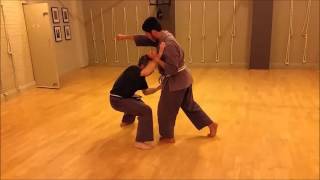
How to do the Goju Ryu Back Wrist Block! The koken uke is used in 2 of the advanced Goju Ryu Kata. The first one is Sanseiru and the second is Suparenpai. As with all Goju Ryu technique there are elements of hard/soft contained within them. This short clip offers a few ideas into the applications that are contained in the kata. Included in the clip: Blocking with the downward with the reverse hand and countering with the lead hand. Blocking upward with the lead hand and countering with the reverse hand. There is an illustration of combining blocking soft and countering both hard and soft hand. Combining reverse block and lead block while simultaneously countering during the lead block. Combining reverse block, lead block, cross reverse block while simultaneously countering during the lead block. Lastly, the last 3 1/2 minutes are devoted to explaining the mechanics of Koken Uke. I hope you have found this short clip helpful! Please feel free to contact me if you have any questions. Roger Wehrhahn http://www.mountainteachings.com/store/c3/Karate.html www.mountainteachings.com
Related Techniques
Frequently Asked Questions
What does this video teach about kakuto uchi?
This video covers introduction to kakuto uchi mechanics, single technique execution, directional variations and hand control. It provides detailed instruction from Roger Wehrhahn.
How long does it take to learn kakuto uchi?
The basic mechanics can be understood in a single session, but developing reliable execution requires consistent drilling over weeks of practice. This 8-part breakdown helps structure your training by isolating each phase of the technique.
What are the key details for finishing kakuto uchi?
When executing with the left hand on top, the practitioner reaches inward with the left hand toward the chest while rolling the right hand inward. The right hand then snaps and pulls back outward while the left hand continues upward and around. The elbow must remain close to the body throughout the movement to maintain proper structure and power generation.
Related videos
San Dan Uke - Alternate Version III- Koken Uke
Eastwind Martial Arts Virtual Dojo
Karate club Washide self-defense techniques demonstration 1. version
Karate Club Washide
Blocks aren't used in isolation
Dan Djurdjevic - The Way of Least Resistance
Shotokan Karate - Kihon Ippon #3 Jodan (Face Punch) tutorial by Paul Gale Network
Paul Gale Network
The sukui uke and nukite in seiunchin kata
Dan Djurdjevic - The Way of Least Resistance