Practical Kata Bunkai: Chinte Two Finger Spear Hands (Nihon Nukite)
0
Nihon Nukite·practicalkatabunkai
http://www.iainabernethy.co.uk/ In this video we explore some of the bunkai of the kata Chinte (“Unusual Hands”); speci…
Translation: two-finger piercing hand
Nihon Nukite is a karate open-hand strike that uses the extended index and middle fingers as the striking surface, targeting the eyes. [1] The hand forms a V-shape with the two fingers spread apart at approximately eye-width distance, while the remaining fingers curl into the palm. [1] This is the most specialized nukite variant — it exists for a single purpose: simultaneous bilateral eye attack. [1] The V-formation allows both fingers to enter both eye sockets simultaneously, making it far more effective than a single-finger eye gouge. [1] Like all nukite variants, it requires finger conditioning to prevent the fingers from buckling on impact. [1]
Nihon nukite is documented in traditional karate as the eye-specific variant of the nukite (spear hand) family. [1] It appears in the curricula of Shotokan, Goju-Ryu, and Okinawan karate styles, typically taught at advanced levels. [1] The technique also appears in Wing Chun as a similar two-finger eye jab (biu jee). [1] It is preserved primarily as a self-defense and military combatives technique, having been removed from most sport curricula due to the permanent injury it causes. [1]
The single most effective eye attack in empty-hand combat — the V-formation covers both eyes simultaneously, doubling the probability of contact. [1] A successful nihon nukite ends any confrontation immediately through temporary or permanent blindness. However, it is purely a self-defense technique with zero sport application and extreme ethical considerations. [1]
Banned in all major sport competition due to targeting eyes, throat, or groin. Used in self-defense training and traditional kata only. [1]
No images yet for this technique.
Sign in to suggest an image.
http://www.iainabernethy.co.uk/ In this video we explore some of the bunkai of the kata Chinte (“Unusual Hands”); speci…
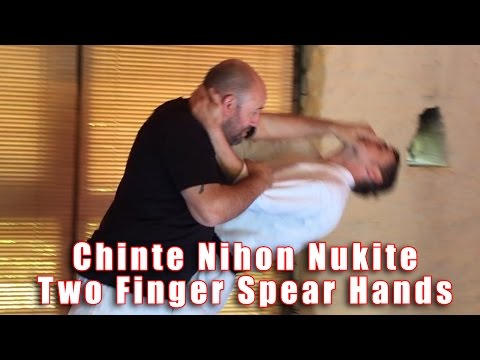
A few basic self-defense applications for the Spear-Hand strike/Nukite Please like & subscribe. Leave questions and co…
Nihon nukite (two-finger spear hand) is a striking technique that combines precision targeting with grappling applications in self-defense contexts. Kata For Self Defense Shotoryu Goshinjutsu emphasizes the technique's use as a control and takedown tool following arm interception, where the strike to vulnerable points—the jaw edge, neck, or solar plexus—facilitates body-weight-driven ground positioning. The instructor demonstrates how stepping forward with the spear hand traps an opponent's arm while enabling shoulder isolation and subsequent arm-bar applications. Practical Kata Bunkai focuses on closer-range, "dirty" infighting applications, highlighting strikes to the jaw delivered with downward force to drop the opponent's head, enabling follow-up finger strikes to the nostrils for head control and upward driving pressure. Both instructors agree the technique targets sensitive anatomical points (jaw, neck, nostrils) and functions as a bridge between striking and grappling. Kata For Self Defense Shotoryu Goshinjutsu stresses body mechanics and leverage for takedowns, while Practical Kata Bunkai emphasizes the technique's utility against larger opponents through precise targeting and pain compliance rather than pure power, using the initial strike to create openings for controlling the head and advancing position.
Synthesized from 2 instructors
No instructional courses yet for this technique.
Sign in to suggest a course.
Risk of injury to the person this technique is applied to
Designed to cause permanent bilateral blindness. One of the most dangerous empty-hand techniques in martial arts.
Skill level needed to execute this technique reliably
Whether this technique is allowed under major competition rule sets
Oyama, M. This Is Karate / Essentials of Karate.
[1] Oyama / Funakoshi / Nakayama — hand formation and nukite variant chapters
Official karate technique names (和語/漢語)
Established Japanese martial arts naming convention — native Japanese term (和語/漢語)
[1] Oyama / Funakoshi / Nakayama — hand formation and nukite variant chapters
strong finger conditioning, precise V-spread calibration, jab-speed delivery
long fingers, strong interphalangeal joints
finger extensors (lock), forearm flexors (rigid hand), triceps (thrust), shoulder (drive)
Nihon nukite (two-finger spear hand) targets the eyes with a V-formation of index and middle fingers. The most specialized eye attack in martial arts — the V-spread covers both eye sockets simultaneously. Purely a self-defense technique. (Oyama, This Is Karate; Nakayama, Dynamic Karate)
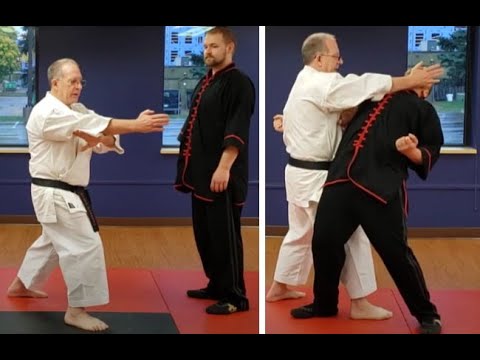
From a self-defense standpoint, nihon nukite is primarily used as a covering hand to protect yourself from being struck when an opponent comes in close, rather than as an offensive strike itself.
Target the jawline area, using the natural bridge of the jaw itself as your striking point when the opponent comes down with their strike.
Nihon Nukite is a karate open-hand strike that uses the extended index and middle fingers as the striking surface, targeting the eyes. The hand forms a V-shape with the two fingers spread apart at approximately eye-width distance, while the remaining fingers curl into the palm.
Nihon nukite is documented in traditional karate as the eye-specific variant of the nukite (spear hand) family. It appears in the curricula of Shotokan, Goju-Ryu, and Okinawan karate styles, typically taught at advanced levels.
WKF Karate: Eye attacks strictly prohibited {src:WKF Kumite Rules 2026|/sources/WKF: banned — Kumite-Rules-2026.pdf}; Unified MMA: Eye gouging is a foul {src:Unified Rules of MMA, August 2025|/sources/Unified: banned — MMA-Rules-August-2025.pdf}; IBJJF: All striking prohibited {src:IBJJF Rules Book v6.0, June 2024|/sources/IBJJF: banned — Rules-v6.0-June-2024.pdf}; WAKO Kickboxing: Eye attacks prohibited {src:WAKO Full Contact Rules|/sources/WAKO: banned — Full-Contact-Rules.pdf}
Danger rating 9/10. Extreme — designed to cause permanent bilateral blindness. One of the most dangerous empty-hand techniques in martial arts.
The standard setup chain: Parry opponent's jab → immediately thrust nihon nukite to eyes → Grab collar with lead hand → pull opponent's face forward → nihon nukite with rear hand → Low kick to leg → opponent bends forward → rising nihon nukite to exposed eyes.
Standard counters include: Head movement — any lateral shift defeats the precision requirement / Forearm parry — deflect the hand offline before contact / Sunglasses/eye protection — in real-world scenarios, eyewear provides some defense.
Common variants: Standard nihon nukite (horizontal V-formation to both eyes simultaneously); Vertical nihon nukite (fingers stacked vertically, targeting one eye with backup); Rising nihon nukite (upward angle from below eye line); Retreating nihon nukite (delivered while stepping backward as a defensive counter).
Banned in all major sport competition due to targeting eyes, throat, or groin. Used in self-defense training and traditional kata only.
Top errors to watch for: Insufficient finger conditioning — fingers buckle and fracture on impact / V-spread too wide or narrow — misses one or both eyes / Telegraphing the strike — the unusual hand formation is visible if presented too early / Using against non-eye targets — the technique is useless against any hardened surface.
The Nihon Nukite is also known as Nihon Nukite, Nihon-Nukite, Two Finger Spear Hand, Two Finger Strike, Double Finger Thrust.