Foundational Stance and Grip
The tsuki thrust begins from the basic kamae (stance) with the jo held in standard grip. The practitioner establishes a comfortable, shoulder-width stance as the foundation for all subsequent movements.
The Draw-Back and Cover
Before executing the thrust, the jo is drawn backward with the thumb covering the end of the staff. This covering motion serves a dual purpose: it conceals the weapon's trajectory from the opponent while creating a foreshortened appearance that obscures the attack's timing.
Forward Extension and Hand Position
As the back foot advances forward, the jo extends toward the target. The leading hand turns palm-down while the rear hand rotates palm-up, creating a unified kinetic chain from the lower body through the weapon.
Tenuuchi (Finger Closure) Mechanics
Rather than fully rotating the rear hand upward, the practitioner employs sequential finger closure through tenuuchi. This advanced grip technique maintains the jo's rotation while preventing the weapon from popping upward on contact.
Body-Initiated Movement
The thrust must originate from hip and torso movement rather than isolated hand motion. The body initiates the action, the feet follow, and the hands complete the extension in a coordinated sequence.
Finishing Stance Expansion
The practitioner concludes the movement with a wider-than-shoulder stance for increased stability. The jo strikes at the level of the xiphoid process (lower sternum), maintaining horizontal alignment with the imaginary opponent's center.
Extended Thrust Follow-Through
The back hand pushes fully through the strike, extending the jo further than the basic version. Although this sacrifices some stability, the movement maintains grounding by drawing the weapon back without overcommitting the stance.
Reverse Grip Application (Gyaku)
The tsuki thrust is repeated identically using the reverse (gyaku) grip. The same principles apply: cover the end, step forward with the back foot, lock the strike at chest level, and finish in a wider stance.
Aiki-jo - Tsuki (Aikido jo)
Key Takeaways
- •Foundational Stance and Grip
- •The Draw-Back and Cover
- •Forward Extension and Hand Position
- •Tenuuchi (Finger Closure) Mechanics
Aiki-jo (Aikido Jo) Greg O'Connor - 7th Dan, Aikikai Founder & Chief Instructor of Aikido Centers Inc. / Aikido Centers of New Jersey An informal explanation of the Aiki-jo of our Aikido practice meant to help students when practicing at home and in their regular practice. (The black t-shirt and white gi pants represent how our Aikido practice has been turned upside down with the required shutdown and social distancing of March, April and May of 2020 due to the Covid-19 quarantine.
Frequently Asked Questions
What does this video teach about tsuki thrust?
This video covers foundational stance and grip, the draw-back and cover, forward extension and hand position. It provides detailed instruction from Greg O'Connor.
How long does it take to learn tsuki thrust?
The basic mechanics can be understood in a single session, but developing reliable execution requires consistent drilling over weeks of practice. This 8-part breakdown helps structure your training by isolating each phase of the technique.
What are the key details for finishing tsuki thrust?
The back hand pushes fully through the strike, extending the jo further than the basic version. Although this sacrifices some stability, the movement maintains grounding by drawing the weapon back without overcommitting the stance.
Related videos
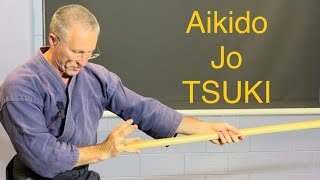
Aikido Jo Thrust TSUKI tutorial
Paul Frank

3 “magic knockout” pressure points. (Amazing!)
FightFast
WUTANG SWORD the basics (watch & train)
The Kung Fu Fam
Knife Defense Won't Work Against A Skilled Attacker
Budo Brothers
Kendo Basics: How to Cut ( swinging your shinai) A breakdown of the kendo technique to cut/strike
Kendo Tips