Setup and Context
The pancake is a follow-up technique to the quarter Nelson, used when an opponent resists the standard quarter Nelson flip by positioning their leg and arm defensively. It is typically applied when defending against a leg attack such as a double-leg or single-leg takedown attempt, following a sprawl position.
Initial Position and Opponent Resistance
From the sprawl position with a quarter Nelson grip applied to the opponent's head and neck, the defender allows the opponent to lift their head upward if they resist the initial crank. This apparent concession is intentional, as it places the opponent in an off-balanced position vulnerable to the pancake technique.
Executing the Pancake Flip
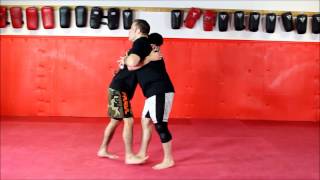
When the opponent lifts their head in resistance, the defender frames the opponent's head, applies a cross-face with their bicep, and flips the opponent laterally onto their back. The defender's closed fist is positioned deep against the opponent's neck and head, creating a position resembling a headlock.
Finishing Position and Control
Once the opponent is flipped to their back, the defender maintains the bicep-to-neck pressure with a deep fist position. The defender extends their arm fully across the opponent's body to secure a pinning position, making it difficult for the opponent to bridge or escape.
Maintaining the Grip During Escape Attempts
A critical detail is keeping the overhook arm (called the 'wizard' hand) positioned deep throughout the technique rather than releasing and re-engaging it. If the opponent's arm manages to position between their body and the defender's arm, the defender should transition to a chicken wing control by moving to the side and securing a full chicken wing grip.
Submission and Rule Considerations
In Brazilian Jiu-Jitsu competition, the deep fist position can be transitioned into a throat choke for a submission finish. In wrestling, choking is not permitted, so the technique is used purely for the pin, though maintaining pressure on the neck remains part of the control mechanism.
LEARN the Tasty Wrestling PANCAKE!!!
Key Takeaways
- •Setup and Context
- •Initial Position and Opponent Resistance
- •Executing the Pancake Flip
- •Finishing Position and Control
This video I breakdown the "Pancake" which is like a headlock when your opponent pops his head up. Check out the details and you are sure to find something useful! Enjoy! If you have any questions, comments, or suggestions, please comment below. More videos to come! Please like, share, and subscribe!! PLEASE Click this link to SUPPORT the TeachMeGrappling Channel!!! https://www.patreon.com/TeachMeGrappling or https://www.paypal.me/CoachBrianPeterson Your contribution is much appreciated and will help me continue to bring you content! 🙏 www.NextLevelGuy.com The NextLevelGuy Podcast with Coach Brian Peterson has been released!! Check it out!
Related Techniques
Frequently Asked Questions
What does this video teach about pancake?
This video covers setup and context, initial position and opponent resistance, executing the pancake flip. It provides detailed instruction from TeachMeGrappling Coach Brian.
How long does it take to learn pancake?
The basic mechanics can be understood in a single session, but developing reliable execution requires consistent drilling over weeks of practice. This 6-part breakdown helps structure your training by isolating each phase of the technique.
What are the key details for finishing pancake?
A critical detail is keeping the overhook arm (called the 'wizard' hand) positioned deep throughout the technique rather than releasing and re-engaging it. If the opponent's arm manages to position between their body and the defender's arm, the defender should transition to a chicken wing control by moving to the side and securing a full chicken wing grip.
Related videos
ALL You Need is a HEADLOCK!!!
TeachMeGrappling Coach Brian
The MOST Effective Headlock!
TeachMeGrappling Coach Brian
Introduction To Pancake Guard - A Minimal Effort Guard Retention Trick.
Keenan Cornelius
Suplex without the jacket for MMA
IVAN VASYLCHUK. SILA PARTERA
Poughkeepsie BJJ Lateral Drop - Precision MMA LaGrange, NY
Precision Boxing & MMA