Introduction & Setup
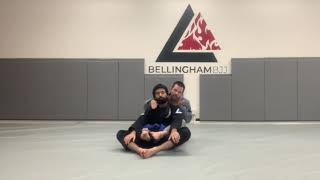
Chad Lyman, director of Combatos and Progressive Force Concepts, demonstrates the one-wing collar choke with Greg Caltech, a Team Zenith competitor. The instructors will present four finishing variations from a single initial grip while mounted on the opponent's back.
Common Mistake: Arm Placement
The most frequent error occurs when the top-side arm remains in the middle of the opponent's body during seat belt control. This positioning prevents access to the collar and neck. The correct approach is to hide the arm in the opponent's armpit and cross it over, allowing the supporting hand to clear space for collar access.
Establishing the First Relevant Grip
The foundational technique emphasizes establishing the first relevant lapel grip before attempting any finish. The thumb stays inside the collar while fingers grip outside, racing to secure this attachment before the opponent can defend. Once obtained, this grip becomes the launching point for all four variations.
Variation 1: Single-Wing Finish
From the initial lapel grip secured behind the opponent's back, the instructor falls to the side while extending the choke. This represents the primary attacking option when the opponent does not resist significantly.
Variation 2: Stacked Double-Lapel Choke
When the opponent clamps down on the initial grip, the instructor punches across to secure the opposite lapel. Both hands are then stacked at the chest, and the instructor falls to complete the choke.
Variation 3: Bow-and-Arrow Choke
As the opponent escapes laterally and clears the hook, the instructor posts a leg across the opponent's body to prevent half-guard. The instructor then feints an armbar attempt while maintaining the collar grip, transitioning into a bow-and-arrow choke variation.
Variation 4: Clock Choke Finish
When the opponent continues rotating toward turtle position, the instructor maintains the lapel grip and follows around front. From this position, a clock choke is executed as the opponent's rotation is exploited against them.
Key Principle: Grip Retention
The critical factor across all variations is never relinquishing the initial collar grip unless consciously transitioning to a different grip. Once established, the grip should be carried through the entire sequence, allowing the instructor to adapt to the opponent's escape attempts seamlessly.
4 ways to finish a collar choke off of the 1st relevant grip...
Key Takeaways
- •Introduction & Setup
- •Common Mistake: Arm Placement
- •Establishing the First Relevant Grip
- •Variation 1: Single-Wing Finish
Choke progression...establish a cross grip, finish with a single wing, staked hands cross choke, bow and arrow choke, and a clock choke
Frequently Asked Questions
What does this video teach about one wing collar choke?
This video covers introduction & setup, common mistake: arm placement, establishing the first relevant grip. It provides detailed instruction from Code 4 Concepts Chad Lyman.
How long does it take to learn one wing collar choke?
The basic mechanics can be understood in a single session, but developing reliable execution requires consistent drilling over weeks of practice. This 8-part breakdown helps structure your training by isolating each phase of the technique.
What are the key details for finishing one wing collar choke?
When the opponent continues rotating toward turtle position, the instructor maintains the lapel grip and follows around front. From this position, a clock choke is executed as the opponent's rotation is exploited against them.
Related videos
Grappling Concepts for MMA or Self Defence - Develop a FAST Rear Naked Choke with Rene Dreifuss
Stuart Tomlinson
Single Wing & Bow Choke from the Mount - Jiu Jitsu Training
Gracie Barra O'Fallon
Head And Arm Rear Naked Choke by Heath Pedigo
BJJ Fanatics
Sode Guruma Jime || Sleeve Wheel Choke
The Judo Way of Life
Fundamentals: Gable Grip Choke from the Back
Bellingham BJJ