Initial Setup and Arm Placement
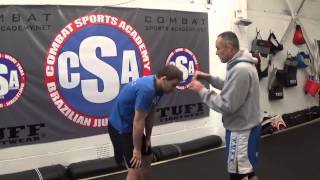
The instructor begins by establishing the crucifix position with the opponent's chin down. The attacking arm comes across the opponent's jaw while the second hand secures the outside of the shoulder. This dual-hand configuration allows the practitioner to control both the head rotation and upper body positioning simultaneously.
Head Rotation and Pressure Application
With the forearm positioned on the opponent's jaw, the practitioner initiates head rotation by flexing the wrist outward while maintaining shoulder pressure. A slight step-in and upward lift creates the turning motion—head rotation combined with upward force—that transitions into the submission.
Chest Capture and Hip Positioning
The practitioner captures the opponent's head under their chest and secures it in the armpit. Hip positioning is then squared up to create maximum pressure, with wrist flexion directed outward against the jaw. This hip-to-head connection creates the mechanical leverage necessary for the neck crank submission.
Defense Counter: Arm Escape Resistance
When the opponent attempts to pull the attacking wrist away, the practitioner responds by transitioning the grip deeper into the armpit. Significant pressure is maintained on the back of the neck and head, preventing the escape. A knee strike to the opponent's body softens resistance and reestablishes control.
Takedown Entry: Chopping the Rear Leg
Following the knee strike, the practitioner rotates the opponent's body and executes a rear leg chop. The same-side hand plants on the floor while the corresponding leg slides through behind the opponent's legs. This transition positions the practitioner to finish the neck crank from a ground position.
Ground Finish: Sliding Arm Over Neck
As the practitioner lands on the floor, the arm slides over the back of the opponent's neck while the same-side leg secures position behind the legs. The body tucks tightly to the opponent, creating the final neck crank with maximum leverage and control.
Counter to Head Escape
If the opponent attempts to extract their head from the initial crucifix position, the practitioner redirects the head in its current direction and immediately throws an elbow strike. This prevents the escape while creating space and momentum to re-establish the grommet position with renewed pressure.
Level Change and Re-entry Strategy
When the opponent pulls away, the practitioner combines elbow and knee strikes with a level change to transition sides. From this new angle, the practitioner re-enters the neck crank position with control re-established. This sequence prevents the opponent from fully escaping and maintains offensive pressure throughout.
The Grovit Neck Crank to Crucifix Neck Crank / Double leg Takedown
Key Takeaways
- •Initial Setup and Arm Placement
- •Head Rotation and Pressure Application
- •Chest Capture and Hip Positioning
- •Defense Counter: Arm Escape Resistance
I demonstrate some old school techniques which can be used in pro Grappling events that allow neck crank/locks and pro MMA The first is a Grovit neck lock,one of my favorite moves and one of the first moves i learnt many years ago. The second i set up the Grovit with strikes again and as the post to create distance i capitalize on this by entering into a takedown finishing with the crucifix neck crank. The third is a Grovit being set up with some strikes, i then show you an option for a double leg takedown if your opponent slips out of the submission. Both these neck locks are very dangerous and should be practiced under expert supervision such as your coach
Related Techniques
Frequently Asked Questions
What does this video teach about face crank from crucifix?
This video covers initial setup and arm placement, head rotation and pressure application, chest capture and hip positioning. It provides detailed instruction from MMA Media.
How long does it take to learn face crank from crucifix?
The basic mechanics can be understood in a single session, but developing reliable execution requires consistent drilling over weeks of practice. This 8-part breakdown helps structure your training by isolating each phase of the technique.
What are the key details for finishing face crank from crucifix?
If the opponent attempts to extract their head from the initial crucifix position, the practitioner redirects the head in its current direction and immediately throws an elbow strike. This prevents the escape while creating space and momentum to re-establish the grommet position with renewed pressure.
Related videos
Face locks / Neck cranks
AZ Battle School

Seven Deadly Neck Cranks | Jiu-Jitsu & Submission Grappling
Knight Jiu-Jitsu

Crank his neck or knee his face - A devasting Neck Crank from the Leg Nelson
EffortlessJiuJitsu
The Grovit Neck Crank to Crucifix Neck Crank / Double leg Takedown
MMA Media
Crank his neck or knee his face - A devasting Neck Crank from the Leg Nelson
EffortlessJiuJitsu