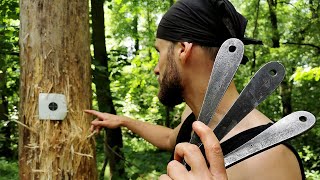
Introduction & Safety Protocol
This instructional guide teaches knife throwing fundamentals with emphasis on recreational practice in controlled environments. The instructor establishes critical safety parameters: never use this technique for self-defense, always practice in isolated outdoor areas away from people and structures, and maintain awareness of potential blade bounce-back and breakage.
Balanced Knife Fundamentals
Properly balanced throwing knives feature weight distribution centered along the blade's midline, creating predictable and even rotational patterns during flight. This balanced design is the defining characteristic that makes specialized throwing knives superior for consistent results and controlled technique execution.
Distance-to-Rotation Ratio
The core principle of knife throwing follows a mathematical relationship: each step backward from the target equals one half-rotation (180 degrees) of the blade. To achieve one complete blade rotation, the thrower must maintain four paces of distance, which positions the knife for optimal point-first contact with the target.
Throwing Unbalanced Blades
Unbalanced knives—such as kitchen or bread knives with weight concentrated toward the handle—require grip adjustment to compensate. The thrower must lower their hand position during release to shift the rotational balance point closer to center, mimicking the behavior of a properly balanced blade.
Distance Adjustment & Refinement
If the blade lands at an angle rather than point-first, the thrower should increase distance by approximately four inches and retry. This incremental adjustment method allows practitioners to dial in the precise distance needed for their specific blade and throwing style.
Extended Objects: Sword Throwing
Longer bladed weapons like swords operate under the same rotational principles but require significantly greater throwing distance due to their increased blade length. Practitioners should maintain approximately two additional feet of distance compared to standard knives to account for the larger rotational arc.
Self-Defense Clarification
Knife throwing has no practical application in self-defense scenarios and should never be attempted for this purpose. Retaining possession of weapons remains the appropriate defensive strategy in threatening situations.
Environmental Requirements
Safe knife throwing practice demands complete isolation in outdoor settings with no spectators, animals, or structures in proximity. This recreational activity carries inherent risks of ricochet and blade fragmentation that necessitate absolute environmental control.
LEARN TO THROW ANY KIND OF KNIFE
Key Takeaways
- •Introduction & Safety Protocol
- •Balanced Knife Fundamentals
- •Distance-to-Rotation Ratio
- •Throwing Unbalanced Blades
This is only for recreational purposes! I don’t recommend doing this for any kind of self-defense situation, but throwing knives in a Safeway is super super super fun. Do you have any questions? Leave them in the comments below! Also, here is a link to the kids book that I mentioned in the video. https://www.amazon.com/Epic-Nature-Journal-Anthony-Porter/dp/1962202577/ Many movies throw knives, and the techniques are extraordinarily varying. If you see certain people throwing them by the blades, that is a technique that is used for a different style of throwing, or if the target is an odd number of steps away, if you are using my current technique. Feel free to follow and comments, do all that stuff. #howto #survival #nature #comedy #bushcraft #outdoors #animals #archery #knifethrowing #knife #mythbuster 
Frequently Asked Questions
What does this video teach about standard knife throwing technique?
This video covers introduction & safety protocol, balanced knife fundamentals, distance-to-rotation ratio. It provides detailed instruction from OutdoorAnthony.
How long does it take to learn standard knife throwing technique?
The basic mechanics can be understood in a single session, but developing reliable execution requires consistent drilling over weeks of practice. This 8-part breakdown helps structure your training by isolating each phase of the technique.
What are the key details for finishing standard knife throwing technique?
Knife throwing has no practical application in self-defense scenarios and should never be attempted for this purpose. Retaining possession of weapons remains the appropriate defensive strategy in threatening situations.