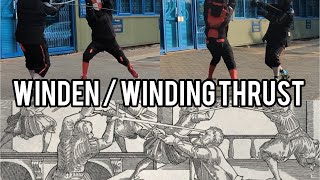
Introduction to Hangings and Windings
Hangings (hengen) and windings (vinden) represent the final technical verses of Liechtenauer's system for unarmored longsword combat. These positions derive from the ox and plow stances and are fundamental to understanding the entire Zettel curriculum. Winding refers to the act of turning the blade into a hanging position, a concept many practitioners recognize visually but struggle to articulate.
Defensive and Offensive Applications
Hangings and windings serve both defensive and offensive functions. The choice between ox and plow depends on which openings the opponent threatens: plow defends lower targets while ox protects the upper body. Since Liechtenauer's system emphasizes engaging upper openings, practitioners will wind into ox and plow most frequently to protect the head.
Hard and Soft Windings
Windings divide into hard and soft categories based on opponent pressure. Soft windings occur when the opponent holds the center line, requiring the fencer to establish strong-on-weak contact and seize control. Hard windings respond to lateral pressure by winding on the outside of the sword while maintaining close distance—a counterintuitive but effective approach that prevents the opponent from generating lethal force.
The Three Wonders: Cut, Thrust, and Slice
The three wonders (traivunda) represent the three ways to injure an opponent: thrust, cut, and slice. All three techniques execute from the same winding motion, with range determining selection—thrust at distance, cut at medium range, and slice when close, typically targeting the neck and face. This yields 24 distinct winding techniques when applied to the four main positions.
Footwork and Distance Control
Proper winding demands intentional stepping rather than arm extension. Practitioners must choose passing steps, advancing steps, or other methods based on range and context to maintain control of the bind. Extending the arms forward sacrifices the protective and controlling advantages of hangings and windings, reducing the technique to point-fighting alone.
Against Extended Arm Fencing
Historical sources criticize masters who teach extended-arm longsword fencing as weak and ineffective. Liechtenauer's system develops true strength through proper distance management and blade control rather than muscular extension. The comparison to a rabbit chase illustrates how reaching and stretching waste energy and surrender the advantages inherent to shortened sword work.
Recognizing Windings Throughout the Zettel
Windings appear throughout the Zettel in various contexts, though not always explicitly named. Doubling, mutating, and outer takings all constitute winding variations. When the text references longpoint or shooting, these represent distinct techniques outside the winding framework and should not be confused with winding applications.
Threat and Counters
Windings must present genuine threats; every movement must be capable of landing if the opponent fails to react. Excessive focus on the bind creates openings for skilled opponents to strike. The manuscript itself provides explicit counters, particularly through techniques like schilhau, demonstrating that winding proves vulnerable to practitioners who understand its mechanics.
Foundation of All Longsword Work
Liechtenauer identifies windings as the true foundation of sword fencing from which all other techniques and methods derive. Mastery requires consistent, deliberate practice combined with guidance from skilled instructors who understand both historical sources and practical application. The vinden represent not a secret weapon but the essential framework that enables effective longsword combat.
Liechtenauer's Zettel - Ep 32 | Hengen & Winden + All 24 Windings
Key Takeaways
- •Introduction to Hangings and Windings
- •Defensive and Offensive Applications
- •Hard and Soft Windings
- •The Three Wonders: Cut, Thrust, and Slice
Something I said that's incorrect is saying setting on is just longpoint. Setting on is usually described with long point and shooting, however there are some examples of it being described with Half-swording and hangings. It's such an important set of verses that I couldn't shave the time down. And the last 3 minutes are all 24 Windings. This video only covered what they are, so I didn't get into specifics about how to use them and motions etc. Its sad to come to the end of Liechtenauer's series. Thank you for the support and watching. I'll be working on what to make going forward. I know I spelt Longpoint wrong, but I don't have super high standards. These video's have some of the assumed knowledge going into the windings episode. Unter Hengen https://www.youtube.com/watch?v=cw2bpqQJCiE Longpoint https://www.youtube.com/watch?v=uyJvtNsobl0 0:00 Hanging & Winding 6:23 All 24 Windings Series Info: Due to social distancing I'm going to make a series going through the verses of the Zettel for my students to use as a reference. The Zettel is the series of cryptic verses written by Johannes Liechtenauer to his students(1400s). It would become the foundation of the German combat system lasting over 200 years. In my opinion the Zettel and the treatises from it are a series of advanced techniques written for people who can already fight with a sword. Therefore these videos as well are not made to be an in depth trainer for beginners but just going through the idea behind each verse. These are my interpretation at the moment but as we develop, grow and learn, ideas can change. Feel free to disagree with me and try out other interpretations. My goal is to make very short and precise videos for one or two verses. Because of this there will be lots of information and details that don't make the cut.
Frequently Asked Questions
What does this video teach about standard winden?
This video covers introduction to hangings and windings, defensive and offensive applications, hard and soft windings. It provides detailed instruction from SuperiorHEMA.
How long does it take to learn standard winden?
The basic mechanics can be understood in a single session, but developing reliable execution requires consistent drilling over weeks of practice. This 9-part breakdown helps structure your training by isolating each phase of the technique.
What are the key details for finishing standard winden?
Windings must present genuine threats; every movement must be capable of landing if the opponent fails to react. Excessive focus on the bind creates openings for skilled opponents to strike. The manuscript itself provides explicit counters, particularly through techniques like schilhau, demonstrating that winding proves vulnerable to practitioners who understand its mechanics.