Introduction to Jo Self-Defense
The jo, or Japanese walking stick, serves as an effective self-defense tool that is both practical and discreet. Unlike longer staffs, the jo's compact size allows for indoor practice and travel without drawing attention.
Wrist Roll Conditioning Drill
The wrist roll exercise builds essential hand and wrist strength for effective jo manipulation. The practitioner holds the staff between thumb and forefinger, rolling it over the hand in controlled motions before advancing to unassisted rolls at increasing speeds.
Fundamental Spearing Strike
The spearing strike is executed by positioning the jo between the practitioner and opponent, then sliding it forward using thumb direction and pulling motion. The technique targets soft body areas and must be practiced ambidextrously, alternating sides with proper hand positioning.
Hand Position Transitions
Maintaining continuous contact with the weapon prevents disarming by sliding one hand over the other while keeping both hands on the staff. The practitioner executes strikes on alternating sides while transitioning hand positions and footwork simultaneously.
Dual-Hand Strike Control
The bottom hand generates power by pulling like a sword draw, while the top hand accelerates and controls strike angles. This combination creates both power and directional precision through coordinated wrist rotation and hand sequencing.
Overhead Strike Execution
The overhead strike begins with hands positioned on opposite sides of the jo, then slides forward with proper foot alignment matching the top hand side. The technique requires synchronizing hand rotation with forward stepping for maximum impact.
Center Line Defense Principle
All incoming attacks—punches, knife strikes, and sword attacks—concentrate force along the center line. Deflecting attacks laterally rather than meeting them head-on proves more effective, particularly against bladed weapons that could split the jo.
Standard Jo Block Mechanics
The standard jo block positions both hands to the sides with palms facing each other, then rotates the back hand upward in an arc while turning the front hand downward. This motion both deflects incoming attacks and positions the jo for immediate counter-strikes.
Block-to-Strike Combination
After executing the block with proper hand rotation, the practitioner pulls the jo back slightly before spearing toward the opponent's throat. The sequence concludes with bringing the jo overhead and striking downward, creating a continuous defensive-offensive flow.
Japanese Jo or walking stick for self defense
Key Takeaways
- •Introduction to Jo Self-Defense
- •Wrist Roll Conditioning Drill
- •Fundamental Spearing Strike
- •Hand Position Transitions
Get your Quantum Cane Masters Staffs here: https://canemasters.com/collections/walking-sticks-and-walking-staffs?ref=GpLhKkHm_wUID and save ten percent when you use coupon code MATT In this video you are going to learn how to use a Japanese Jo or walking stick for self defense. Matt Pasquinilli of 89tigers.com teaches you how to use a martial arts short staff to defend yourself in this simple and easy to follow tutorial and workout with a hand and wrist strengthening spin and three basic strikes and one block. Grab your Jo or walking stick and follow me! That's not a hard and fast rule. Don't overthink it. If it's taller than you, it's a long staff. If it's shorter than you by a lot, it's a short staff. If it's about as long as your forearm to your fingertip, it's a stick. Call it whatever you want. Grab yours and follow me. I'm going to have you warm your hands and your wrists up with this overhand spin. An obvious question might be, why would you spin in self defense? You wouldn't until you expand your concept of what self defense is. You want to be a martial artist, expand that concept of self defense. Self defense against weak wrists and hands, and hands that are going to drop the staff because they don't have any muscles 'em, self defense against that is spinning the staff. Stop it and spin it back the other way. All right, now you're warmed up. Let's talk about how to carry it. The most obvious way to carry your short staff is as a walking stick. You're behind it in this position. Anytime you're using it, assisting you, whether you're really leaning into it or you just have it on the ground, you're behind it. That means when the threat is in front of you, your stick is between the threat and your body, your vital organs, especially. From this position, you can just simply pick it up and grab it with the other hand. Now you have it like this. This is how we fought in the Marine Corps with the pugil sticks or with the bayonet on the end of the rifle. It's a very obvious instinctive way to use a walking stick. You're behind your stick. You bring it in, slide in a little bit, get a good grip, make sure your fists are tight and jam, right into the body. Now, I don't want you to overthink technique too much at this beginning stage. Principle over technique. The principal involved, let's keep the stick between you and the other guy. The technique that's involved can be a jab, can be a slam down on the top of their head. You can whack them with the backside of the staff. You can, I don't know if you know how to spin, do some kind of fancy spin. That's technique and technique is not important, principle is. Situational awareness first. Pay attention what's happening around you. Number two, what are their targets? Number three, what tools do you have to destroy or remove their targets, and then after that number four is just the fight's not over until you win. Now back to the stance. You can be carrying it in this position. If you feel like a threat is more eminent or you don't feel secure, maybe you think there's somebody behind you or to the side of you, bring it up to the hand, walk like this, but this is a little bit more menacing. You walk around like this, you'll provoke something that wasn't supposed to be there. It's better to be safe than sorry. That means it's better to be more prepared when you feel like there might be a threat than to be caught completely off guard. Another way to think about carrying it is just in the hand next to your body, walking like this. It's a short enough staff. It's not ridiculously long. Maybe it looks like you're carrying a piece of lumber. So you're walking down the street or in an alleyway or wherever you are, have your sticking your hand like this, you can stop. You can talk to people. You don't have to look like a threat. Again, threat, just carrying a piece of wood. Now, back to the strikes. I said you can jam in this way, into the body. Now, there are all kinds of techniques involved, and ggain, don't worry about technique yet. We'll go over that later. Just think of pushing, tight grip, slam as hard as you can in the center of the body. music from bensound.com
Frequently Asked Questions
What does this video teach about standard jo block?
This video covers introduction to jo self-defense, wrist roll conditioning drill, fundamental spearing strike. It provides detailed instruction from Matt Pasquinilli.
How long does it take to learn standard jo block?
The basic mechanics can be understood in a single session, but developing reliable execution requires consistent drilling over weeks of practice. This 9-part breakdown helps structure your training by isolating each phase of the technique.
What are the key details for finishing standard jo block?
The standard jo block positions both hands to the sides with palms facing each other, then rotates the back hand upward in an arc while turning the front hand downward. This motion both deflects incoming attacks and positions the jo for immediate counter-strikes.
Related videos
No-contact Basic Aikido Techniques #1 - With Jo
Tampa Aikido
6 Forbidden Knockout Pressure Points (Martial Arts Secrets You’re Not Supposed to Know)
Master Yourself
Shinto Muso Ryu Gyakute zuki
funkrelaxo
SHINTO MUSO RYU JODO DEMONSTRATION | JODO AUCKLAND
AIKIDO SILVERDALE
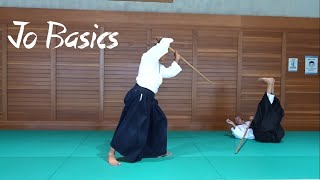
Basic Jo Principles - Introduction to Chiba Sensei's Weapons System #7
Davinder Bath