Core Principles of Firearm Defense
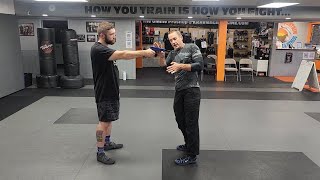
When defending against a firearm threat at forehead height, the defender must operate from two fundamental facts: the weapon will discharge upon contact, and the attacker will retract their arm or body immediately after firing. Any effective firearm defense must address these two inevitable realities. Defenses that fail to account for these factors should be immediately rejected as unreliable.
Primary Defensive Objectives
The defender's first priority is to move off the line of fire immediately, preventing a direct hit. The second priority is to pursue the attacker's retracting motion to maintain control of the weapon and prevent escape. These two objectives must be executed in rapid succession to neutralize the threat effectively.
Entry and Deflection Mechanics
The defender raises both hands with the foreheadcoming forward while simultaneously driving the right foot toward the attacker's groin. This aggressive, forward-moving entry forces the defender off the firing line while closing distance. The motion uses the defender's body weight and momentum to control the weapon's trajectory.
Weapon Acquisition and Securing
Upon contact, the defender grabs the weapon while driving forward, then rotates it away from the attacker's body. A small step with the left foot forward aids balance and creates additional lateral offset from the center line. Once the weapon is secured in the defender's hands, control is established.
Disengagement Protocol
Once the defender successfully secures the firearm, there is no tactical reason to continue engaging the attacker. The defender should immediately open distance and create separation to safety. For law enforcement, the proper procedure is to clear the weapon and draw their own sidearm before disengaging.
Training Methodology
Practitioners should begin training at slow speeds to develop proper mechanics and timing. The technique should be practiced repeatedly with role rotation, ensuring all students experience both defender and attacker positions. Smooth, controlled repetition builds muscle memory and reflex response necessary for crisis situations.
How to Defend against a Gun to the Face | Krav Maga Defense
Key Takeaways
- •Core Principles of Firearm Defense
- •Primary Defensive Objectives
- •Entry and Deflection Mechanics
- •Weapon Acquisition and Securing
Full Playlist: https://www.youtube.com/playlist?list=PLLALQuK1NDrhbNpRSUEAloceyNEMzcKzN - - Like these Krav Maga Tutorials !!! Check out the official app http://apple.co/1MpyDY0 Want more techniques for Contact Combat? Mastering Krav Maga (Volume I): http://amzn.to/1VHIavC Krav Maga: Real World Solutions to Real World Violence Paperback: http://amzn.to/1VHVRjy Krav Maga for Beginners: A Step-by-Step Guide: http://amzn.to/1G0yZVe Complete Krav Maga: The Ultimate Guide: http://amzn.to/1htaEvv Krav Maga: An Essential Guide to the Renowned Method: http://amzn.to/1VHImeo Watch more Krav Maga Self-Defense Techniques videos: http://www.howcast.com/videos/509338-How-to-Defend-against-a-Gun-to-the-Face-Krav-Maga-Defense Master Rhon Mizrachi: We're doing defense against a gun, forehead height. Please. Student: Give me your money! Master Mizrachi: Gun. You are allowed to make two assumptions, and they are not assumptions. It is what's going to happen. The minute you touched it, it'll go boom. And it's a fact. Right after it went boom, he's going to his arm back or his entire body back. And it's a fact as well. And if any gun defense that you have seen until now will not answer to these two obvious questions, then you should question your defense against a gun. First of all, because it will fire, the number one priority is for me to get out of the line of the gun. That's first of all. Second of all, I have to keep in mind that I'm going to have to chase it to some degree, because he's going to have to pull. I'm gonna get off the line, and I'm gonna strike him. And I'm gonna attack in, bringing the gun into his belly. From here, I'm going to yank it out, throw a fresh round empty chamber, and open the gap. If you are in the law enforcement community and this is not your weapon, you should clear the weapon and pull your own weapon out. Please. Thank you. This is one. One, heads come up, forehead goes in. So if you look at it from the side, I'm actually here. Head. One. Back. One. Back. One. Back. It is done on one foot, and at the same time right foot kicks towards the groin. One. Back. One. Back. One. Back. Once you hit, you grab, you lean forward, and you rotate to it. Most people ... Oh, what I should advise you to do is to take a small step, and to add a step with your left foot forward, because it will carry you slightly off his center, and it will make your life a lot more comfortable. Head. One. Step and rotate to it. Rotate the gun out, and it's in your hands. Again. Head. One. Step and step, push it into him. Take the gun, and it's in your hand. I should tell you that if you happened to do it and the gun ended up in your hand, there's no reason to continue and chase him. You should just open the gap right away. Please. Take the gun, start working. Every time you switch, because every time somebody else is going to end up with the gun. Step slow, please. Smooth, try to maintain the motion smooth. Thank you very much.
Related Techniques
Frequently Asked Questions
What does this video teach about defence against gun threat front?
This video covers core principles of firearm defense, primary defensive objectives, entry and deflection mechanics. It provides detailed instruction from Howcast.
How long does it take to learn defence against gun threat front?
The basic mechanics can be understood in a single session, but developing reliable execution requires consistent drilling over weeks of practice. This 6-part breakdown helps structure your training by isolating each phase of the technique.
What are the key details for finishing defence against gun threat front?
Once the defender successfully secures the firearm, there is no tactical reason to continue engaging the attacker. The defender should immediately open distance and create separation to safety. For law enforcement, the proper procedure is to clear the weapon and draw their own sidearm before disengaging.
Related videos

Black Scout Tutorials - Urban Tactics - Pistol Disarming from the Front
BlackScoutSurvival
How To Defend A Gun Threat | Front Two Handed Cupping Technique
ClearSky.Training

Subway Common Sense - Self Defense Techniques
Vee AJ Jitsu

SITTING ON THE SUBWAY part 2 - Self Defence Techniques
Vee AJ Jitsu

SITTING ON THE SUBWAY part 1 - Self Defence Techniques
Vee AJ Jitsu