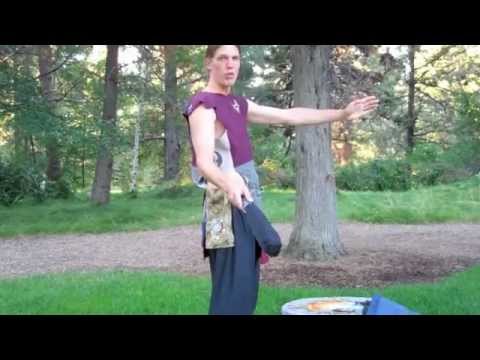
reverse grip knife combat sinawali
0
Forward Grip·wmpyr
I think many people do not understand FMA and think that because it is a traditional martial art style that it is only f…
Translation: forward grip
The Forward Grip (also called saber grip or hammer grip) holds the knife with the blade extending from the thumb side of the fist, as one would hold a hammer. [1] This grip provides the greatest reach, strong thrusting capability, and intuitive cutting motions along all standard angles of attack. [1],[2] The forward grip is the most commonly taught knife grip in both military combatives and Filipino martial arts because of its versatility and natural biomechanics. [2],[3]
The forward (saber) grip, with the blade extending from the top of the fist along the thumb side, is the most common and most versatile knife grip. [1] It provides the greatest reach, the widest range of cutting angles, and the ability to thrust effectively. Its primary advantage is reach — the forward grip extends the blade as far from the body as possible. [2]
The forward grip (hammer grip, sak-sak) is the most natural and commonly used knife grip across all blade-fighting traditions. [1]
The forward grip is the standard knife-holding position in most FMA competition and training. [1]
No images yet for this technique.
Sign in to suggest an image.
I think many people do not understand FMA and think that because it is a traditional martial art style that it is only f…
No matter what martial art you do, a good grip is crucial to your development as a martial artist. In this video, I sho…
First in a series of tutorials on Belegarth combat. Overviews defensive principles focusing on basic grip, stance, guard…
The forward grip in knife fighting is foundational to effective striking, blocking, and control. Bhakdar emphasizes grip construction by analogizing to hammer grip mechanics, maintaining an arc from shoulder through weapon tip that facilitates both striking power and blocking efficiency. Critical to the forward grip's defensive application is wrist positioning: rotating the wrist outward creates distance between an incoming attack and the defender's arm, effectively stopping momentum without requiring large movements. The forward grip integrates with stance and guard positioning—Bhakdar advocates a semi-sideways body orientation that narrows the torso target area and positions the weapon to defend the central rectangular 'box' of the body. In contrast, wmpyr addresses the forward grip primarily as a baseline for comparative study, demonstrating how dual forward grips facilitate arm weaving drills (sinawali patterns) before transitioning to reverse/ice pick grip variations. Wmpyr notes that forward grip with sinawali employs the knives as 'short sticks,' making the technique more intuitive than reverse grip applications. Mantis Mechanics' contribution focuses on grip strength development rather than technique mechanics, addressing the functional demands underlying effective forward grip deployment through targeted exercises like softball pull-ups, towel pull-ups, and farmer carries. While Bhakdar and wmpyr discuss positional mechanics, Mantis Mechanics emphasizes that grip functionality should align with martial arts application—whether grappling, striking, or sustained control.
Synthesized from 3 instructors
No instructional courses yet for this technique.
Sign in to suggest a course.
Risk of injury to the person this technique is applied to
Knives and short blades are the most common weapon in real-world assaults; high lethality
Skill level needed to execute this technique reliably
Whether this technique is allowed under major competition rule sets
Bubishi: The Classic Manual of Combat (Patrick McCarthy, 2008)
Alias sources — [1] Filipino Martial Arts (Wiley, 1994) [2] Hoplology (Burton, 1884) [3] Comprehensive Asian Fighting Arts (Draeger & Smith, 1969)
Effectiveness sources — [1] Wiley, M., Filipino Martial Arts (Charles E. Tuttle, 1994) [2] Inosanto, D., The Filipino Martial Arts (Know Now Publishing, 1980)
Established Japanese martial arts naming convention — native Japanese term (和語/漢語)
Alias sources — [1] Filipino Martial Arts (Wiley, 1994) [2] Hoplology (Burton, 1884) [3] Comprehensive Asian Fighting Arts (Draeger & Smith, 1969)
Effectiveness sources — [1] Wiley, M., Filipino Martial Arts (Charles E. Tuttle, 1994) [2] Inosanto, D., The Filipino Martial Arts (Know Now Publishing, 1980)
wrist control for edge alignment, grip endurance, footwork precision
quick wrists, strong forearms, good posture
forearm extensors/flexors, deltoids, core, calves
Starting with sticks builds foundational arm weaving motions that are essential for knife work. According to WMPYR, brutal knife techniques are based off arm weaving motions, so it's important to master the basics with sticks before progressing to knives.
Mantis Mechanics emphasizes that you should first decide what you want to use your grip for—whether it's pulling someone in, holding for extended periods like in jiu-jitsu, or generating crushing force—then choose exercises that emulate those specific movements rather than training all grips the same way.
Mantis Mechanics recommends three exercises: softball pull-ups (varying finger positions), towel pull-ups, and farmer carries with heavy weight. These build forearm endurance and pulling strength applicable to martial arts.
The Forward Grip (also called saber grip or hammer grip) holds the knife with the blade extending from the thumb side of the fist, as one would hold a hammer. This grip provides the greatest reach, strong thrusting capability, and intuitive cutting motions along all standard angles of attack.
The forward grip is the instinctive way humans grasp a tool or weapon and has been the default knife grip in combat throughout history. Military knife manuals from Fairbairn's 1942 Get Tough to modern special operations curricula teach the forward grip as the primary combat hold.
WEKAF: legal — Legal in padded stick competition; HEMA: legal — Legal in applicable weapon categories
Danger rating 9/10. Extreme — knives and short blades are the most common weapon in real-world assaults; high lethality
The standard setup chain: Ready Position → Distance Control → Execute Technique → Return to Guard.
Standard counters include: Parry (Absetzen) — deflect the incoming blade with a counter-displacement / Void (Step Back) — withdraw from measure to avoid the cutting arc / Counter-Cut (Nachreisen) — strike into the opponent's opening during their attack.
Common variants: Standard cut (primary cutting angle from the ready stance); Thrust (tsuki) (straight thrust targeting the throat, chest, or face); Rising cut (kiri-age) (upward diagonal cut from low to high); Diagonal cut (kesa-giri) (downward diagonal cut following the kimono line).
The forward grip is the standard knife-holding position in most FMA competition and training.
Top errors to watch for: Extending the thumb along the spine during thrusts — the thumb should wrap the handle during powerful thrusts to prev… / Holding the knife too loosely — the forward grip must be firm enough to prevent disarms while remaining flexible / Not using the pommel — the butt of the knife in forward grip is a useful striking tool at close range / Limiting to thrusts only — the forward grip allows cuts, slashes, and draw cuts; use the full repertoire.
The Forward Grip is also known as Junte-mochi, Sak-Sak Grip, Hammer Grip, Standard Knife Grip.