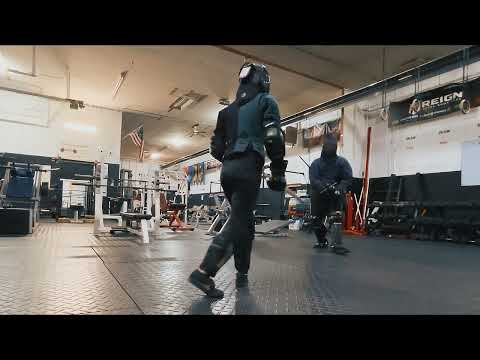
S4 - Dagger vs Longsword - HEMA Challenge
0
Dagger — HEMA·McCamey YHF
Here we've got a fun couple of matches pitting the longsword against someone armed with only a dagger. The chance for vi…
Translation: dagger — HEMA
The Dagger (HEMA) family covers the European historical dagger combat techniques preserved in medieval and Renaissance fight-books. [1] HEMA dagger fighting is characterised by its integration with armoured combat (Harnischfechten), where the dagger was the weapon of choice for dispatching a downed opponent through gaps in plate armour. [1],[2] Techniques include thrusts to vulnerable points such as the visor, armpits, and groin, along with disarms, locks, and throws that blend seamlessly with wrestling (Ringen). [2],[3] Major sources include Fiore dei Liberi's Fior di Battaglia, which devotes an entire section to dagger (daga), and the German Fechtbücher of Hans Talhoffer, Paulus Kal, and Codex Wallerstein. [3],[4]
European dagger combat was codified in Italian and German fight-books from the late fourteenth century onward, with Fiore dei Liberi's 1409 manuscript providing one of the most systematic treatments. [1] German masters such as Hans Talhoffer (c. 1420–1490) illustrated dagger techniques for judicial duels, while the anonymous Codex Wallerstein (c. 1470) added further material. [2],[3] The HEMA revival of the late twentieth century brought these manuscripts back into active study, and today dagger is a competitive discipline at events such as Swordfish and Longpoint. [3],[4]
Dagger combat was one of the most important and extensively documented fighting arts in medieval Europe, as the dagger was the weapon most commonly carried and most frequently used in close-quarters combat and judicial duels. [1] Fiore dei Liberi devotes the largest single section of Fior di Battaglia to dagger combat, documenting dozens of plays (techniques) including thrusts, disarms, locks, and takedowns. [2]
Dagger combat is documented in virtually every major European fight book, including Fiore dei Liberi's Fior di Battaglia (1409), Hans Talhoffer's fight books (1443–1467), and the Codex Wallerstein. [1] Fiore's dagger system serves as the foundation for understanding his entire martial art, as he uses dagger plays to teach principles that apply to all weapons. [2]
HEMA dagger competition features techniques from medieval fighting manuals, with dedicated dagger divisions at tournaments like Swordfish and CombatCon. [1]
No images yet for this technique.
Sign in to suggest an image.
Here we've got a fun couple of matches pitting the longsword against someone armed with only a dagger. The chance for vi…
No instructional courses yet for this technique.
Sign in to suggest a course.
Risk of injury to the person this technique is applied to
Knives and short blades are the most common weapon in real-world assaults; high lethality
Skill level needed to execute this technique reliably
Whether this technique is allowed under major competition rule sets
The Art of Combat (Joachim Meyer, 1570)
Alias sources — [1] MMA Instruction Manual (UFC, 2008) [2] MMA Instruction Manual (UFC, 2008) [3] MMA Instruction Manual (UFC, 2008)
Effectiveness sources — [1] Anglo, S., The Martial Arts of Renaissance Europe (Yale University Press, 2000) [2] Fiore dei Liberi, Fior di Battaglia (1409), Getty MS Ludwig XV 13
Standard katakana transliteration of Western martial arts terminology (外来語) — used in Japanese MMA, boxing, and BJJ communities
Alias sources — [1] MMA Instruction Manual (UFC, 2008) [2] MMA Instruction Manual (UFC, 2008) [3] MMA Instruction Manual (UFC, 2008)
Effectiveness sources — [1] Anglo, S., The Martial Arts of Renaissance Europe (Yale University Press, 2000) [2] Fiore dei Liberi, Fior di Battaglia (1409), Getty MS Ludwig XV 13
wrist control for edge alignment, grip endurance, footwork precision
quick wrists, strong forearms, good posture
forearm extensors/flexors, deltoids, core, calves
Every move, in any martial art, shares a few universal traits. Mix and match below to pinpoint the right tool — or compare equivalents across styles.
The dagger appears in 1,746 passages across 113 books — one of the most referenced weapons in our corpus. HEMA dagger fighting (Ringen am Messer) is documented in multiple Fechtbücher. The dagger was the close-quarters sidearm of the medieval period. (113 books; Clements, Medieval Swordsmanship; Tobler, Secrets of German Medieval Swordsmanship)
The Dagger (HEMA) family covers the European historical dagger combat techniques preserved in medieval and Renaissance fight-books. HEMA dagger fighting is characterised by its integration with armoured combat (Harnischfechten), where the dagger was the weapon of choice for dispatching a downed opponent through gaps in plate armour.
European dagger combat was codified in Italian and German fight-books from the late fourteenth century onward, with Fiore dei Liberi's 1409 manuscript providing one of the most systematic treatments. German masters such as Hans Talhoffer (c.
Traditional martial arts: legal — Practiced in traditional kata/forms and weapon-specific competition under var…; IWUF: legal — Legal in wushu taolu if applicable; HEMA: legal — Legal in applicable historical weapon categories
Danger rating 9/10. Extreme — knives and short blades are the most common weapon in real-world assaults; high lethality
The standard setup chain: Ready Position → Distance Control → Execute Technique → Return to Guard.
Standard counters include: Beat Parry — deflect the blade with a sharp lateral beat before it reaches target / Displacement — move the body off the line while threatening with the point / Counter-Thrust — extend into the attacker's line during their advance.
Common variants: Standard cut (primary cutting angle from the ready stance); Thrust (tsuki) (straight thrust targeting the throat, chest, or face); Rising cut (kiri-age) (upward diagonal cut from low to high); Diagonal cut (kesa-giri) (downward diagonal cut following the kimono line).
HEMA dagger competition features techniques from medieval fighting manuals, with dedicated dagger divisions at tournaments like Swordfish and CombatCon.
Top errors to watch for: Treating HEMA dagger as knife fighting — medieval dagger combat includes extensive grappling, locks, and throws that … / Fighting at the wrong range — HEMA dagger fighting occurs at grappling distance; staying at arm's length is not the c… / Ignoring the off-hand — the empty hand is essential for grabs, checks, and joint locks in HEMA dagger combat / Using only thrusts — HEMA dagger technique includes pommel strikes, cuts, and the use of the crossguard for hooking.
The Dagger — HEMA is also known as Dagā / HEMA, HEMA Dagger, Medieval Dagger, Dolch.