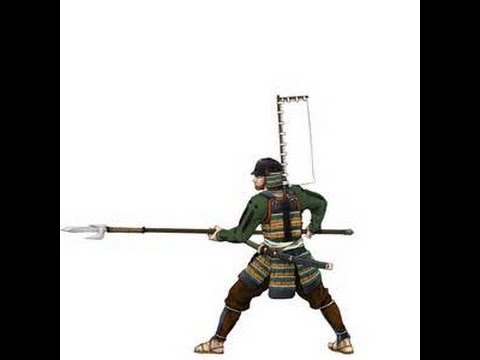
Samurai Spear Challenge
0
Spear Sweep·Antony Cummins
see the original video here https://www.youtube.com/watch?v=CRSj1jBSehg
Translation: Spear Sweep
The Spear Sweep subfamily covers techniques that use the shaft of the yari in sweeping arcs to strike, deflect, or unbalance the opponent, employing the weapon as a staff rather than using the blade to thrust. [1] Sweeping techniques are an important secondary application of the spear, used when the opponent has closed inside thrusting range or when the practitioner needs to create distance by sweeping the opponent's weapon or body. [1],[2] The spear sweep uses the butt end (ishizuki) or the middle of the shaft to strike the opponent's legs, arms, or weapon, or to push the opponent off balance. [2],[3]
Spear sweeping techniques were developed for battlefield situations where the opponent closed past the spear's thrusting range, requiring the practitioner to use the shaft as an improvised staff weapon. [1] Hozoin-ryu sojutsu in particular developed extensive shaft-based techniques complementing the thrust. [2],[3]
Spear sweeps use the shaft to attack the opponent's legs from distance, tripping or unbalancing them while the spear point remains threatening. [1]
Spear sweeping techniques were developed in Chinese gun-shu and Japanese sōjutsu as secondary attacks using the shaft rather than the point. [1]
Spear sweeps are featured in wushu gun-shu forms competition and demonstrated in sōjutsu at koryū events. [1]
No images yet for this technique.
Sign in to suggest an image.
see the original video here https://www.youtube.com/watch?v=CRSj1jBSehg
No instructional courses yet for this technique.
Sign in to suggest a course.
Risk of injury to the person this technique is applied to
Spears, halberds, and naginata; maximum reach with lethal cutting/thrusting capability
Skill level needed to execute this technique reliably
Whether this technique is allowed under major competition rule sets
Chinese Martial Arts Training Manuals (Brian Kennedy & Elizabeth Guo, 2005)
Alias sources — [1] Japanese Swordsmanship (Warner & Draeger, 1982) [2] Secrets of the Samurai (Ratti & Westbrook, 1973) [3] Secrets of the Samurai (Ratti & Westbrook, 1973)
Effectiveness sources — [1] Comprehensive Asian Fighting Arts (Draeger & Smith, 1969)
Established Japanese martial arts naming convention — native Japanese term (和語/漢語)
Alias sources — [1] Japanese Swordsmanship (Warner & Draeger, 1982) [2] Secrets of the Samurai (Ratti & Westbrook, 1973) [3] Secrets of the Samurai (Ratti & Westbrook, 1973)
Effectiveness sources — [1] Comprehensive Asian Fighting Arts (Draeger & Smith, 1969)
wrist snap speed, sliding grip coordination, hip rotation
long reach and strong wrists for staff manipulation
forearms, wrist rotators, core rotators, shoulders
Every move, in any martial art, shares a few universal traits. Mix and match below to pinpoint the right tool — or compare equivalents across styles.
According to Antony Cummins, you don't need to back up with a spear—you can use it effectively at close distance by transitioning to knife-like attacks at the head, or by extending it back. The spear works well across a range of distances in close combat.
Antony Cummins recommends a practical drill: use a staff with a sponge dipped in red paint or ink, have a partner in a white t-shirt approach through a narrow doorway, and practice stabbing them at a vital point to prevent them from advancing further.
The Spear Sweep subfamily covers techniques that use the shaft of the yari in sweeping arcs to strike, deflect, or unbalance the opponent, employing the weapon as a staff rather than using the blade to thrust. Sweeping techniques are an important secondary application of the spear, used when the opponent has closed inside thrusting range or when the practitioner needs to create distance by sweeping the opponent's weapon or body.
Spear sweeping techniques were developed for battlefield situations where the opponent closed past the spear's thrusting range, requiring the practitioner to use the shaft as an improvised staff weapon. Hozoin-ryu sojutsu in particular developed extensive shaft-based techniques complementing the thrust.
Traditional martial arts: legal — Practiced in traditional kata/forms and weapon-specific competition under var…; IWUF: legal — Legal in wushu taolu if applicable; HEMA: legal — Legal in applicable historical weapon categories
Danger rating 9/10. Extreme — spears, halberds, and naginata; maximum reach with lethal cutting/thrusting capability
The standard setup chain: Grip and Stance → Chamber → Strike → Recovery.
Standard counters include: Beat Parry — deflect the blade with a sharp lateral beat before it reaches target / Displacement — move the body off the line while threatening with the point / Counter-Thrust — extend into the attacker's line during their advance.
Common variants: Overhead strike (bringing the staff down from above in a vertical arc); Lateral strike (horizontal sweep targeting the ribs or head); Thrust (straight thrust with the end of the staff); Butt-end strike (striking with the rear end of the staff at close range).
Spear sweeps are featured in wushu gun-shu forms competition and demonstrated in sōjutsu at koryū events.
Top errors to watch for: Using the sweep as the primary attack — the sweep is a setup technique; the thrust is the finisher / Sweeping without a follow-up thrust — the opening created by the sweep is brief; it must be exploited immediately / Sweeping too widely — an exaggerated sweep leaves the fighter open to counter-thrusts during the recovery / Not using both ends of the spear for sweeps — limiting sweeps to the blade end wastes the butt end's potential.
The Spear Sweep is also known as Yari Harai, Spear Sweeping Action, Yari Nagi.