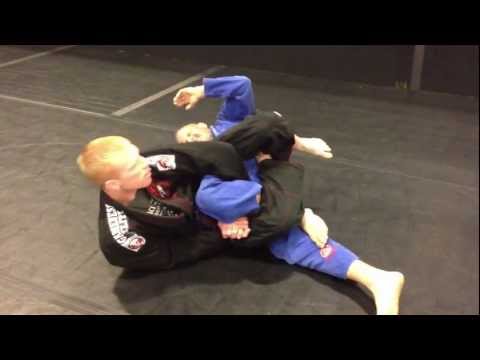
Calf slicer variations
0
Calf Slicer Choke·Michael Robinson
Three Calf Slicer variants I have been working on. The last two are variations that I've figured out recently. Knowing t…
Translation: calf slicer choke
The calf slicer (also called calf crush or calf compression) works by placing a hard fulcrum — typically the shin or forearm — behind the opponent's knee and folding the lower leg back, crushing the calf muscle between the fulcrum and the femur. [1],[2] The technique generates intense pain through deep muscle compression and can also hyperextend the knee joint. Calf slicers are commonly entered from leg entanglement positions, back control (particularly when an opponent tries to clear hooks), and as counters to berimbolo and inversion-based guard passes. [3] In IBJJF competition, calf slicers are legal only at brown belt and above; in ADCC and MMA, they are unrestricted. The calf slicer has become increasingly important in modern no-gi grappling as leg lock games have expanded.
The calf slicer has long been a standard technique in sambo competition, where leg attacks (including compressions) have been central since the sport's formalization in the 1930s. [1],[2] In Brazilian Jiu-Jitsu, the calf slicer was historically underutilized but gained significant popularity in the 2010s as competitors developed sophisticated leg entanglement systems. [3] The technique is now a common feature of ashi garami (leg entanglement) offense, used both as a primary finish and as a way to create reactions that open up heel hook and kneebar entries.
The calf slicer (or calf crusher) compresses the calf muscle against the bone, creating intense pain and potential injury. [1]
Calf slicers were adopted from sambo into BJJ and are classified as compression locks. [1]
Calf slicers are legal at brown and black belt in IBJJF, and in ADCC and MMA competitions. [1]
No images yet for this technique.
Sign in to suggest an image.
Three Calf Slicer variants I have been working on. The last two are variations that I've figured out recently. Knowing t…
No instructional courses yet for this technique.
Sign in to suggest a course.
Risk of injury to the person this technique is applied to
Calf slicers compress the calf muscle against the shin bone and can simultaneously attack the knee
Skill level needed to execute this technique reliably
Whether this technique is allowed under major competition rule sets
Shooto / Japanese Catch Wrestling
Japanese terminology sourced from Shooto / Japanese Catch Wrestling
Japanese MMA pioneer organization — technique terminology
Standard katakana transliteration of Western martial arts terminology (外来語) — used in Japanese MMA, boxing, and BJJ communities
Japanese terminology sourced from Shooto / Japanese Catch Wrestling
shin pressure, leg triangling ability
bony, angular shins for sharper compression
quadriceps, hamstrings, calf muscles (for leg triangle lock)
Every move, in any martial art, shares a few universal traits. Mix and match below to pinpoint the right tool — or compare equivalents across styles.
The calf slicer appears in Jiu Jitsu Style (2015) in competition context: 'Rocha hit a slick x-guard transition before locking off a calf slicer submission attempt.' A compression lock that uses the shin across the back of the opponent's calf. Banned in IBJJF below brown belt. (Jiu Jitsu Style 28, 2015; IBJJF Rules v6.0)
According to Michael Robinson, the calf slicer can actually be executed more easily when your opponent grabs your pant legs, as this gives you a clear setup opportunity to attack the position.
Michael Robinson emphasizes making sure your hand reaches far enough through when you throw the leg over, so you're not left fishing for grip and can grab easily if needed.
Yes, Michael Robinson notes that there are calf slicer variations that work from stand-up, and while they tend to work well with the gi, they can also be done no-gi.
Michael Robinson recommends working from sit-up guard and attacking 'outside the inside,' where you come around and keep the opponent's leg down while setting up the submission.
The calf slicer (also called calf crush or calf compression) works by placing a hard fulcrum — typically the shin or forearm — behind the opponent's knee and folding the lower leg back, crushing the calf muscle between the fulcrum and the femur. The technique generates intense pain through deep muscle compression and can also hyperextend the knee joint.
The calf slicer has long been a standard technique in sambo competition, where leg attacks (including compressions) have been central since the sport's formalization in the 1930s. In Brazilian Jiu-Jitsu, the calf slicer was historically underutilized but gained significant popularity in the 2010s as competitors developed sophisticated leg entanglement systems.
IBJJF: restricted — Brown and black belt only; IJF: banned — Only elbow joint locks permitted in judo — compression locks prohibited; ADCC: legal — Legal; Unified MMA: legal — Legal; FIAS Sport Sambo: legal — Legal; FIAS Combat Sambo: legal — Legal
Danger rating 7/10. Calf slicers compress the calf muscle against the shin bone and can simultaneously attack the knee
The standard setup chain: Establish Position → Create the Threat → Secure the Hold → Finish.
Standard counters include: Early Recognition — identify the submission attempt early and begin defence immediately / Posture and Base — maintain strong posture and base to prevent submission setups / Grip Fight — deny the attacker their preferred gripping configuration.
Common variants: Standard calf slicer (shin across the calf with triangle leg lock compressing t…); Truck calf slicer (applied from truck position after a back-take attempt); Standing calf slicer (trapping the calf during a scramble or guard exchange).
Calf slicers are legal at brown and black belt in IBJJF, and in ADCC and MMA competitions.
Top errors to watch for: Applying without hip control — if the opponent can extend their leg, the slicer releases; control the hip to prevent … / Placing the fulcrum too deep behind the knee — the shin should be positioned just behind the knee crease for maximum … / Cranking too fast — the calf slicer causes sudden intense pain and can damage the knee; controlled application is ess… / Not recognising the knee danger — the calf slicer threatens knee hyperflexion; both attacker and defender must be aware.
The Calf Slicer Choke is also known as Kāfu Suraisā Chōku, Calf Crush, Calf Compression, Leg Slicer.