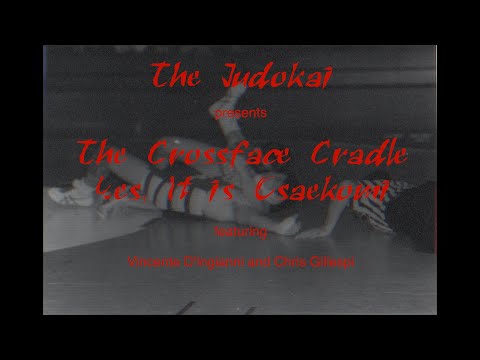
The Crossface Cradle - Yes, it is Osaekomi
0
Crossface Cradle·The Judokai Network
The word "crossface" gets a bad rap in Judo, but it is often misunderstood. Learn to use the #CrossfaceCradle, a popula…
Translation: Crossface Cradle
The crossface cradle from side control combines a crossface forearm drive with a cradle leg hook to fold the opponent in half, generating extreme cervical flexion stress. [1] The attacker drives the crossface forearm across the opponent's jaw from side control while simultaneously hooking one of the opponent's legs with the other arm, then clasps the hands together to lock the cradle. [1],[2] The cradle fold compresses the opponent's head toward their knee, placing the cervical spine under flexion and lateral bending stress simultaneously. [2] The crossface element adds torsional pressure as the forearm drives the head to one side while the cradle pulls the body in the opposite direction. [2],[3]
The cradle is a fundamental wrestling technique used for pinning, with origins in folkstyle and freestyle wrestling traditions. [1] The crossface cradle adaptation as a submission-oriented neck crank developed when wrestlers brought cradle techniques into submission grappling and MMA contexts. [2],[3]
The crossface cradle combines a crossface with a cradle grip to control and crank the opponent's neck and spine. [1]
Crossface cradles originated in wrestling and were adapted for submission finishes in catch wrestling and MMA. [1]
Crossface cradles are used in wrestling (as a pin) and occasionally as cranks in MMA. [1]
No images yet for this technique.
Sign in to suggest an image.
The word "crossface" gets a bad rap in Judo, but it is often misunderstood. Learn to use the #CrossfaceCradle, a popula…
No instructional courses yet for this technique.
Sign in to suggest a course.
Risk of injury to the person this technique is applied to
Cervical flexion cranks force the chin toward the chest, compressing the anterior cervical spine
Skill level needed to execute this technique reliably
Whether this technique is allowed under major competition rule sets
Japanese wrestling / BJJ — Kodokan jumonji + wrestling yurikago
Japanese terminology sourced from Japanese wrestling / BJJ — Kodokan jumonji + wrestling yurikago
Japanese wrestling / BJJ — Kodokan jumonji + wrestling yurikago
Standard Japanese martial arts terminology (kanji/hiragana)
Established Japanese martial arts naming convention — native Japanese term (和語/漢語)
Japanese terminology sourced from Japanese wrestling / BJJ — Kodokan jumonji + wrestling yurikago
grip or squeeze strength, positional control
strong upper body for sustained compression
forearms, biceps, pectorals, core stabilisers
Grab the opponent's far arm at the tricep with no thumbs, then pull it across their body. The Judokai Network emphasizes this grip is the foundation of the technique when executed from a top-and-bottom position.
A frequent error is placing the knee under the opponent's butt and lifting it—this should be avoided. Instead, keep pressure with your head at the temple and control the opponent's arm across their body.
The crossface cradle itself is a legal hold-down (osaekomi) in Judo, though the rules differ between Judo and wrestling. The Judokai Network notes that while cross-facing has gained a bad reputation, the crossface cradle hold-down is a legitimate Judo technique when executed properly.
The crossface cradle from side control combines a crossface forearm drive with a cradle leg hook to fold the opponent in half, generating extreme cervical flexion stress. The attacker drives the crossface forearm across the opponent's jaw from side control while simultaneously hooking one of the opponent's legs with the other arm, then clasps the hands together to lock the cradle.
The cradle is a fundamental wrestling technique used for pinning, with origins in folkstyle and freestyle wrestling traditions. The crossface cradle adaptation as a submission-oriented neck crank developed when wrestlers brought cradle techniques into submission grappling and MMA contexts.
IBJJF: legal — Legal at all belt levels, gi and no-gi — chokes are the safest submission cat…; IJF: legal — Legal (shime-waza) — strangulation techniques are one of three permitted subm…; ADCC: legal — Legal; Unified MMA: legal — Legal — choke submissions are among the most common finishes in MMA; FIAS Sport Sambo: banned — All chokes prohibited in Sport Sambo; FIAS Combat Sambo: legal — Legal
Danger rating 8/10. Cervical flexion cranks force the chin toward the chest, compressing the anterior cervical spine
The standard setup chain: Establish Position → Create the Threat → Secure the Hold → Finish.
Standard counters include: Early Recognition — identify the submission attempt early and begin defence immediately / Posture and Base — maintain strong posture and base to prevent submission setups / Grip Fight — deny the attacker their preferred gripping configuration.
Common variants: Standard grip variation (primary hand configuration for maximum choking pressure); Gi variation (uses the lapel or collar as an anchor for additional fric…); No-gi variation (adapted grip and positioning for submission grappling wit…); Transition finish (applied during a positional change to catch the opponent …).
Crossface cradles are used in wrestling (as a pin) and occasionally as cranks in MMA.
Top errors to watch for: Using the crossface without connecting the cradle — the crossface alone is control, not a submission; the cradle conn… / Applying the crossface too high on the face — the forearm should press across the jaw line for maximum head rotation;… / Not connecting the hands securely — the cradle lock must be tight; a loose connection allows the opponent to straight… / Applying excessive rotational force — the combination of crossface rotation and cradle flexion is extremely stressful….
The Crossface Cradle is also known as Jumonji Yurikago, Crossface Wrestling Cradle, Side Control Crossface Cradle.