BJJ Techniques | Multiple Side Control Chokes | CVBJJ Online
0
Two Hand Collar Choke·ROYDEAN
📘 My new book — How to Survive Brazilian Jiu Jitsu → https://survivebjj.com/ CVBJJ Online : https://www.youtube.com/ch…
Translation: Two-Hand Strangle
The two hand collar choke from back control uses both hands gripping deep inside the opponent's collar to create a cross-pressure strangle. [1] The attacker feeds both hands from behind into the lapel, then pulls outward and downward to compress the carotid arteries using the collar fabric as the choking surface. [1],[2] Effective in gi grappling when the opponent defends the rear naked choke grip by controlling the choking arm. [2]
The two-hand collar choke from the back uses both hands gripping the same side of the collar to compress the carotid arteries. This grip configuration has its roots in Kodokan judo's okuri-eri-jime (送襟絞, 'sliding collar strangle'), where both hands work the lapel from behind. [1] In Brazilian Jiu-Jitsu, the two-hand collar choke was adopted as a reliable back-attack option when the opponent defends against crossed grips. [2] Saulo Ribeiro classifies it among the essential collar attacks from the back, noting that the parallel grip creates a different pressure vector than the cross collar variation and can be more difficult to defend once both hands are set. [3]
The two-hand collar choke uses both hands gripping the collar symmetrically to create a powerful bilateral strangle. [1]
Two-hand collar chokes are fundamental judo shimewaza adopted in BJJ. [1]
Two-hand collar chokes are standard gi submissions in both judo and IBJJF competition. [1]
No images yet for this technique.
Sign in to suggest an image.
📘 My new book — How to Survive Brazilian Jiu Jitsu → https://survivebjj.com/ CVBJJ Online : https://www.youtube.com/ch…
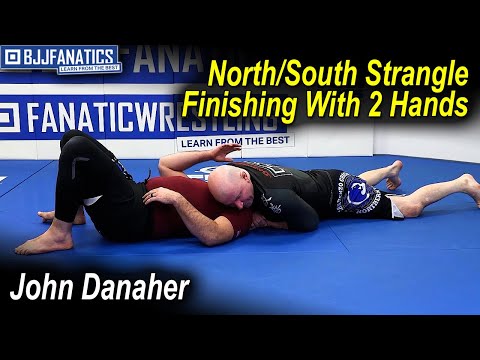
FINISHING the North/South Strangle with 2 HANDS https://bjjfanatics.com John Danaher demonstrates how to finish a North…
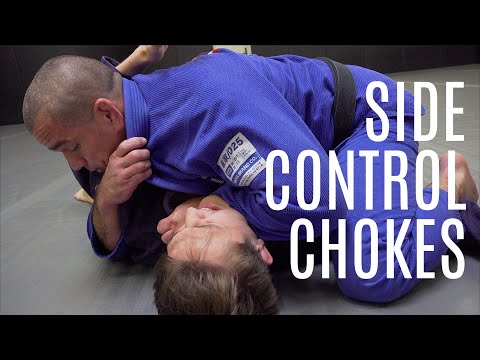
The two-hand collar choke is executed by establishing initial control with a primary strangle arm before securing both hands together to maximize pressure and stability. John Danaher (BJJ Fanatics) emphasizes that approximately 90% of the choke's effectiveness comes from the initial arm placement, with the two-hand lock serving as a finishing mechanism. His approach from back control involves turning the hips slightly to place the outside knee on the mat, walking across the opponent's centerline, locking the hands, then using the locked hands to push the body away before bringing the shoulder down in a 'paper cutter' motion toward the hand. Danaher stresses keeping the elbow underneath the body rather than extended, as this maximizes shoulder pressure on the esophagus. ROYDEAN (CVBJJ Online) provides multiple collar-choke variations from side control, focusing on isolating the opponent's arms and controlling the collar with various hand placements—thumb-in-collar, four fingers, or full-hand grips. His method involves taking slack out of the collar before applying pressure, often using a windshield-wiper motion with the elbow to tighten the choke, and employing head pressure as the finishing mechanism. Both instructors prioritize hand/arm locking and weight distribution, though Danaher's framework centers on back-control mechanics while ROYDEAN addresses side-control applications.
Synthesized from 2 instructors
No instructional courses yet for this technique.
Sign in to suggest a course.
Risk of injury to the person this technique is applied to
Two-handed collar grip creates a strong bilateral strangle from back mount
Skill level needed to execute this technique reliably
Whether this technique is allowed under major competition rule sets
Kodokan Judo — Official Shime-waza #9
Japanese terminology sourced from Kodokan Judo — Official Shime-waza #9
Official Kodokan ground technique classification system
Standard Japanese martial arts terminology (kanji/hiragana)
Established Japanese martial arts naming convention — native Japanese term (和語/漢語)
Japanese terminology sourced from Kodokan Judo — Official Shime-waza #9
upper body squeeze strength, bicep/forearm endurance
shorter, thicker arms for tighter squeeze
biceps, forearms, pectorals, deltoids
John Danaher emphasizes that locked hands are much more effective in competition, similar to how locked feet provide better control in other techniques.
Keep your elbows tucked back underneath you and bring your shoulder down like a paper cutter onto your opponent's esophagus—never lift your hands up to your chest, as extended arms will kill your own strangle.
Lock your hands, then use them to push your opponent away while you move toward the center line, shifting your shoulder down and following with your elbow to complete the strangulation.
The two hand collar choke from back control uses both hands gripping deep inside the opponent's collar to create a cross-pressure strangle. The attacker feeds both hands from behind into the lapel, then pulls outward and downward to compress the carotid arteries using the collar fabric as the choking surface.
The two-hand collar choke from the back uses both hands gripping the same side of the collar to compress the carotid arteries. This grip configuration has its roots in Kodokan judo's okuri-eri-jime (送襟絞, 'sliding collar strangle'), where both hands work the lapel from behind.
IBJJF: legal — Legal at all belt levels, gi and no-gi — chokes are the safest submission cat…; IJF: legal — Legal (shime-waza) — strangulation techniques are one of three permitted subm…; ADCC: restricted — N/A (no-gi competition only — technique requires gi); Unified MMA: restricted — N/A (technique requires gi — not applicable in MMA); FIAS Sport Sambo: banned — All chokes prohibited in Sport Sambo; FIAS Combat Sambo: legal — Legal
Danger rating 8/10. Two-handed collar grip creates a strong bilateral strangle from back mount
The standard setup chain: Achieve Controlling Position → Isolate the Neck → Set the Grip → Apply Pressure.
Standard counters include: Tuck Chin — protect the neck by lowering the chin to prevent the choke from sinking / Two-on-One Grip Fight — use both hands to strip the choking grip before it locks / Turn Into — rotate toward the choking arm to relieve carotid pressure / Posture Up — straighten the spine and create distance to break the choking angle.
Common variants: Short choke (palm-to-palm grip) (compact grip for tight spaces when the chin is partially …); Gable grip RNC (interlocked fingers behind the head for maximum squeeze p…); Body triangle RNC (adds body triangle control for stronger hip management du…); One-arm RNC (single arm under the chin when the second arm cannot reac…).
Two-hand collar chokes are standard gi submissions in both judo and IBJJF competition.
Top errors to watch for: Inserting both hands simultaneously — establish one grip first, then the second; trying both at once allows the oppon… / Insufficient grip depth — both hands must cross the centre line of the neck; shallow grips create pushes rather than … / Pulling the hands apart instead of together — the elbows must drive toward each other and down; separating the hands … / Not using body weight — from mount, lean forward through the grips; from guard, pull the opponent down; muscular sque….
The Two Hand Collar Choke is also known as Ryote-jime, Double Collar Choke, Two-Hand Rear Collar Strangle.