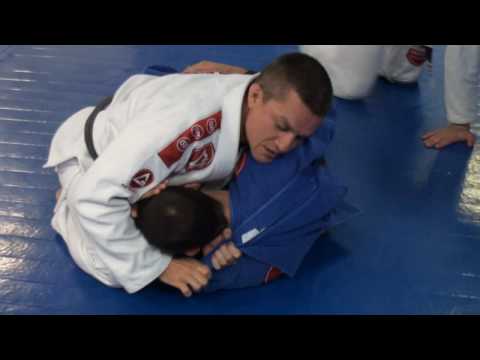
Draculino - Lapel Choke from Half Guard
0
Single Wing Lapel Choke·Draculino GB Texas Jiu-Jitsu
http://www.draculinobjjtraining.com Student Point of View - In class footage of a Loop Choke from the advanced progr…
Translation: single wing lapel strangle
Single wing lapel chokes use one arm threaded under the opponent's armpit (creating a 'wing' control) while the other hand grips the collar to apply a strangle from back control. [1],[2] The one-wing collar choke is the primary technique: the attacker controls one arm by underhooking it and threading the hand to the collar, while the choking hand grips the opposite collar across the neck. [1],[3] The wing control serves dual purposes — it traps one of the opponent's defensive arms and provides a stable anchor point that prevents the opponent from turning into the attacker. [1] This configuration creates an asymmetric strangle where one side is compressed by the collar grip and the other by the underhook arm's pressure against the neck. [2],[4]
The single wing concept has roots in judo's kata-ha-jime (片羽絞め, single wing strangle), a classical shime-waza that combines arm trapping with collar strangulation. [2],[3] Kata-ha-jime was codified early in Kodokan Judo's katame-waza curriculum and remains a competition staple. [2] Brazilian Jiu-Jitsu adopted and refined the single wing collar choke for modern back control systems, where trapping one arm is a standard intermediate step toward finishing the choke. [1],[4]
The single wing lapel choke uses one lapel grip combined with an arm across the throat to create a hybrid strangle. [1]
Single wing choke variations were developed in BJJ to address situations where only one collar grip is achievable. [1]
Single wing lapel chokes are used in gi BJJ competition. [1]
No images yet for this technique.
Sign in to suggest an image.
http://www.draculinobjjtraining.com Student Point of View - In class footage of a Loop Choke from the advanced progr…
No instructional courses yet for this technique.
Sign in to suggest a course.
Risk of injury to the person this technique is applied to
Single wing uses one lapel grip combined with a forearm blade for the strangle
Skill level needed to execute this technique reliably
Whether this technique is allowed under major competition rule sets
Kodokan Judo — Official Katame-waza Classification
Kodokan — Kataha-jime (片羽絞め) classification
Standard Japanese martial arts terminology (kanji/hiragana)
Established Japanese martial arts naming convention — native Japanese term (和語/漢語)
Kodokan — Kataha-jime (片羽絞め) classification
grip or squeeze strength, positional control
strong upper body for sustained compression
forearms, biceps, pectorals, core stabilisers
Every move, in any martial art, shares a few universal traits. Mix and match below to pinpoint the right tool — or compare equivalents across styles.
Sit your hip on your ankle in the mouth position, and place one hand on the floor for base. Keep your shoulder on your opponent's chest to maintain control and create space for your grip.
No—Draculino emphasizes that you don't need a crossface; instead, simply offer the lapel to your hand and keep it close. Focus on controlling with your shoulder position rather than relying on a crossface.
Once you enter your thumb, drive your elbows into the opponent's chest and side while bringing your ear to their ear to finalize the choke without putting pressure on their face.
Lock in the half guard position tightly and maintain your control—this will prevent your opponent from escaping or coming on top despite any strength advantage they may have.
Single wing lapel chokes use one arm threaded under the opponent's armpit (creating a 'wing' control) while the other hand grips the collar to apply a strangle from back control. The one-wing collar choke is the primary technique: the attacker controls one arm by underhooking it and threading the hand to the collar, while the choking hand grips the opposite collar across the neck.
The single wing concept has roots in judo's kata-ha-jime (片羽絞め, single wing strangle), a classical shime-waza that combines arm trapping with collar strangulation. Kata-ha-jime was codified early in Kodokan Judo's katame-waza curriculum and remains a competition staple.
IBJJF: legal — Legal at all belt levels, gi and no-gi — chokes are the safest submission cat…; IJF: legal — Legal (shime-waza) — strangulation techniques are one of three permitted subm…; ADCC: restricted — N/A (no-gi competition only — technique requires gi); Unified MMA: restricted — N/A (technique requires gi — not applicable in MMA); FIAS Sport Sambo: banned — All chokes prohibited in Sport Sambo; FIAS Combat Sambo: legal — Legal
Danger rating 8/10. Single wing uses one lapel grip combined with a forearm blade for the strangle
The standard setup chain: Achieve Controlling Position → Isolate the Neck → Set the Grip → Apply Pressure.
Standard counters include: Tuck Chin — protect the neck by lowering the chin to prevent the choke from sinking / Two-on-One Grip Fight — use both hands to strip the choking grip before it locks / Turn Into — rotate toward the choking arm to relieve carotid pressure / Posture Up — straighten the spine and create distance to break the choking angle.
Common variants: Standard grip variation (primary hand configuration for maximum choking pressure); Gi variation (uses the lapel or collar as an anchor for additional fric…); No-gi variation (adapted grip and positioning for submission grappling wit…); Transition finish (applied during a positional change to catch the opponent …).
Single wing lapel chokes are used in gi BJJ competition.
Top errors to watch for: Attempting the lapel feed before securing the arm trap — establish control first, then attack; reversing the order al… / Using a lapel that doesn't reach — test the lapel length before committing; if it's too short, switch to the other la… / Feeding the lapel in front of the throat — the lapel must pass behind the neck for a blood choke; front-of-throat pla… / Losing the arm trap during the lapel feed — the feed requires one hand, but the arm trap must be maintained with body….
The Single Wing Lapel Choke is also known as Kataha Eri-jime, Kata-ha-jime, Half-Wing Choke, Single-Wing Collar Choke.